Darpa PanditaSera Jey · Bylakuppe Plan a visit
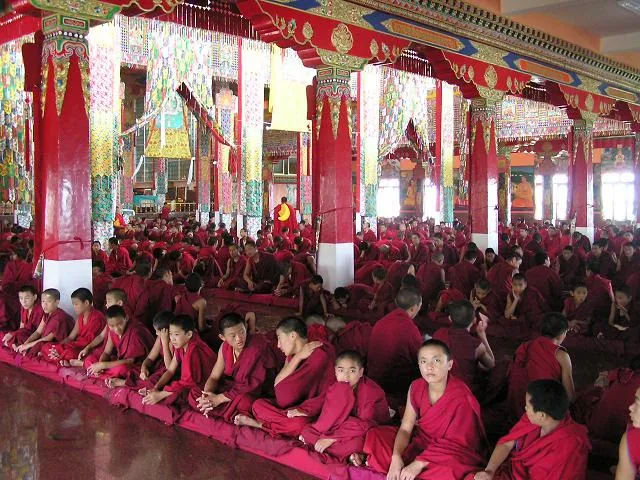
The main temple at Sera Mey during a puja ceremony

17 · Buddhas & deities

Who is in the painting

Twenty-two figures you will meet on a wall, an altar or a thangka, with large pictures, because the useful thing is to recognise one the next time you see it.

Three things worth knowing before the list.

None of these is a god in the sense of a creator. Buddhism has no creator, and nothing here made the world or judges it. A buddha is somebody who became one. The figures are held to be enlightened minds, and the paintings are working objects: something definite for attention to rest on.

A wrathful figure is not an angry one. Fangs, flames and skulls belong to a visual grammar in which force is turned against obstacles rather than against people. The tradition is consistent on this, and it is the detail newcomers most reliably misread.

Some of these practices need initiation and some do not, and every entry below says which. Looking at the images is not a transgression: they hang in public museums and are catalogued in detail. Taking up a practice is a different thing, and where a mantra is restricted this site does not print it. The Mantras page says the same and explains why.

01

Buddhas

A buddha is somebody who became one. None of these is a creator, and none of them made the world. They are held to be minds that completed the path, and they are painted so that a practitioner has something definite to hold in attention.

Śākyamuni Buddha, Tibetan painting or sculpture

Śākyamuni Buddha

Skt.; Tib. Shakya Thupa

Open to anybody

The historical Buddha, and the reason there is anything to discuss.

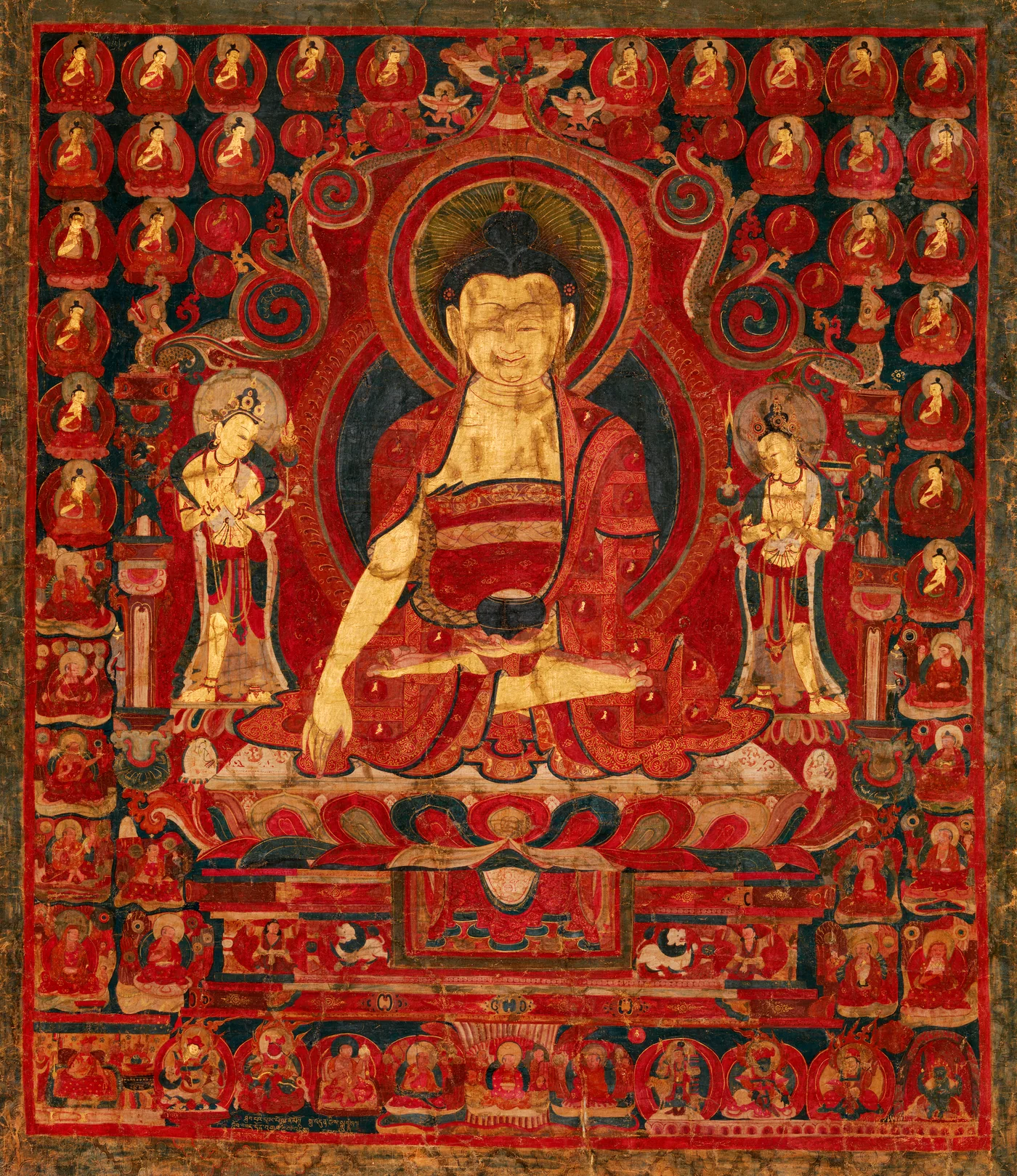
Born in what is now Nepal, he taught in northern India in the fifth century BCE. He sits at the centre of almost every altar and almost every painting, right hand touching the earth. That gesture is a specific moment: challenged on his right to awaken, he called the ground itself as witness.

Unknown author · Public domain · Wikimedia Commons
Amitābha, Tibetan painting or sculpture

Amitābha

Skt. ‘Boundless Light’; Tib. Öpame

Open to anybody

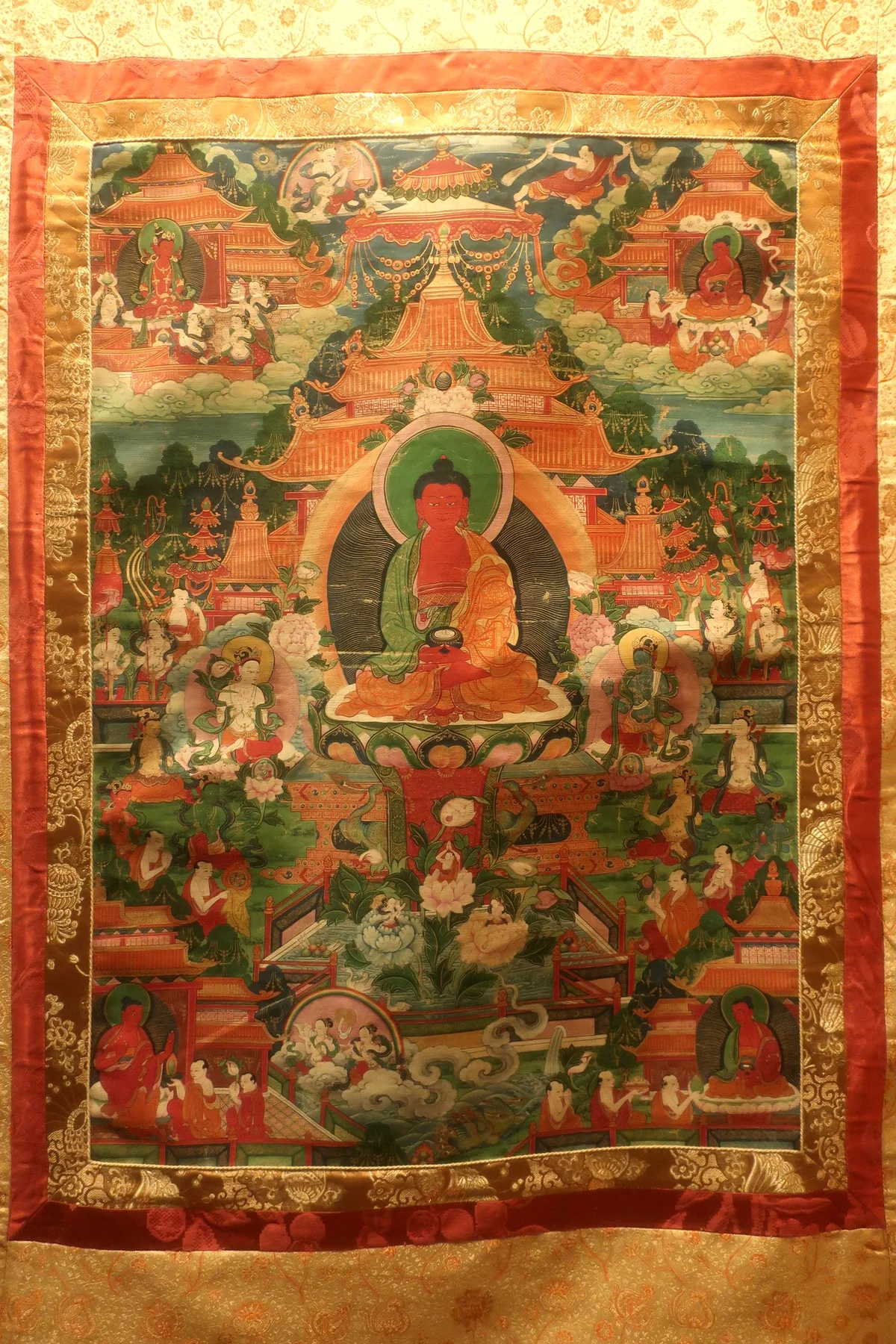
Red, of the western pure land, and of what happens at death.

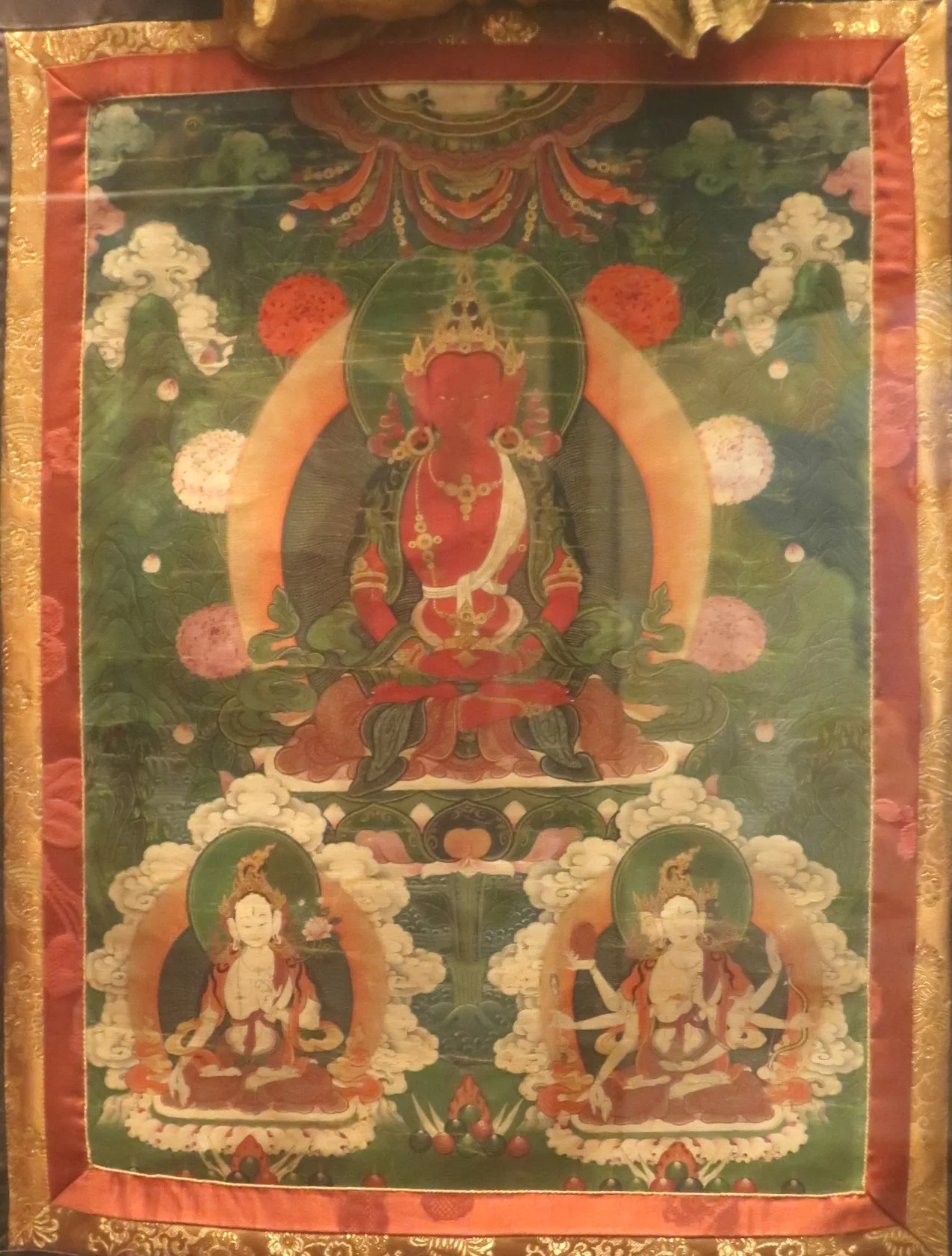
The buddha of the western pure land Sukhavati. In this tradition his practice is strongly associated with the moment of death and with rebirth in a place where practice is possible, which is why his name is recited in the ear of the dying.

Hiart · Public domain · Wikimedia Commons

Amitāyus, Tibetan painting or sculpture

Amitāyus

Skt. ‘Boundless Life’; Tib. Tsepame

Initiation required

The same buddha in long-life form, holding a vase of nectar.

Not a different being but Amitābha in the aspect of long life, crowned and ornamented, holding a vase of deathless nectar. He appears in long-life pujas, which are the ceremonies students most often request for their own teachers.

Hiart · Public domain · Wikimedia Commons

Medicine Buddha, Tibetan painting or sculpture

Medicine Buddha

Skt. Bhaiṣajyaguru; Tib. Sangye Menla

Open to anybody

Lapis blue, holding myrobalan, invoked for healing of every kind.

Usually painted the deep blue of lapis lazuli, holding the myrobalan fruit in his right hand and a bowl of nectar in his left. His practice is done for physical illness, but also for what the tradition regards as the deeper sickness, which is the mind's own disturbing emotions. The image here is a fourteenth-century gilt bronze, so the blue is absent.

Daderot · CC0 · Wikimedia Commons

Maitreya, Tibetan painting or sculpture

Maitreya

Skt.; Tib. Jampa

Open to anybody

The buddha of the next age, and the author of a curriculum text.

The buddha who will teach when the present teaching has been lost. He matters in a monastery for a second reason: the Ornament of Clear Realisation, one of the five great treatises studied for years at Sera Jey, is traditionally held to have been received from him.

Wmpearl · CC0 · Wikimedia Commons

Vajradhara, Tibetan painting or sculpture

Vajradhara

Skt.; Tib. Dorje Chang

Initiation required

Dark blue, arms crossed, the source of every tantric lineage.

The form in which the Buddha is held to have taught tantra. Every lineage of tantric transmission in this tradition is traced back to him, which is why he sits at the top of refuge-field paintings and why a teacher is visualised as inseparable from him.

Sylvain1972 · CC BY-SA 3.0 · Wikimedia Commons

02

Bodhisattvas

A bodhisattva has made the vow to become a buddha for the sake of everybody else, and postpones nothing except their own rest. The first three below are the Rigsum Gönpo, the protectors of the three families, and they are found together constantly: wisdom, compassion and power.

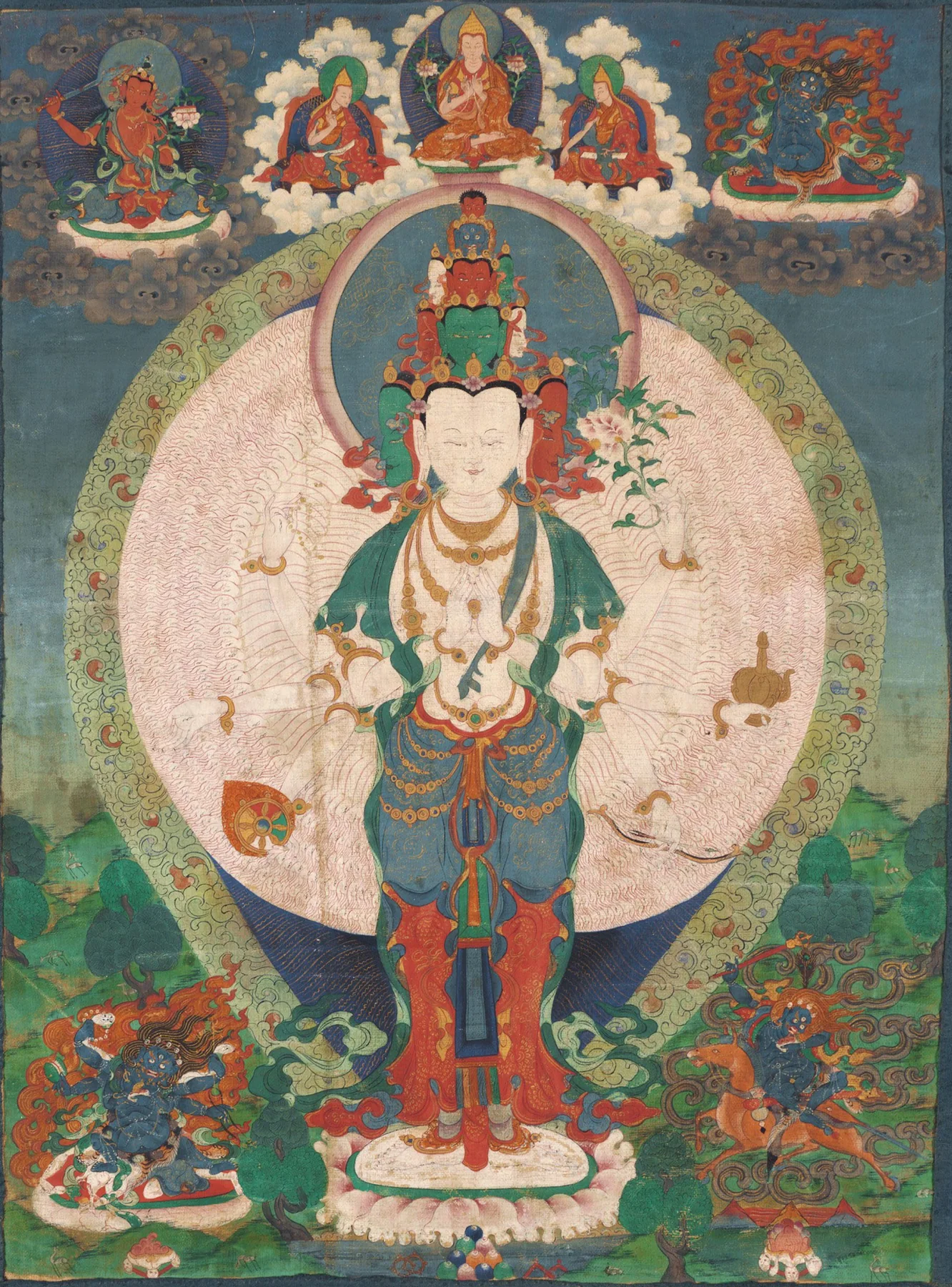
Avalokiteśvara, Tibetan painting or sculpture

Avalokiteśvara

Skt.; Tib. Chenrezig

Open to anybody

Compassion. The patron of Tibet, and the one every Tibetan recites.

Painted white, with two arms, four arms, or a thousand arms and eleven heads, which is the form shown here. The Dalai Lamas are understood within the tradition to be his emanation. His mantra is the one carved on rocks across the plateau and turned in every prayer wheel.

Unknown author · Public domain · Wikimedia Commons
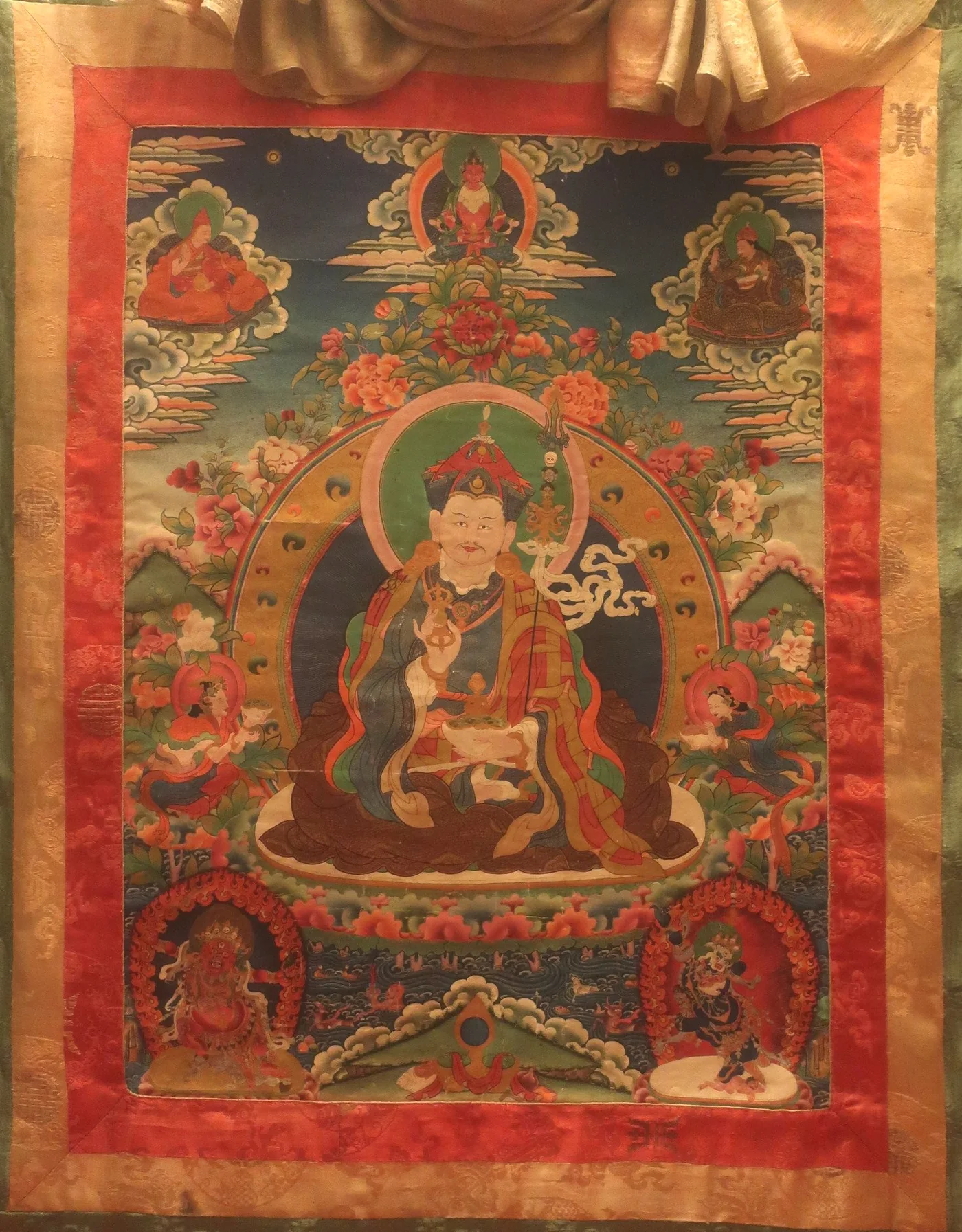
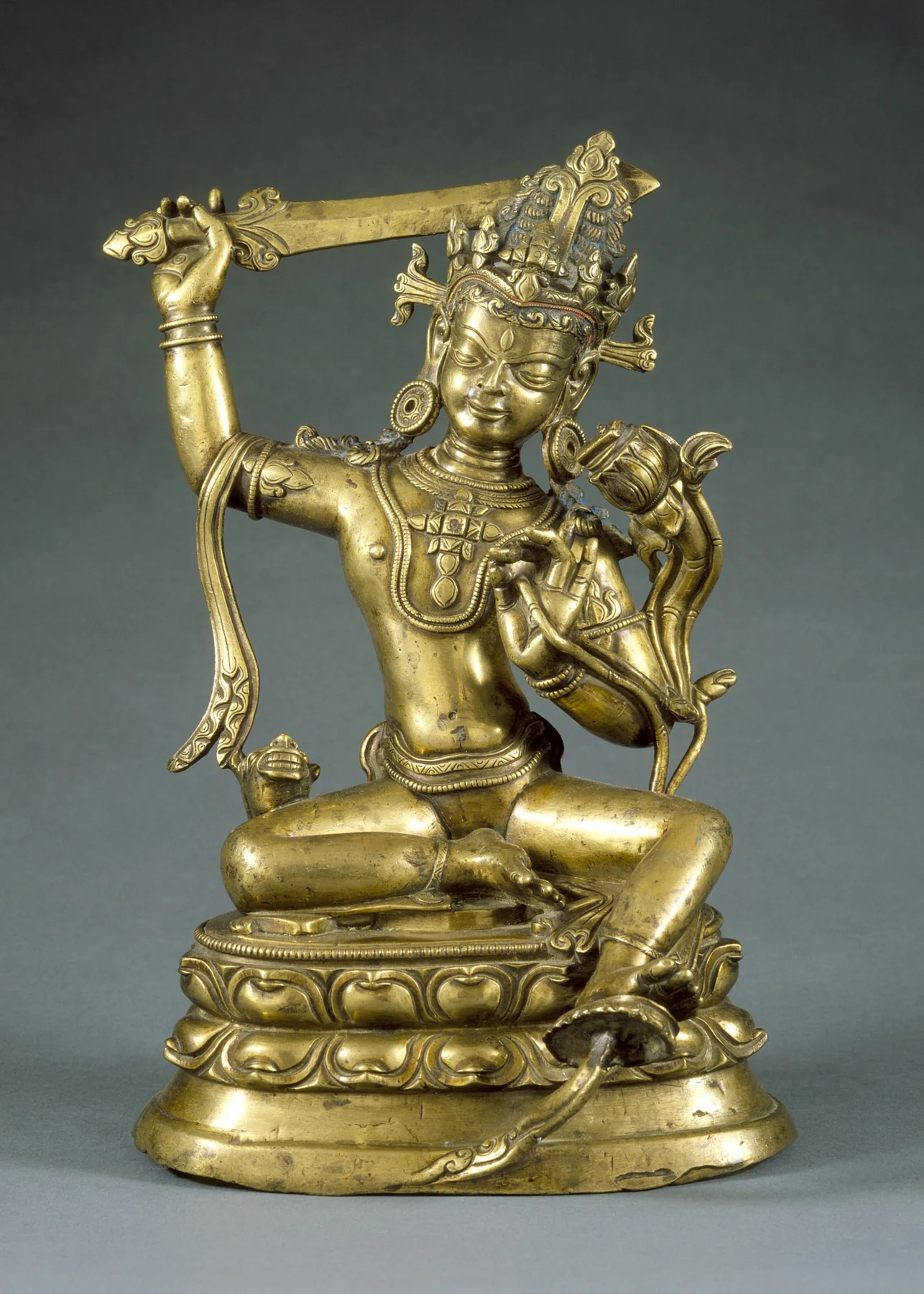
Mañjuśrī, Tibetan painting or sculpture

Mañjuśrī

Skt.; Tib. Jampelyang

Open to anybody

Wisdom. Sword raised in the right hand, sūtra on the lotus at the left.

The sword cuts through confusion; the text on the lotus is the Perfection of Wisdom. He is the patron of study and of debate, which makes him the figure a monk at Sera Jey has most to do with. Tsongkhapa is held to have received teachings directly from him.

Unknown · Public domain · Wikimedia Commons

Vajrapāṇi, Tibetan painting or sculpture

Vajrapāṇi

Skt.; Tib. Chana Dorje

Open to anybody

Power. Wrathful, dark blue, vajra raised in a halo of flame.

The wrath is not anger. It is energy turned against obstacles, and against the practitioner's own laziness and fear. He is held to have gathered and preserved the tantric teachings, and he completes the triad with wisdom and compassion.

Herusche · CC BY-SA 3.0 · Wikimedia Commons

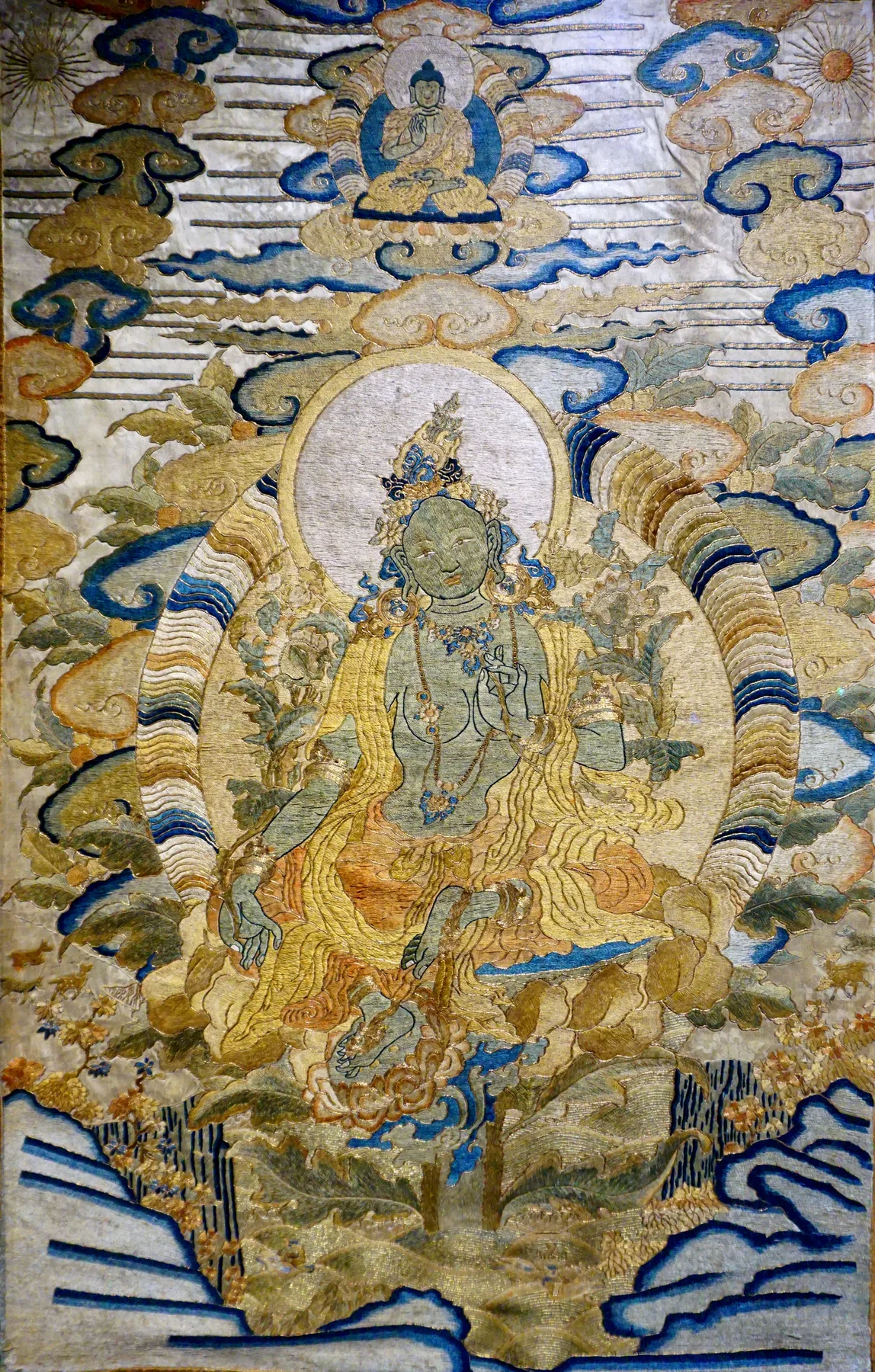
Green Tārā, Tibetan painting or sculpture

Green Tārā

Skt. Śyāmatārā; Tib. Drolma

Open to anybody

The swift one. One leg already stepping down off the lotus.

Where other figures sit in full meditation posture, Green Tārā has one foot lowered, on her way. She is called on for fear, for obstacles and for anything urgent, and she is probably the most widely recited female figure in Tibetan Buddhism.

Photo Dharma from Sadao, Thailand · CC BY 2.0 · Wikimedia Commons

White Tārā, Tibetan painting or sculpture

White Tārā

Skt. Sitatārā; Tib. Drolkar

Open to anybody

Seven eyes, and the practice done for a teacher's long life.

Eyes in her palms, in her soles and in her forehead: she sees where help is needed. Her practice is done for long life and for healing, very often on behalf of somebody else, and most often of all on behalf of a teacher.

Rijksmuseum · CC0 · Wikimedia Commons

Vajrasattva, Tibetan painting or sculpture

Vajrasattva

Skt.; Tib. Dorje Sempa

Open to anybody

White, holding vajra and bell. The purification practice.

His hundred-syllable mantra is the standard purification practice in this tradition, and it is one of the four preliminaries a student completes a hundred thousand times. The point is not guilt. It is that karma is held to be workable rather than fixed.

Anomymous · Public domain · Wikimedia Commons

03

The three principal tantric deities

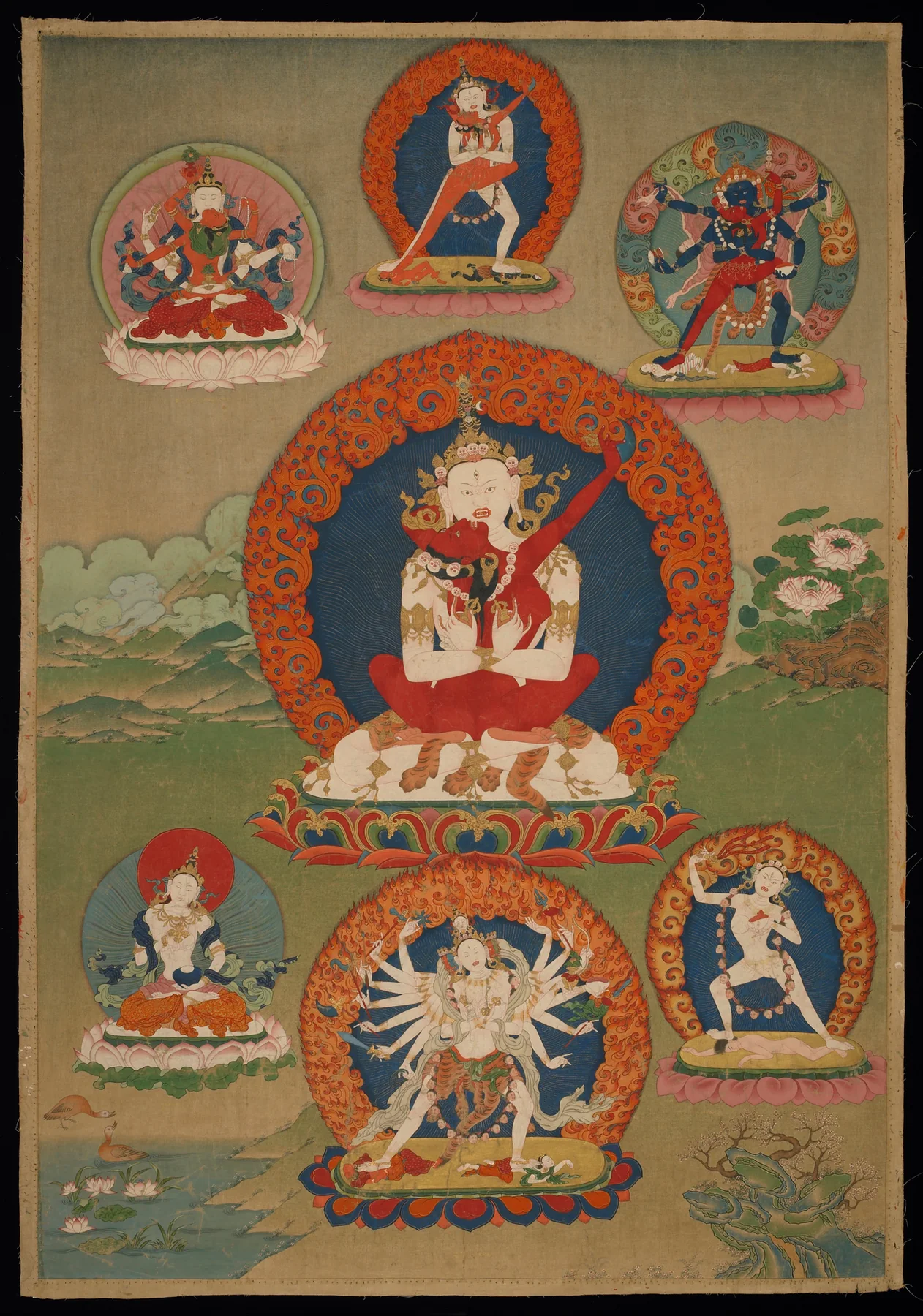
These three are a speciality of the Geluk system and of Tsongkhapa in particular, practised together. They require initiation. Their images are public, catalogued in every museum and printed in every art book, and looking at them is not a transgression. Taking up the practice without empowerment from a qualified teacher is a different matter, and this site does not print their mantras for that reason.

Guhyasamāja, Tibetan painting or sculpture

Guhyasamāja

Skt. ‘Secret Assembly’; Tib. Sangwa Düpa

Initiation required

The foundation of the whole tantric system in this tradition.

The form emphasised in the monasteries and tantric colleges is Akshobhyavajra, dark blue, three faces and six arms, in union. Guhyasamaja is treated as the system that explains how the others are to be read, which is why it comes first in a tantric college.

Unknown author · Public domain · Wikimedia Commons
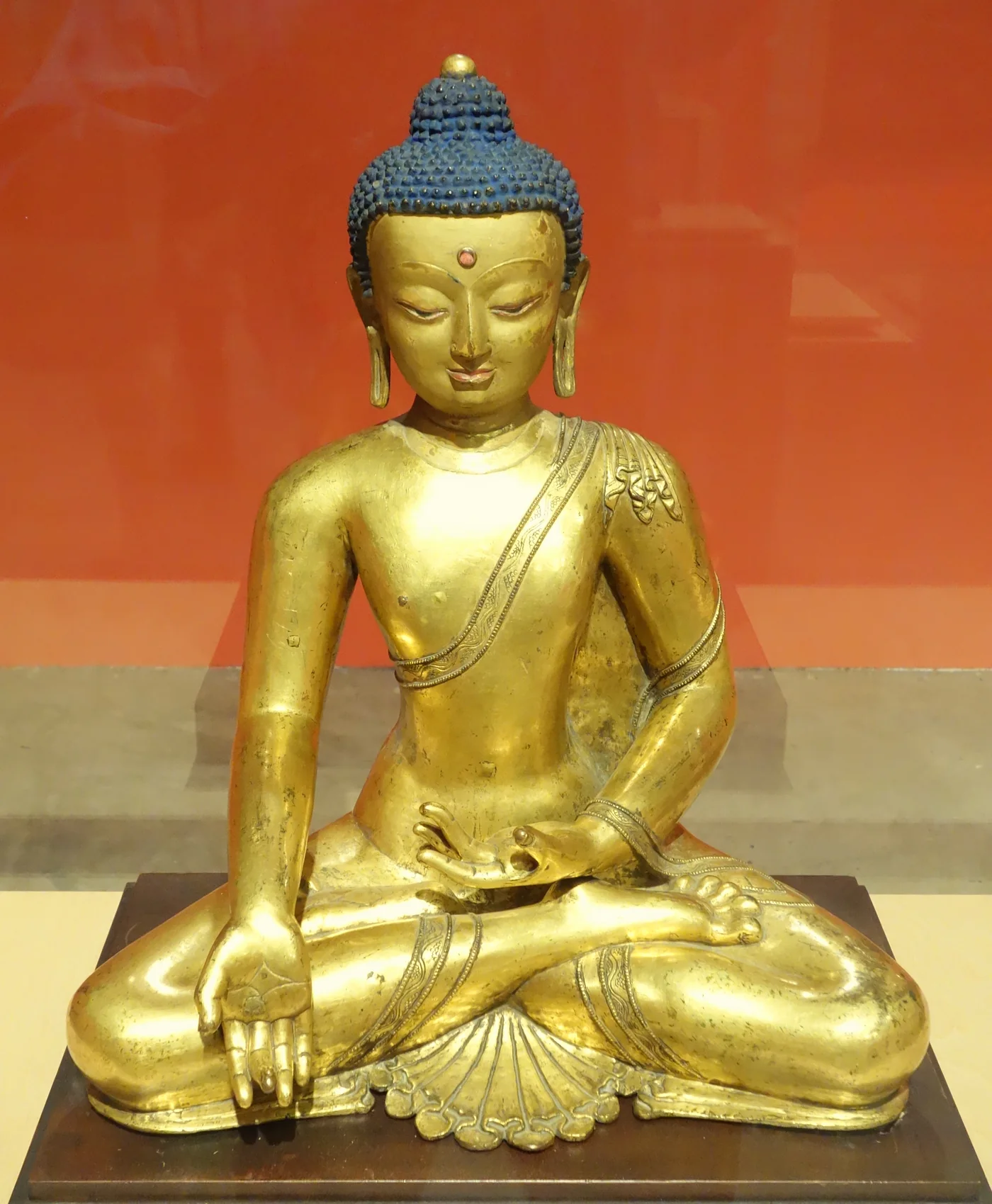
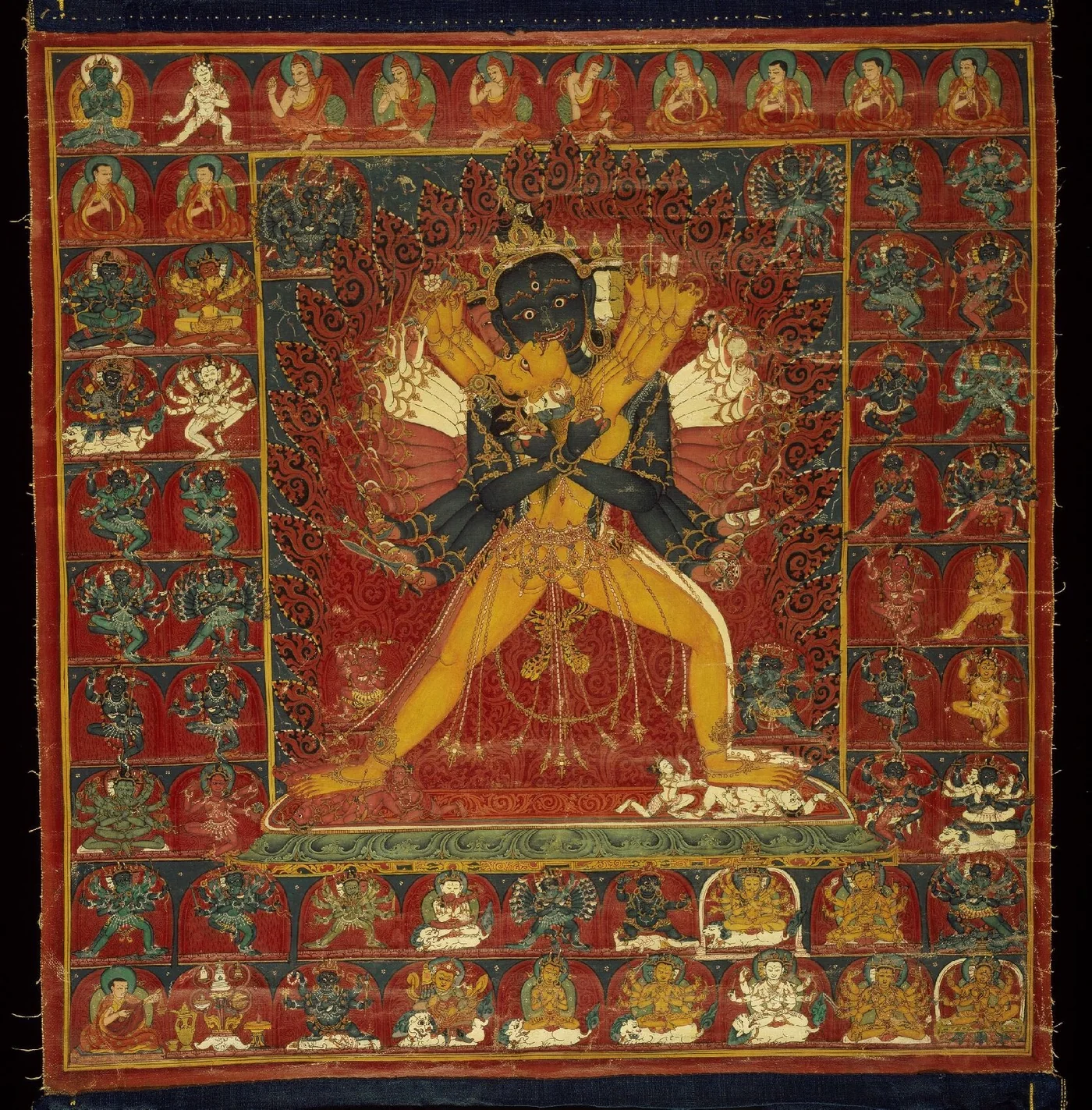
Cakrasaṃvara, Tibetan painting or sculpture

Cakrasaṃvara

Skt.; Tib. Khorlo Dompa

Initiation required

Also called Heruka. The system taught in the Luipa lineage here.

Dark blue, in union with Vajravarahi, standing on prone figures that stand for what is being overcome. Sixty-two deities in the external mandala and sixty-two in the body mandala, in the form the Geluk tantric colleges practise.

Unknown author · Public domain · Wikimedia Commons
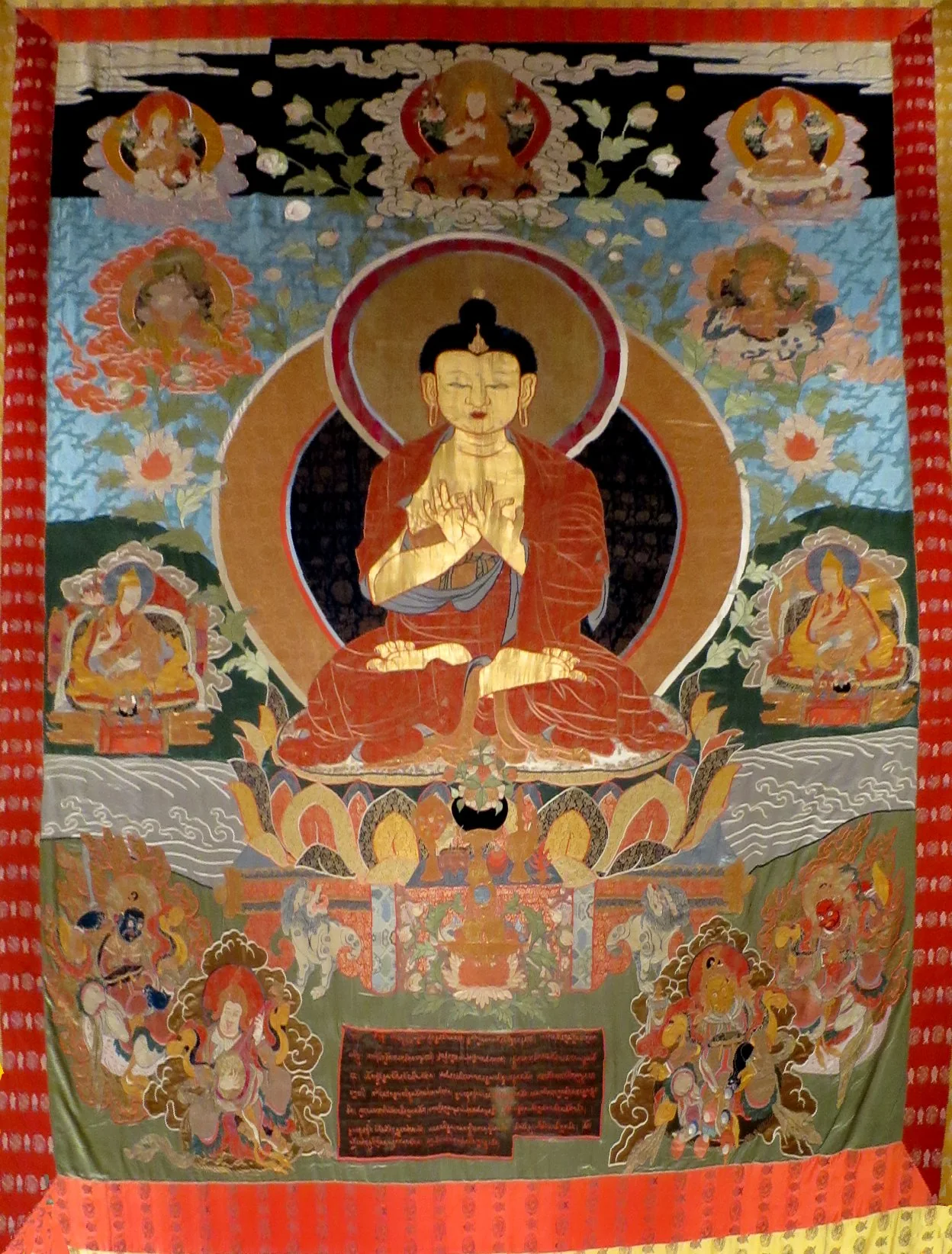
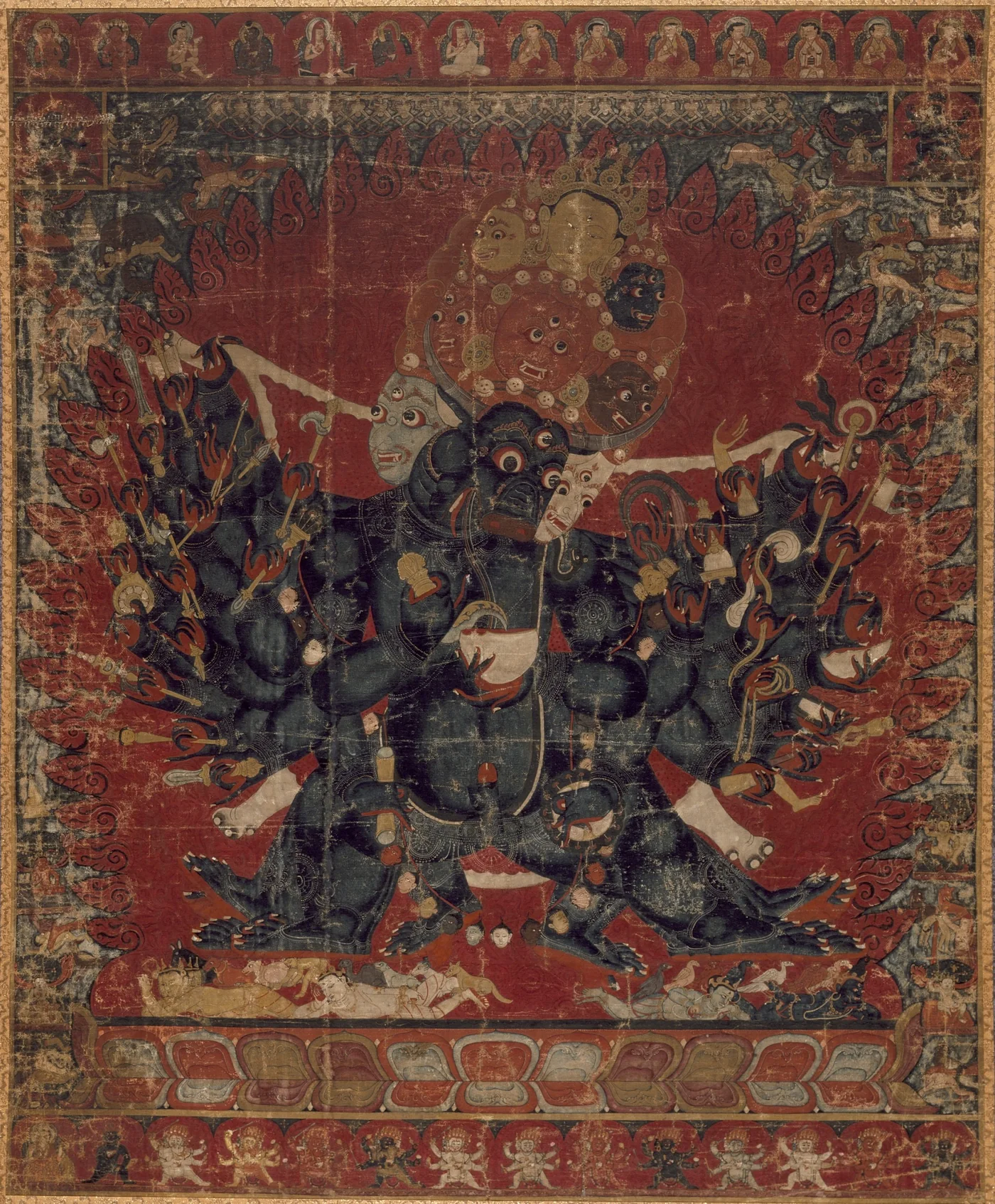
Yamāntaka, Tibetan painting or sculpture

Yamāntaka

Skt.; also Vajrabhairava; Tib. Dorje Jigje

Initiation required

Buffalo-headed, and the wrathful form of the bodhisattva of wisdom.

Vajrabhairava and Yamāntaka are two names for the same practice. The Thirteen-Deity form is the one used here. The iconography is deliberately terrifying and the meaning is precise: this is wisdom taking the shape of the Lord of Death in order to end death.

anonymous · Public domain · Wikimedia Commons
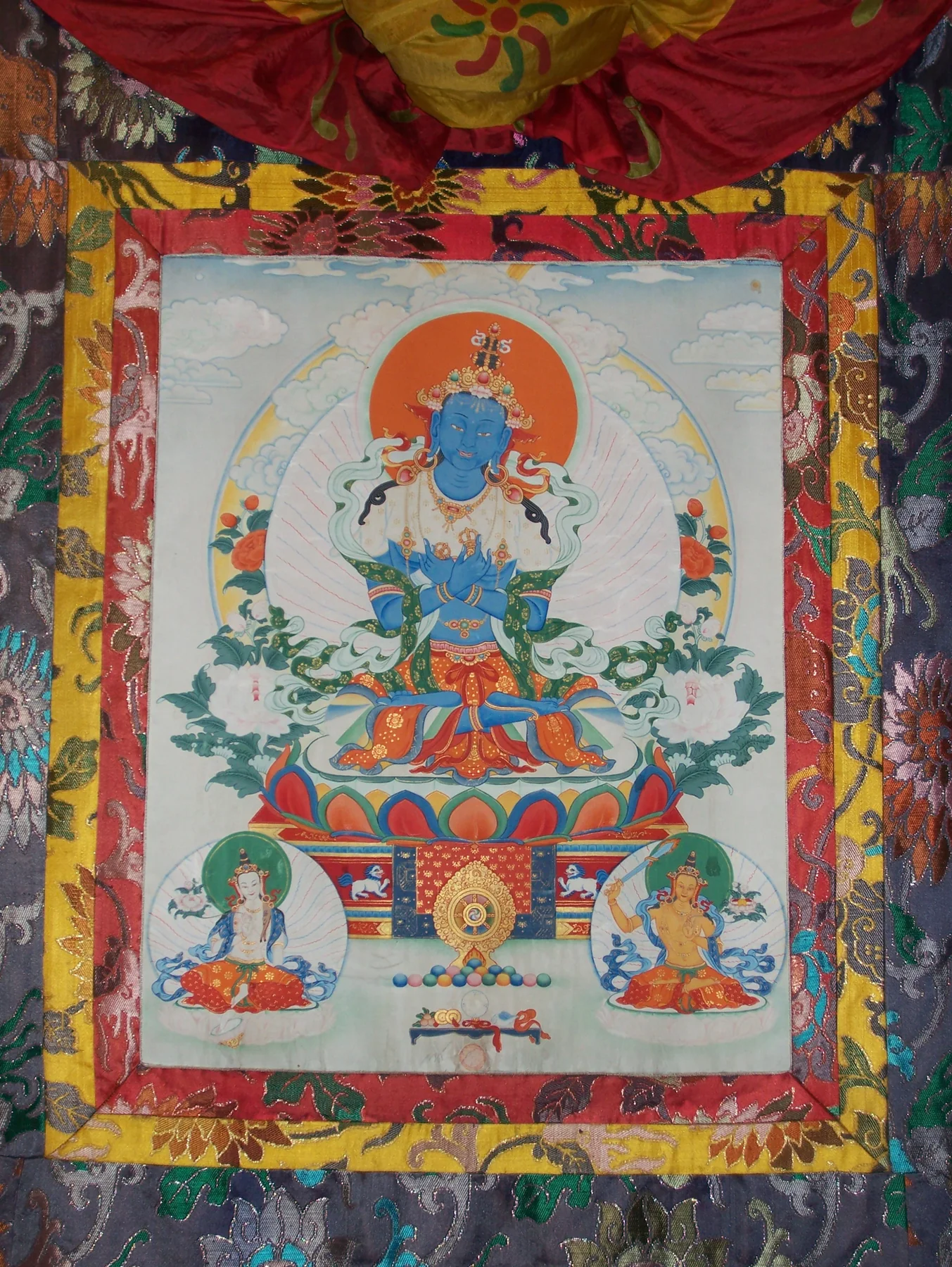
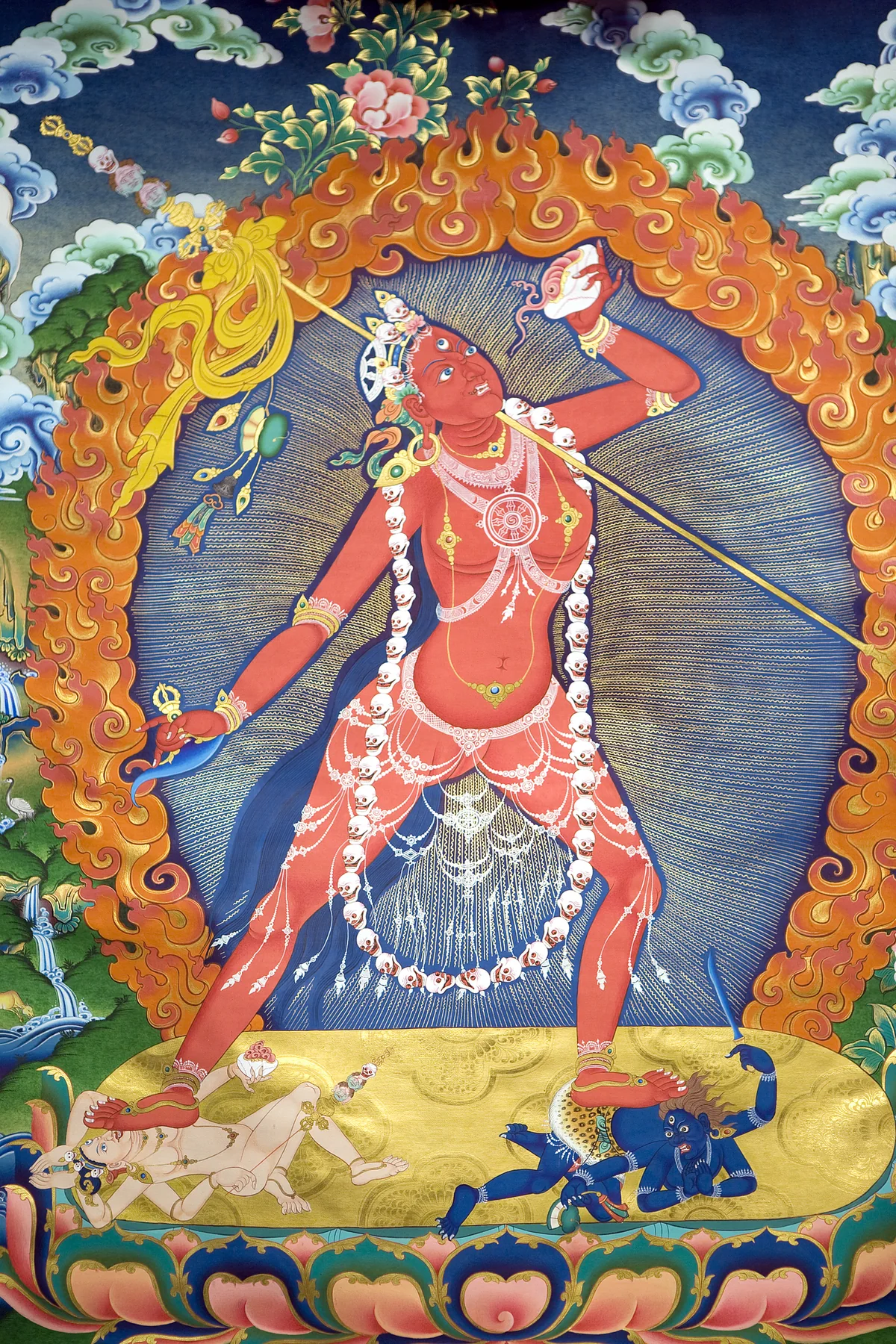
Vajrayoginī, Tibetan painting or sculpture

Vajrayoginī

Skt.; Tib. Dorje Neljorma

Initiation required

Red, dancing, the female buddha of the Cakrasaṃvara cycle.

Standing in a halo of fire with her head tilted back, drinking. She belongs to the Cakrasaṃvara system and is widely practised in this tradition by both monastics and lay practitioners who have received the initiation.

My photograph of one of my personal thangkas commissioned in Dharamsala India · Public domain · Wikimedia Commons
Kālachakra, Tibetan painting or sculpture

Kālachakra

Skt. ‘Wheel of Time’; Tib. Dükyi Khorlo

Initiation required

The one whose initiation is given to tens of thousands at once.

A separate tantric system with its own cosmology, medicine and calendar. It is the exception to everything above: His Holiness the Dalai Lama has conferred the Kālachakra empowerment publicly more than thirty times, to crowds of a hundred thousand and more.

Anonymous · Public domain · Wikimedia Commons
04

Protectors

A Dharma protector is not a god who is bargained with. Within the tradition these are understood as enlightened minds appearing in wrathful form, whose function is to clear obstacles to practice. The first three below are the documented triad of the Geluk tradition, chosen by Tsongkhapa and his closest students, and they appear together along the bottom of Geluk paintings.

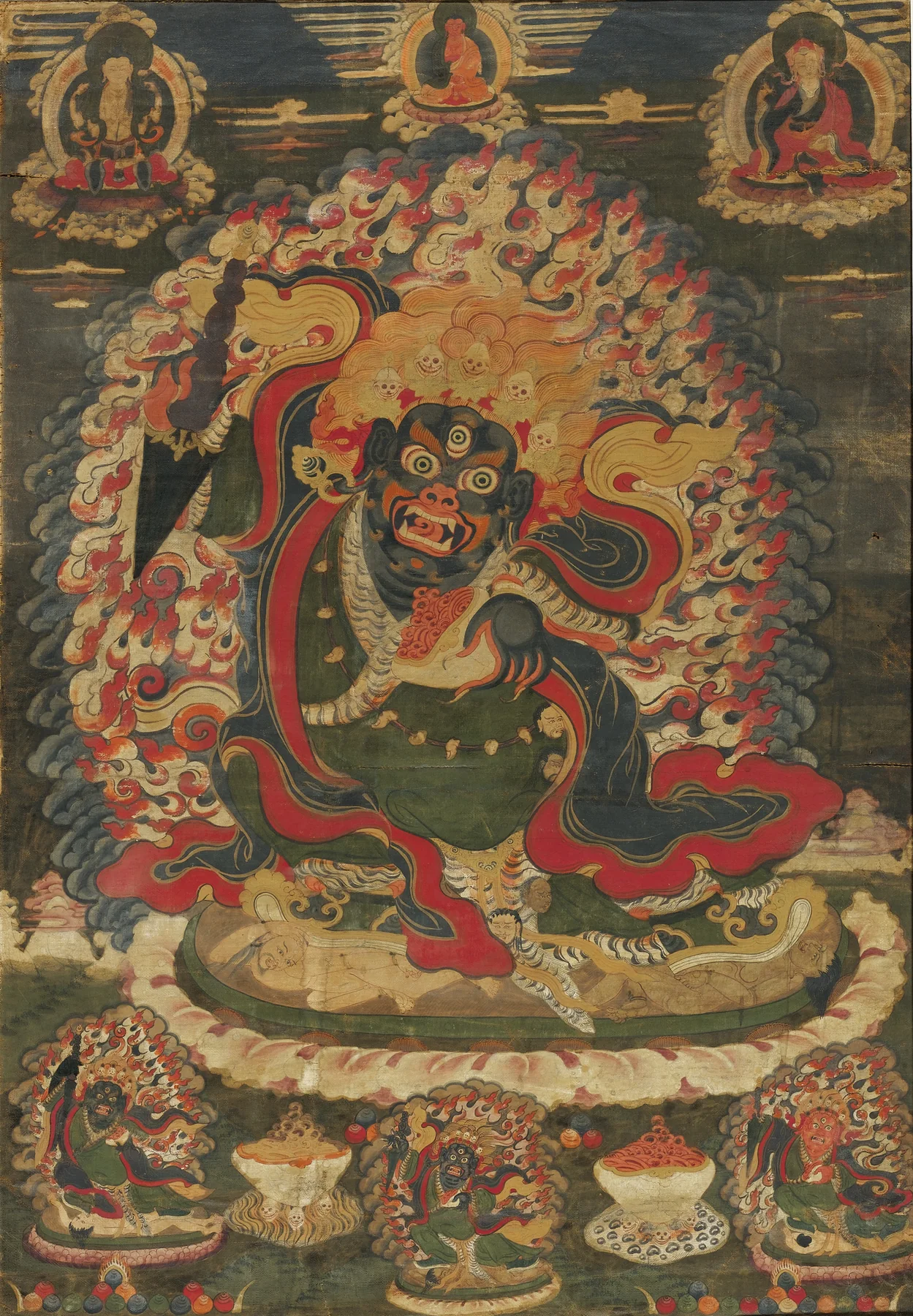
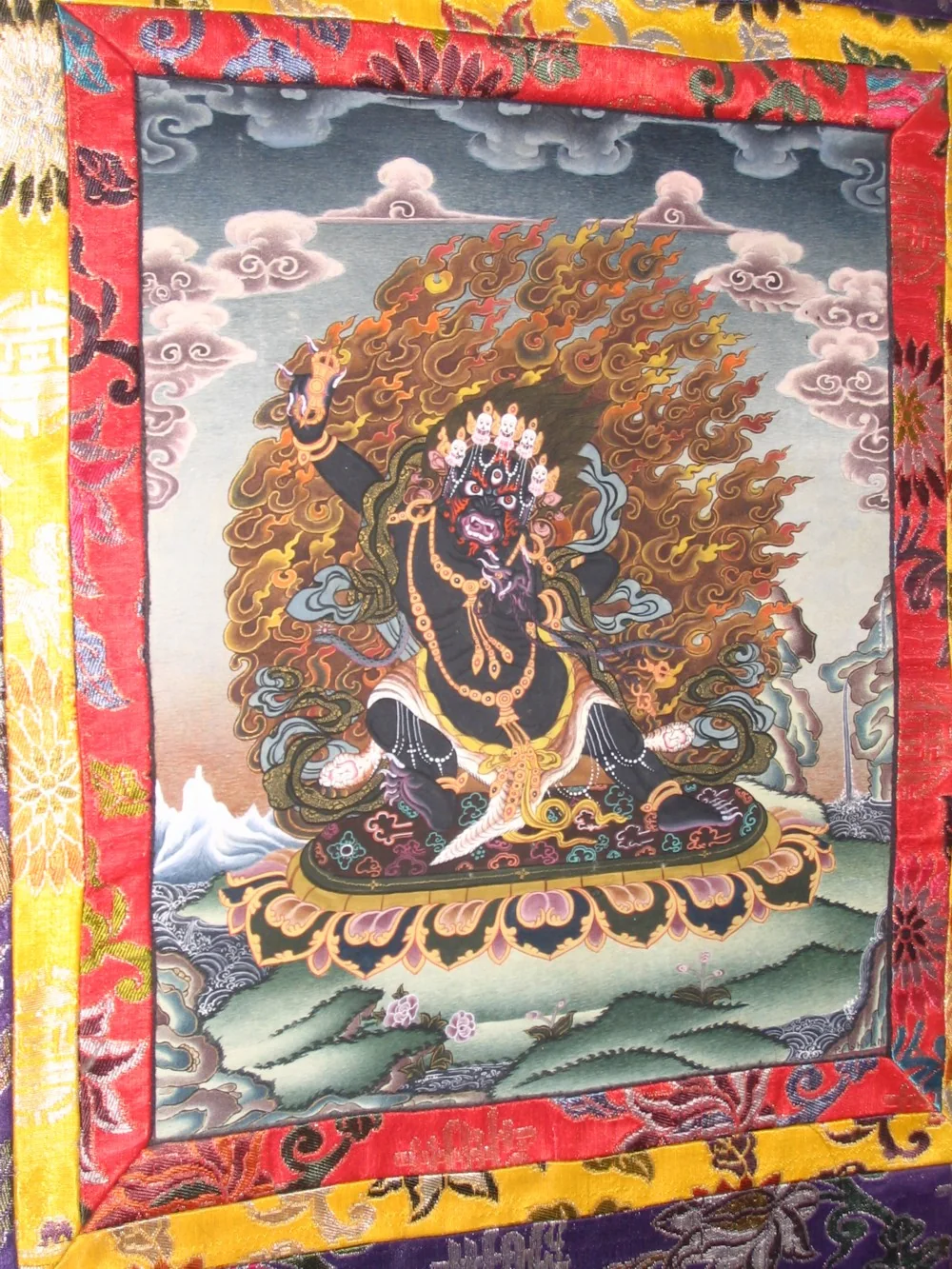
Six-armed Mahākāla, Tibetan painting or sculpture

Six-armed Mahākāla

Skt. Śaḍbhuja Mahākāla; Tib. Gonpo Chadrukpa

Initiation required

First of the three. Black, six arms, wrathful.

The wisdom protector most widely practised in this tradition. The six arms are read against the six perfections. Wrathful appearance, protective function: the tradition is consistent that the anger in the image is not the deity's own.

Anonymous · Public domain · Wikimedia Commons
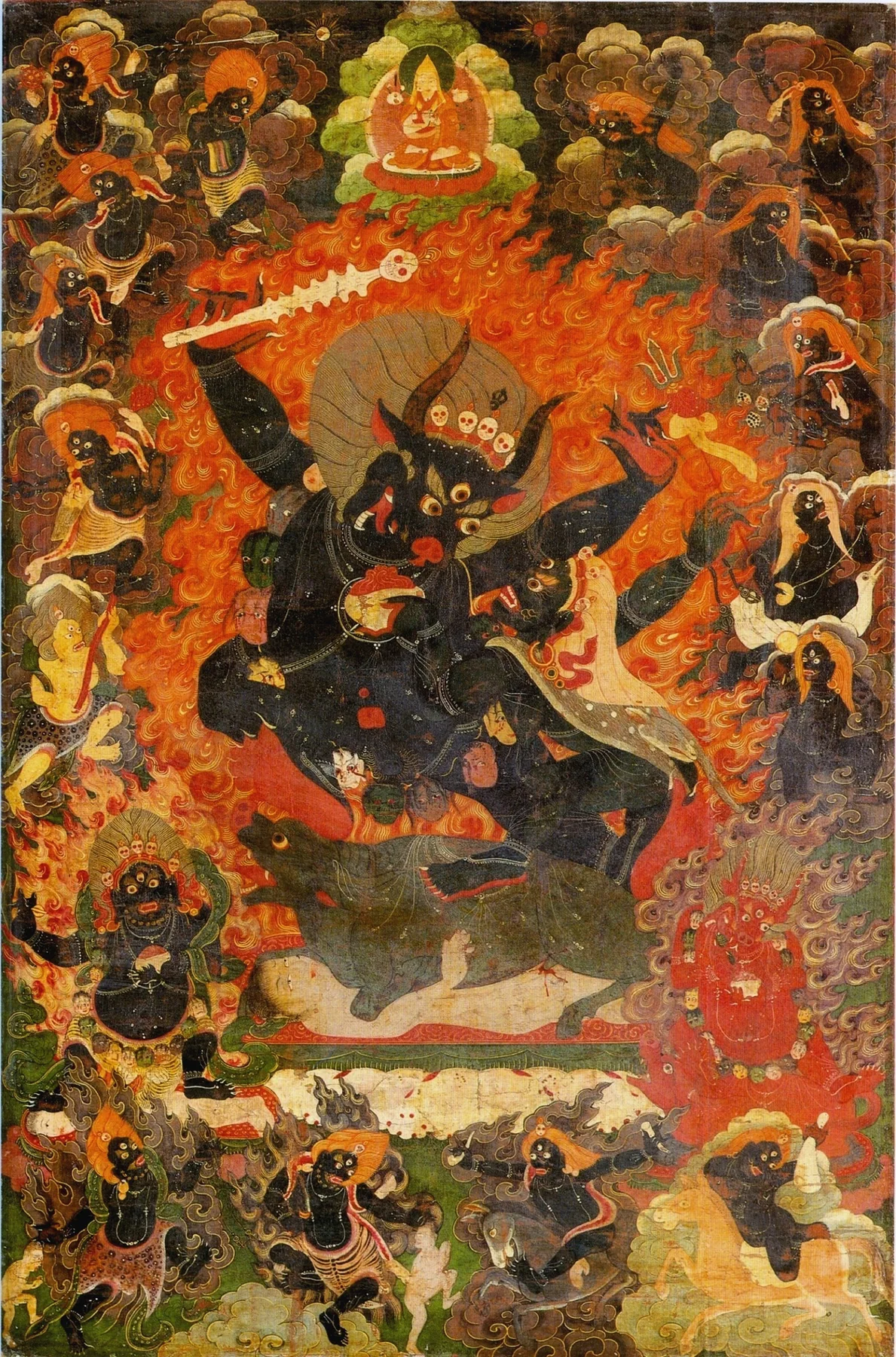
Yama Dharmarāja, Tibetan painting or sculpture

Yama Dharmarāja

Tib. Shinje Chogyal; also Kālarūpa

Initiation required

Second of the three. Bull-headed, standing on a buffalo.

The Lord of Death in the aspect of one who has been subdued and set to work. He is closely linked to Yamāntaka, and the pairing is the point: what was feared has been turned into what protects.

Anonymous · Public domain · Wikimedia Commons
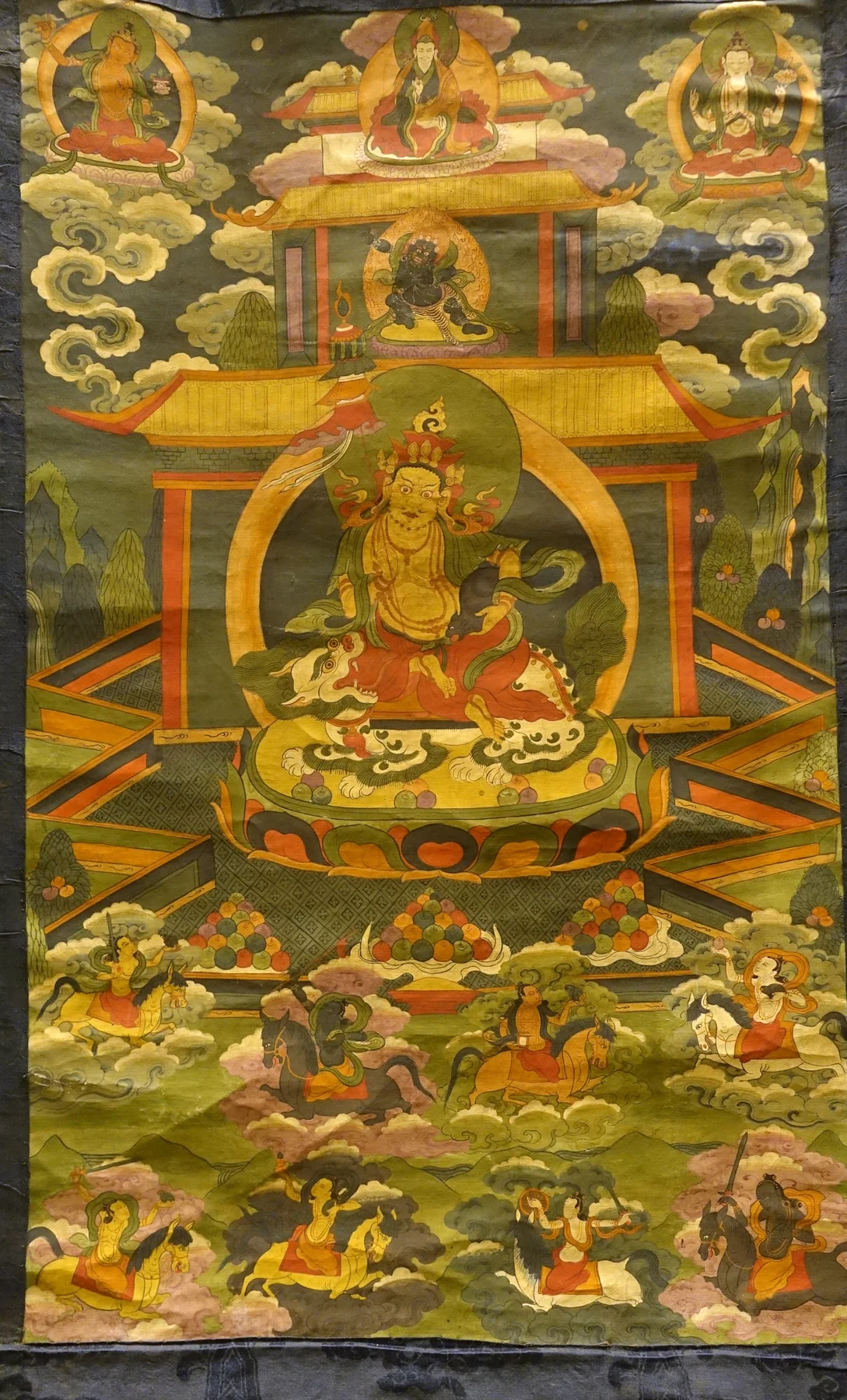
Vaiśravaṇa, Tibetan painting or sculpture

Vaiśravaṇa

Skt.; Tib. Namtose

Initiation required

Third of the three. Gold, riding a snow lion, with eight horsemen.

Guardian of the north and of wealth, shown riding a lion with a mongoose in his hand and eight horsemen below. The triad of these three is related to the three scopes of the Lamrim, the graded stages of the path.

Daderot · Public domain · Wikimedia Commons
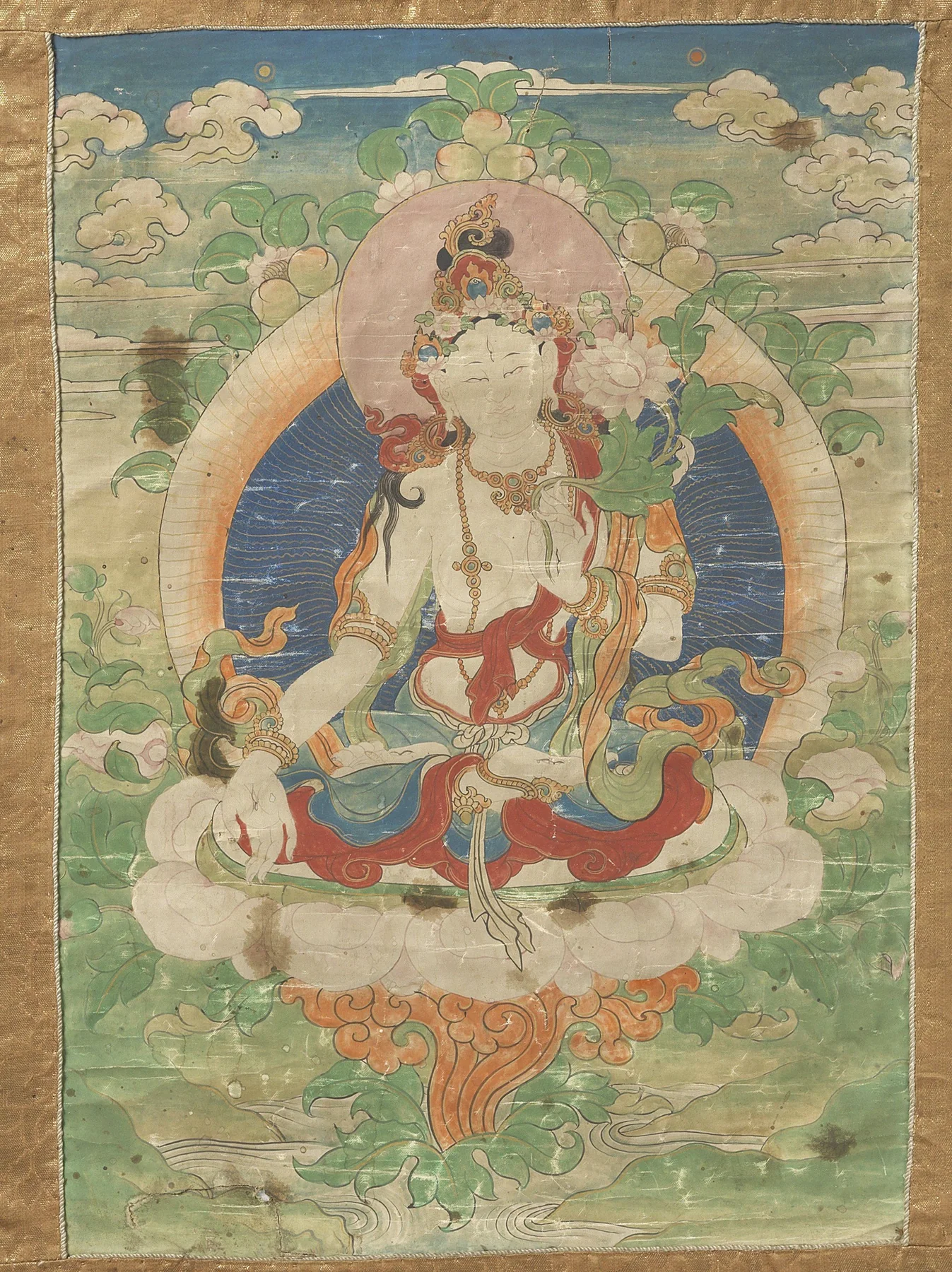
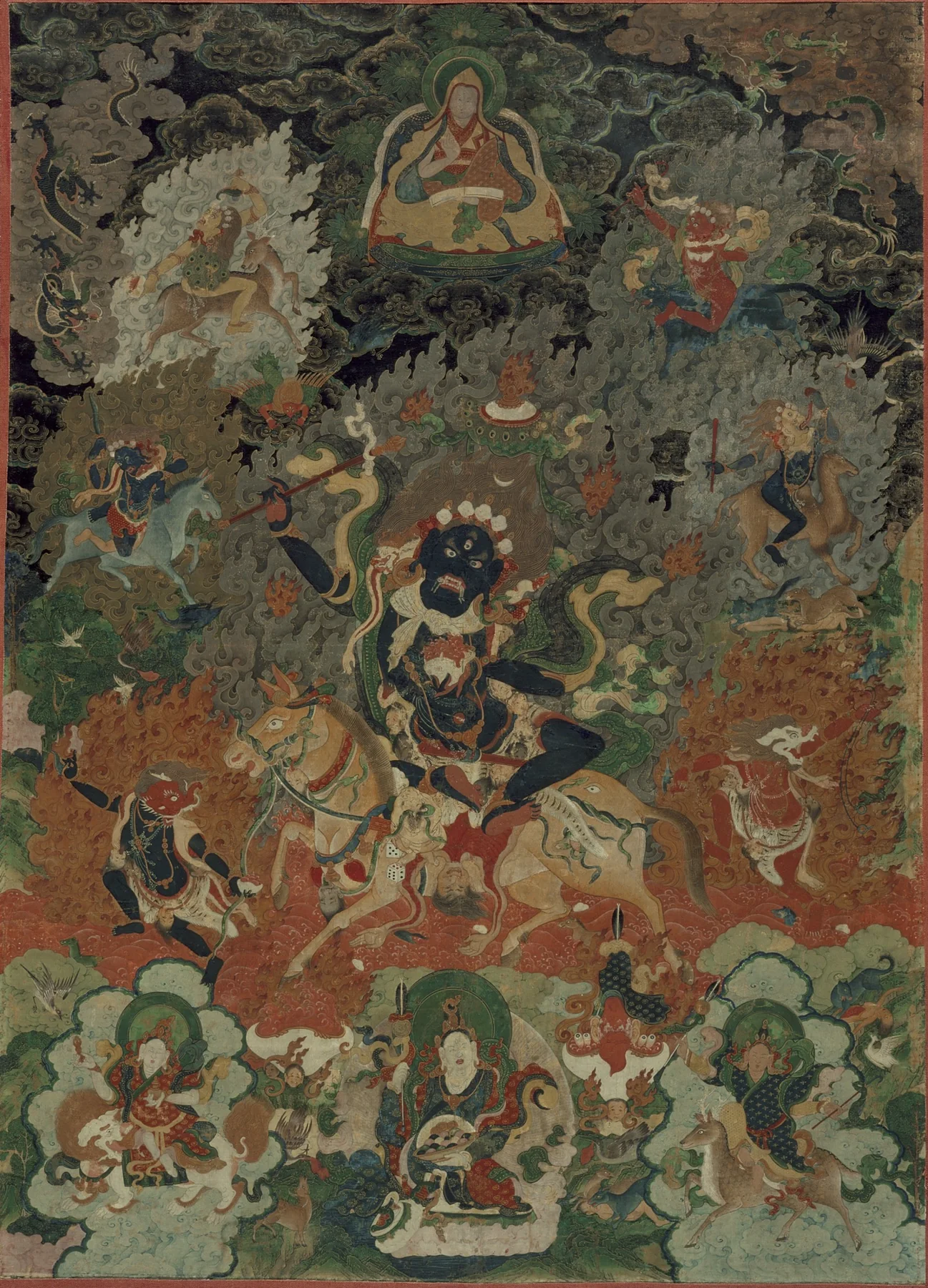
Palden Lhamo, Tibetan painting or sculpture

Palden Lhamo

Skt. Śrī Devī; the Magzor Gyalmo form

Initiation required

Not one of the three, and the most important after them.

Riding a mule across a sea of blood, the only female figure among the great protectors. She was popularised within the Geluk tradition by the Second Dalai Lama and is regarded as the chief protector of the Lhasa region. The oracle lake Lhamo Latso, consulted when a Dalai Lama is being sought, is associated with her.

anonymous · Public domain · Wikimedia Commons
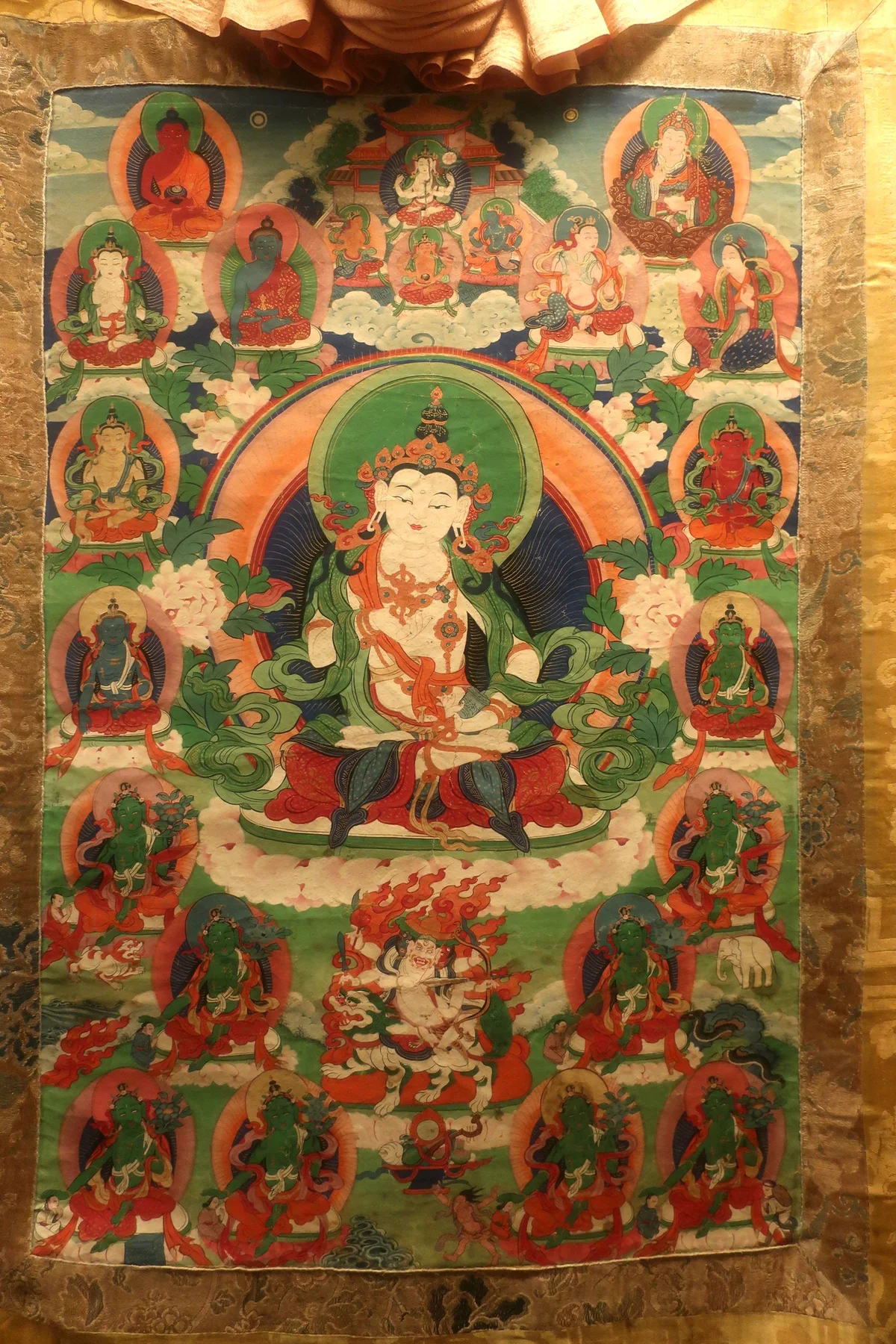
Namgyalma, Tibetan painting or sculpture

Namgyalma

Skt. Uṣṇīṣavijayā; Tib. Namgyalma

Open to anybody

Three faces, eight arms, and the long-life practice.

One of the three long-life deities together with White Tārā and Amitāyus. Her mantra is among those printed on the blessing cords handed out at teachings, and her practice is done for the dying and for the recently dead.

Hiart · Public domain · Wikimedia Commons
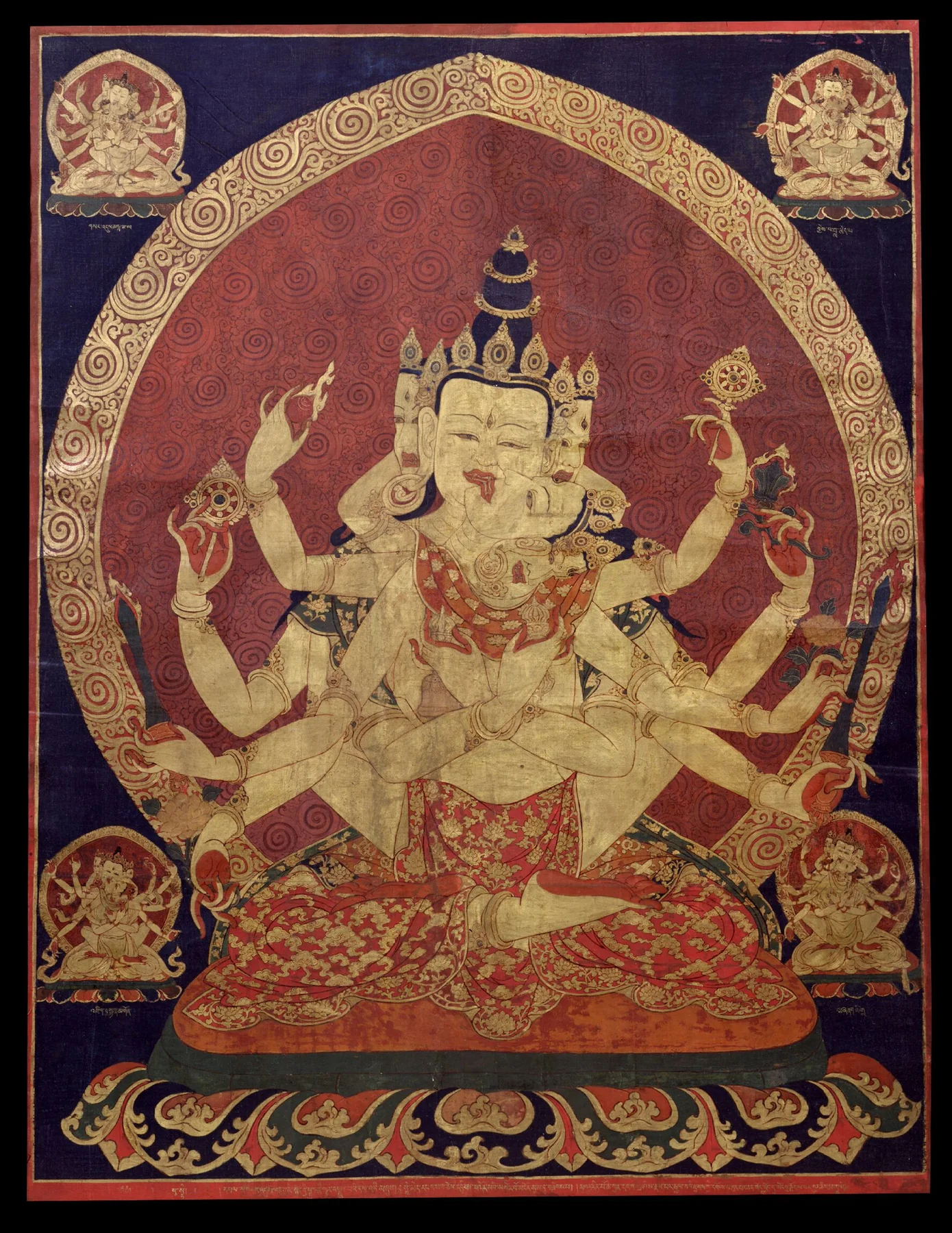

Every figure here is also a card in the Lexicon, and the nine mantras that are open to anybody are on the Mantras page with word-by-word meanings. For the teachers rather than the deities, see The Wider World.

Sources

References

Iconography and groupings were checked against Himalayan Art Resources and against Alexander Berzin’s Geluk-sourced explanations. Every image was fetched from Wikimedia Commons and then looked at before use, because a file name is not proof of what a painting shows.

  1. 1
    Tradition: Gelug ProtectorsHimalayan Art Resources

    That the three principal Geluk protectors are Six-armed Mahakala, Yama Dharmaraja and Vaishravana, that the selection originates with Tsongkhapa and his closest students, that the triad relates to the three scopes of the Lamrim, and that Magzor Gyalmo was popularised in the Geluk tradition by the Second Dalai Lama and is regarded as chief protector of the Lhasa region.

  2. 2
    Himalayan Art ResourcesHimalayan Art Resources

    The reference catalogue used to identify figures and check iconography.

  3. 3
    What Is Chakrasamvara Practice?Alexander Berzin, Study Buddhism

    That the combined practice of Guhyasamaja, Chakrasamvara and Vajrabhairava is a speciality of the Geluk system and of Tsongkhapa in particular, and the forms emphasised in the monasteries and tantric colleges.

  4. 4
    What Is Guhyasamaja Practice?Alexander Berzin, Study Buddhism

    Guhyasamaja as the foundation of the Geluk tantric system, and the three vajras of enlightened body, speech and mind.

  5. 5
    What Is Vajrabhairava, Yamantaka Practice?Alexander Berzin, Study Buddhism

    Vajrabhairava and Yamantaka as the same practice under two names, and the Thirteen-Deity form used in the Geluk tradition.

  6. 6
    Explaining Dharma ProtectorsLama Zopa Rinpoche, FPMT

    What a Dharma protector is and is not, from within this tradition.

  7. 7
    Kalachakra initiationsThe Office of His Holiness the Dalai Lama

    The thirty-four Kālachakra empowerments given between 1954 and 2017, with places and attendance.

  8. 8
    Brief biography of the Fourteenth Dalai LamaThe Office of His Holiness the Dalai Lama

    Birth, recognition, 1950, Beijing in 1954, the Geshe Lharampa examination, the 1959 exile, the 1989 Nobel Peace Prize, and the 2011 retirement from political office.

  9. 9
    The Five Great TreatisesKopan Nunnery

    Plain-language description of the five Indian root texts and their authors.

  10. 10
    Wikimedia CommonsWikimedia Foundation

    The source of every photograph and portrait on this site, all freely licensed.

Every factual claim on this page rests on one of the sources above. Links open in a new tab. The full list for the whole site, and the standard this site holds itself to, is on the sources page.