02 · Start Here
Starting from nothing
You do not need to believe anything, join anything, or buy anything to begin. This page is written for somebody who knows nothing at all and would like that to change. No jargon that is not explained on the spot.
First
What Buddhism actually says, in six sentences
- Life contains a lot of dissatisfaction, and not only the obvious kind. Even the good parts are unstable, and you know it.
- That dissatisfaction has a cause, and the cause is inside you rather than out in the world: it is a habit of misreading how things exist, and the craving and aversion that grow out of that.
- Because it has a cause, it can be removed. This is the whole bet. If the problem were simply the world, there would be no method.
- There is a method, and it is trainable: ethics, concentration, and understanding, in that order, practised over a long time.
- Nothing exists in the solid, independent way it appears to. Everything depends on causes, on its parts, and on being labelled by a mind. Seeing this clearly is what actually loosens the grip.
- And the point of doing any of it, in this tradition, is not your own peace. It is to become capable of being useful to everybody else.
That is the skeleton. Everything else (the robes, the chanting, the twenty years of debate) is machinery built to make those six things real rather than merely agreed with.
Your first month
Do this, not more than this
The commonest mistake is doing too much too fast, running out of enthusiasm, and concluding it did not work. Here is a month that almost anybody can finish.
- Read one book. One. Not five. There is a list further down. Finish it before you buy another.
- Sit for ten minutes a day. Same time each day. Sit upright, follow your breath, and when you notice you have wandered off, come back. Noticing that you wandered is the exercise. Ten minutes you actually do beats an hour you plan. Why this site does not go further than that explains what meditation means here and why the rest needs a teacher.
- Watch one thing in your own mind. Pick anger, or wanting, or boredom. For a month, just catch it happening and notice what it feels like before it takes over. This is the beginning of the whole method.
- Be useful to somebody every day. Small and specific. This is not a nice extra; in this tradition it is the load-bearing part.
- Go and look at something real. A Buddhist centre, a temple, a talk. Say you are new. Nobody will mind, and you will learn more in one evening than in a week of reading.
- Do not make any vows, take any empowerments, or pick a guru yet. There is no rush and the tradition agrees with that.
What to read
Books, in the order they will actually help
All of these are in the tradition of His Holiness the Dalai Lama. Start at the top. The list gets harder as it goes down, and there is no prize for skipping ahead.
Begin
Buddhism for Beginners
Thubten Chodron
Question and answer format, short chapters, plain English. An American nun trained in this tradition answering the exact questions a newcomer actually has. This is the single easiest place to start.
Open Heart, Clear Mind
Thubten Chodron
A short, warm introduction to how the mind works in Buddhist terms and what you can do about it. No prior knowledge assumed.
Becoming Your Own Therapist
Lama Thubten Yeshe free to read
Three public talks with the questions left in, so you can watch him handle scepticism live. Free to read from the Lama Yeshe Wisdom Archive.
The Art of Happiness
the Dalai Lama with Howard C. Cutler
A psychiatrist interviews the Dalai Lama over years. Barely uses Buddhist vocabulary. Good if the religious framing puts you off and you want the practical core first.
Go deeper
Approaching the Buddhist Path
the Dalai Lama and Thubten Chodron
Volume one of the Library of Wisdom and Compassion, published by Wisdom Publications. It sets the context: the human wish for happiness, the nature of mind, Buddhist history, and how this all lands in the modern world. It stands alone, and it is also the foundation of the series.
The Foundation of Buddhist Practice
the Dalai Lama and Thubten Chodron
Volume two. The bedrock: what to actually establish first so that a practice lasts.
An Open Heart
the Dalai Lama
Short, and built around the practices of compassion. A good bridge between reading about Buddhism and doing something.
Transforming Problems into Happiness
Lama Zopa Rinpoche
Very short. About what to do with difficulty, which is usually the reason people arrive in the first place.
The Foundation of Buddhist Thought
Geshe Tashi Tsering
Six volumes from a Sera Mey geshe who has taught Westerners in London for thirty years: The Four Noble Truths, Relative Truth Ultimate Truth, Buddhist Psychology, The Awakening Mind, Emptiness, Tantra. Take them in order. This is the closest thing to a real curriculum you can do from an armchair.
The classics
Liberation in the Palm of Your Hand
Pabongka Rinpoche
A twenty-four day lamrim teaching, written down. Long, warm, full of stories. The book many Tibetan teachers reach for when somebody is serious.
Three volumes. The founder of this tradition setting out the whole path in order, in 1402. Not a first book. It is the mountain the others are pointing at, and the final section on insight is genuinely difficult.
A Guide to the Bodhisattva's Way of Life
Śāntideva free to read
An eighth-century Indian poem about compassion that is still read aloud in monasteries every day. His Holiness the Dalai Lama has said it is the text he values most. Read a chapter at a time, slowly.
Two notes. First, buy from anywhere you like, but Wisdom Publications and Shambhala publish most of these and many are in libraries. Second, if a book is not working for you, put it down and try another. There is no single correct first book.
Free, and good
You do not have to spend anything
Four places that give away serious material. Between them they cover more than most people get through in a decade.
If you want to go deep
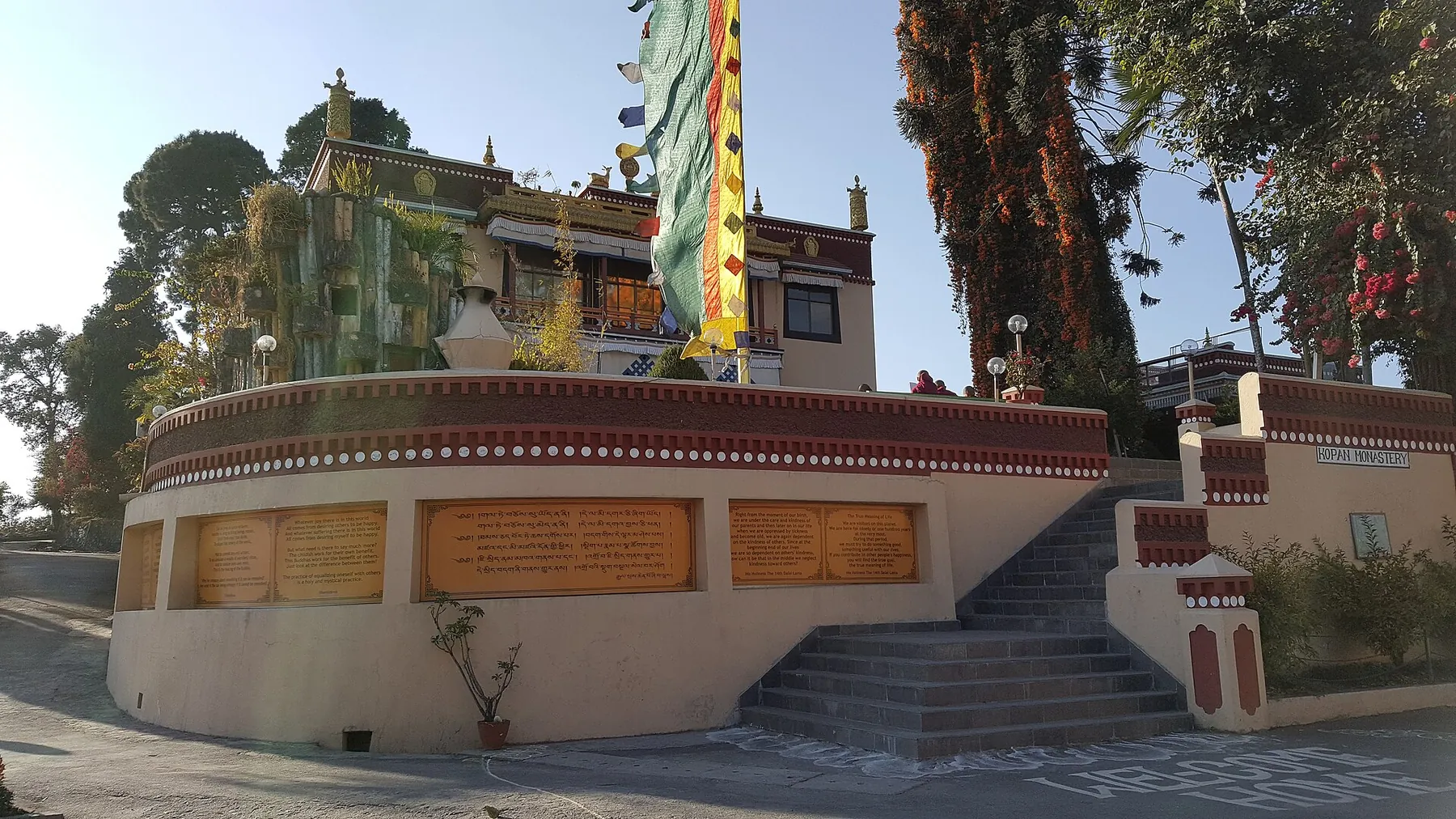
Go to Kopan
There is a hill outside Kathmandu where a very large share of the Western Buddhists in this tradition first met it. If you want more than a book, that is where to go.
In April 1971 Lama Zopa Rinpoche taught a ten-day course there to about a dozen foreigners. It has run every year since. It grew into the month-long November course, which now draws around two hundred people a year from everywhere, and which has changed the direction of a remarkable number of lives. Many of the senior students in this tradition, including the people who went home and founded the centres listed on this site, walked up that hill as travellers and came down as something else.
It is a lamrim course, which means it walks the entire path in order, and its structure has barely changed in fifty years. Lama Zopa Rinpoche called coming to a Kopan course the most important education of your life. He was not being decorative.
You do not have to be Buddhist, you do not have to know anything, and you do not have to commit to anything afterwards. You do have to actually be there: phones and laptops are handed in at reception for the duration, attendance at every session is compulsory, and silence runs from nine at night until after lunch.
Shorter, and closer
A month in Nepal is not everybody's first step. Tushita in Dharamsala runs ten-day introductions to Buddhism in the same tradition. Most FPMT centres run weekend and evening courses, and many run residential retreats. Any of them will take somebody who has never meditated.
Find a centre near you → · How Kopan happened → · What it takes to actually leave →
The teacher question
Do you need a guru, and why
Short answer: not yet, and then eventually yes, and the gap between those two is longer than most beginners expect.
What a teacher is actually for
Three things that a book cannot do. A teacher can tell you which of your problems is the real one, because you will almost always be working on the wrong one. A teacher can correct your practice before a small error becomes a ten-year habit. And for tantra, a teacher is not optional at all: those practices are transmitted person to person through empowerment, and without that transmission they do not function.
When you actually need one
You can get a long way on reading, a meditation habit and a decent class. The point at which a teacher becomes necessary is when you want to take vows, receive an empowerment, or begin a practice with real commitments attached. Before that, look, listen and read.
How to check somebody, which is the important part
His Holiness the Dalai Lama's advice here is unusually blunt and has been consistent for decades. Examine a teacher thoroughly before accepting them. The tantric literature suggests that student and teacher should examine each other for as long as twelve years before entering the relationship. That is not a figure of speech; it is there to make the point that there is no hurry whatsoever.
He has also said that the instruction to see the guru's actions as perfect should not be pressed on ordinary practitioners, and that if a teacher behaves in ways that contradict the Dharma or teaches things that contradict it, that instruction gives way to reason. Every student is responsible for checking what they are told against reason and against the teaching itself.
Practical questions to ask before you commit to anybody
- Where did they study, for how long, and with whom? A real answer is specific and checkable.
- Do they encourage you to question them, or does questioning get treated as a lack of faith?
- Is money a condition of access to teachings?
- Are you being pushed toward vows, empowerments or commitments quickly?
- Are students discouraged from studying elsewhere, or from leaving?
- Is the centre openly connected to a recognised body, such as FPMT or one of the great monasteries, or listed by the Office of His Holiness the Dalai Lama?
- How do the long-standing students behave? Do they seem freer than when they arrived, or smaller?
None of these questions is rude. A good teacher expects them, and the tradition itself tells you to ask.
Clearing the decks
Six things that are not true
“Meditation means emptying your mind.”
Not in this tradition. The characteristic Geluk method is analytical meditation: you take a proposition and reason through it until it stops being information and becomes conviction. Calm concentration is the tool, not the goal. If your mind is blank, nothing is being investigated.
“Buddhism has no beliefs, so anything goes.”
Buddhism asks you to test things rather than swallow them, which is not the same as having no positions. This tradition makes very specific claims about mind, causation and how things exist, and monks spend twenty years arguing about them precisely because the claims are definite.
“Karma means you deserved it.”
Karma is a description of how intentional actions leave traces that shape later experience. It is not a scoreboard and nobody is administering it. Using it to explain why somebody else is suffering is a misuse of the idea, and a cruel one.
“You have to become a Buddhist.”
You do not. His Holiness the Dalai Lama has said many times that most people are better off improving within the tradition they grew up in, and he invites non-Buddhists to his teachings as observers. Take what is useful.
“You need a guru immediately.”
You need one eventually for tantric practice. For learning the foundations, reading and a good class will carry you a long way, and the tradition explicitly recommends taking your time. See below.
“It is all very calm and gentle.”
Come and stand in the debate courtyard at four in the afternoon.
When you get stuck
The rest of this site is built for exactly this
Every word, explained
121 cards. When a book drops bodhicitta or yigcha on you without warning, it is defined here in plain English.
The sounds, and what they say
What people are actually reciting, word by word, with sources and a counter you can use.
Longer pieces
Why the debate courtyard has no chairs, what the five great books are for, and what a Kālachakra initiation offers an ordinary person.
Sources
References
The advice on finding and checking a teacher is His Holiness the Dalai Lama's own, not this site's. The reading list is drawn from what teachers in this tradition actually recommend.
- 1The Dalai Lama on questioning the advice of the guruShambhala Publications
Examining a teacher before accepting them, and the limits of guru devotion for ordinary practitioners.
- 2The Dalai Lama: Reliance on a TeacherShambhala Publications
The twelve-year mutual examination of teacher and student before the relationship is entered.
- 3Discovering BuddhismFPMT
The fourteen-module introductory programme, its topics and how it is delivered.
- 4Mantras and their prerequisitesFPMT
When an initiation is required to recite a mantra and when it is not, and the oral transmission.
- 5Approaching the Buddhist Paththe Dalai Lama and Thubten Chodron, Wisdom Publications
Volume one of the Library of Wisdom and Compassion, recommended as a foundation.
- 6The Foundation of Buddhist ThoughtGeshe Tashi Tsering, Wisdom Publications
The six-volume course from a Sera Mey geshe, and the programme behind it at Jamyang London.
- 7Becoming Your Own TherapistLama Yeshe Wisdom Archive
Lama Yeshe's public talks, free to read, recommended as a first book.
- 8Lama Yeshe Wisdom ArchiveLYWA
The collected teachings of Lama Yeshe and Lama Zopa Rinpoche, much of it free to read.
- 9Study BuddhismBerzin Archives
A free archive of explanations of Tibetan Buddhism built with Geluk teachers.
- 10Who We AreSravasti Abbey
The training monastery founded in Washington State in 2003 by Ven. Thubten Chodron.
Every factual claim on this page rests on one of the sources above. Links open in a new tab. The full list for the whole site, and the standard this site holds itself to, is on the sources page.