Seven festivals that move every year, drawn as a
calendar for 2026 and 2027, with the Tibetan date in every square.
The Tibetan calendar is lunar. Its dates walk backwards through our year by
about eleven days, and then jump forward when a month is doubled. That is why a festival can be
in February one year and March the next, and why no fixed list is possible.
Where these come from. The lunar day of each festival is fixed and
published by FPMT. The Gregorian day it lands on is read off the Phugpa calendar for that year,
Phugpa being the system the Tibetan administration in Dharamsala uses. Nothing here was
calculated by hand, and the calendar punishes anybody who tries: it skips some days and doubles
others, and 2027 has a whole extra month.
What each day is. The short notes further down say what each
occasion commemorates. The days, in full gives each one properly,
with what is actually done on it.
How they were checked. For 2026 there are independently published dates to
compare against, and six agree exactly: Losar, Saga Dawa Duchen, Universal Prayer Day, Chokhor
Duchen, Lhabab Duchen, and the span of the entire fourth month. That agreement is why 2027 is
here. It is read the same way from the same archive, but most bodies that publish these lists
have not published 2027 yet, so treat it as accurate rather than confirmed and check with your
own centre before booking anything.
2026
The year of the Fire male Horse
Only the months that carry a festival are drawn. The small figure in the corner of each square is the Tibetan date: month, then day.
Only the months that carry a festival are drawn. The small figure in the corner of each square is the Tibetan date: month, then day.
A leap year. The second Tibetan month occurs twice, once intercalary and once delayed, marked i in the squares. That extra month is why these dates fall roughly three weeks later than 2026’s rather than eleven days earlier. No arithmetic on last year’s dates would have found them.
Four of the seven are düchen, great occasions, each marking one of
the Buddha’s extraordinary deeds. On these days, FPMT teaches, the karmic result of an
action is multiplied by one hundred million, a figure attributed to the
vinaya text Treasure of Quotations and Logic. For Saga Dawa Duchen the figure given
is three hundred million, because it marks three events rather than one.
Two things are worth saying plainly. It cuts both ways: the multiplication is of karmic
results, not of good ones only. And it is a teaching within the tradition with a named
textual source, which is why this page attributes it rather than stating it flatly.
The Tibetan new year. Two halves: the old year is sent off and its debts and quarrels settled, then the new one is invited in with prayer flags, juniper smoke and guthuk, a noodle soup with things hidden in the dumplings that are read as telling you about your character. In a monastery it also opens the great prayer festival.
The fifteenth day closes fifteen in which the Buddha is held to have displayed miraculous powers, to subdue six teachers who lacked faith in him. All fifteen days count, not only the last.
The holiest day of the year: the Buddha’s birth, his enlightenment and his parinirvana, all three at once. That is why the multiplication attached to it is larger than for the other three. The whole fourth month is the month of merit.
The Buddha’s first teaching, at Sarnath, seven weeks after his enlightenment. He had decided not to teach, on the grounds that nobody would understand, and then changed his mind. Everything downstream of that, including this website, starts here.
The Buddha’s return to earth after months teaching the gods of the Heaven of the Thirty-Three, among them his mother Mayadevi, who had died a week after his birth and been reborn there.
The anniversary of Je Tsongkhapa’s parinirvana in 1419, the year Sera was founded. Butter lamps go in every window. In the Geluk tradition this is the great day of the year that is not one of the four.
Tibetan Uprising DayNot a religious festival. The anniversary of the 1959 uprising in Lhasa, and the reason the institutions on this site are in India.
His Holiness the Dalai Lama’s birthdayFixed in our calendar, not the lunar one. He was born on 6 July 1935.
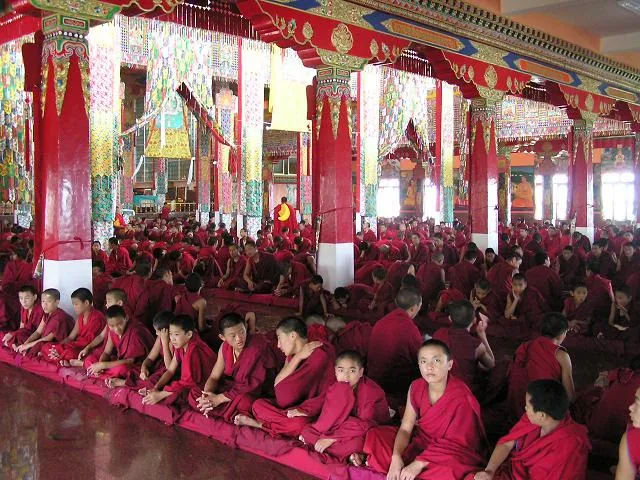
The festival year as it is kept inside a monastery is on
Monastic Life. If you are going to a teaching on one of these days,
what happens at a teaching covers the rest. Terms are in the
Lexicon.
Dates are read from the Phugpa calendar archive and checked against independently published lists. Where the two could be compared, for 2026, they agree on every date.
The year-by-year Phugpa calendars from which every Gregorian date on the calendar page is read. Phugpa is the system used in Dharamsala, and the files annotate the Buddha days themselves.
An independent published list of the 2026 dates, used to check the dates read from the Phugpa calendar rather than to replace them. Losar, Saga Dawa Duchen, Universal Prayer Day, Chokhor Duchen, Lhabab Duchen and the span of the fourth month all agree.
Which four days count as the great holy days, the lunar date of each, what each commemorates, and the teaching that karmic results are multiplied on them, attributed to the vinaya text Treasure of Quotations and Logic.
The founding by Jetsun Kunkhen Lodrö Rinchen Senge, the two administrations, the Geshe Lharampa degree, the 75th abbot, and the affiliated centres abroad.
Birth, recognition, 1950, Beijing in 1954, the Geshe Lharampa examination, the 1959 exile, the 1989 Nobel Peace Prize, and the 2011 retirement from political office.
Every factual claim on this page rests on one of the sources above. Links
open in a new tab. The full list for the whole site, and the standard this site holds itself to,
is on the sources page.