Darpa PanditaSera Jey · Bylakuppe Plan a visit
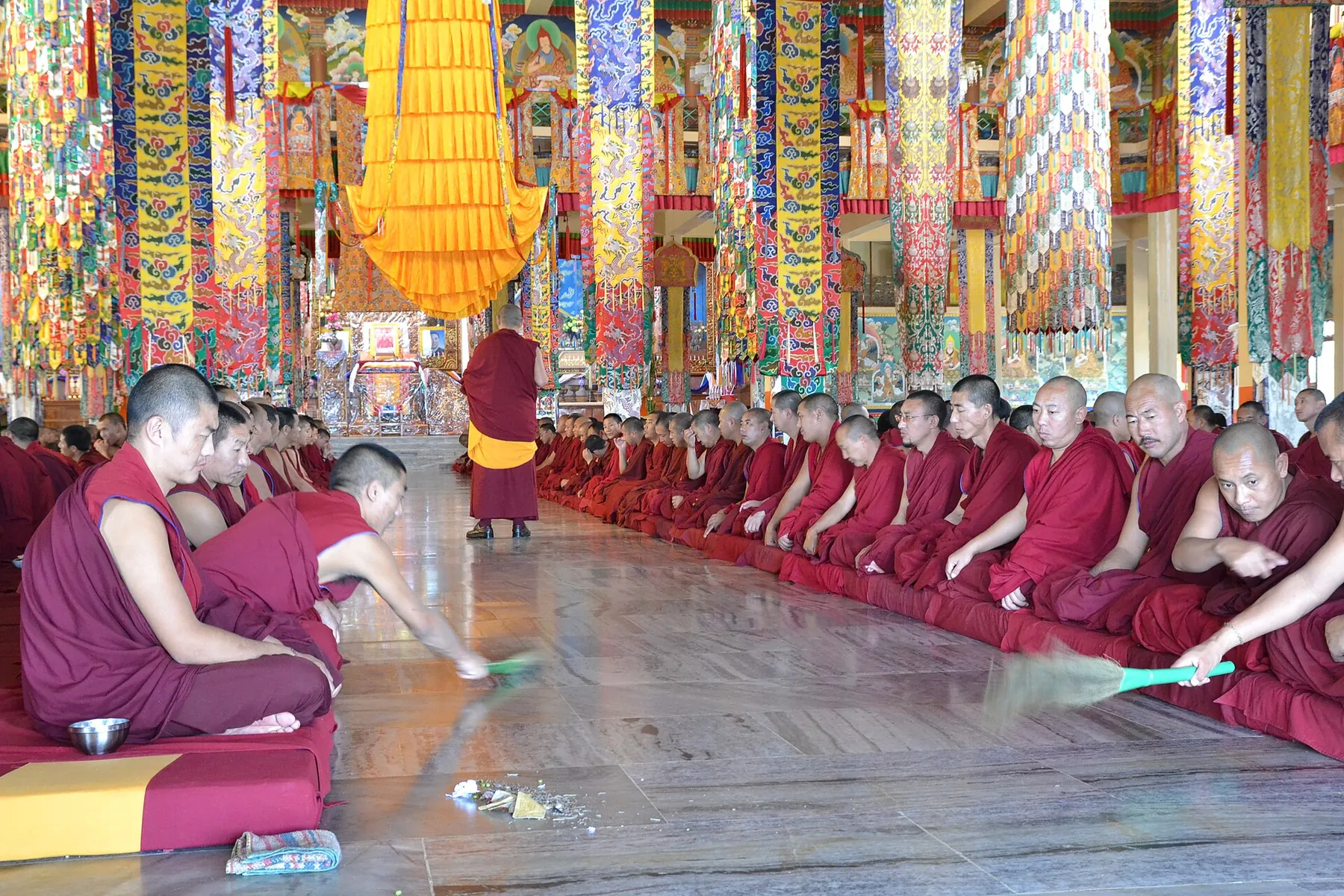
Monks seated in the assembly hall at Sera Jey during a ceremony

20 · The days

What each day actually is

Eight occasions, what each one commemorates, why it falls when it does, and what people do on it. The calendar answers when. This answers what.

Four of these are düchen, great occasions, each marking one of the Buddha’s extraordinary deeds. The other four matter for different reasons: one is a household new year, one is a prayer festival that shaped the Geluk academic year, one is older than Buddhism in Tibet, and one is the anniversary of a death in 1419.

Dates below are read from the same Phugpa tables as the calendar, so the two pages cannot drift apart.

Losar

ལོ་གསར།

Tib. lo gsar, ‘new year’

Month 1, day 1

Next18 February 2026then7 February 2027

The Tibetan new year, and the one day on this page that is as much a household occasion as a religious one.

Two halves, in order

Losar is not one celebration but two joined together, and the order matters. First the old year is sent off: debts settled, quarrels ended, the house cleaned out, and the accumulated rubbish of the year disposed of deliberately rather than incidentally. Only then is the new year invited in.

Guthuk, and the dumpling that tells you about yourself

On the eve, families eat guthuk, a noodle soup. Objects are hidden inside some of the dumplings, and what you get is read as a comment on your character. Wool means you are kind. Charcoal means you have a black heart. It is affectionate rather than solemn, and it is the part children remember.

Then the new year

New prayer flags go up. Juniper and incense are burned. Khapse, deep-fried biscuits in various shapes, are made in quantity, and at Dolma Ling the nuns make elaborate butter sculptures of flowers and auspicious symbols. In a monastery Losar also opens the great prayer festival that follows it.

On the day

  • Settle what is unsettled before the day, which is the actual practice
  • New prayer flags, juniper smoke
  • Guthuk on the eve, khapse through the days after

Mönlam Chenmo

སྨོན་ལམ་ཆེན་མོ།

The Great Prayer Festival

Month 1, days 4 to 11

Next21 February 2026 to 27 February 2026then10 February 2027 to 17 February 2027

Not a single day but a week, and the reason the Geluk academic year has the shape it has.

Founded in 1409, and why that year matters

Je Tsongkhapa established Mönlam Chenmo at the Jokhang in Lhasa in 1409, ten years before he died and ten years before Sera was founded. Monks of Drepung, Sera and Ganden gathered for it. From 1417 Drepung presided. It has run for about six hundred years.

The examinations

This is the detail that connects the festival to this site. The oral examinations for the Geshe Lharampa degree, the highest in the Geluk system, were held during Mönlam. A candidate who had studied for twenty years defended in front of the assembled monks of three monasteries, during the most public week of the year. The degree was not awarded in a room.

What it leads to

The week runs from the fourth to the eleventh day of the first month, inside the fifteen days of miracles, and the whole sequence closes on Chotrul Duchen.

On the day

  • Mass recitation
  • Debate and examination in public
  • In exile, kept in Dharamsala and at the re-established monasteries

Chotrul Duchen

ཆོ་འཕྲུལ་དུས་ཆེན།

The Day of Miracles

Month 1, day 15

One of the four

Next3 March 2026then20 February 2027

The first of the four great days, and the close of fifteen days rather than a day on its own.

What is commemorated

Over fifteen days the Buddha is held to have displayed miraculous powers in order to subdue six teachers who lacked faith in him, and to inspire faith in his followers. FPMT is precise that the observance is days 1 to 15 of the first month, with day 15 called Chotrul Duchen. All fifteen count.

Why a tradition this sceptical of display commemorates a display

Buddhism is generally cool about miraculous powers. The Vinaya restricts advertising attainments, and this site has a whole page on what the tradition does not claim. The reading given inside the tradition is that the display was for a specific purpose and an audience that needed it, not a demonstration of power for its own sake. That distinction carries a lot of weight here and is easy to miss from outside.

On the day

  • The fifteen days, not only the last one
  • Butter lamp offerings
  • In Tibet, the great butter sculpture displays

Saga Dawa Duchen

ས་ག་ཟླ་བ་དུས་ཆེན།

FPMT spells it Saka Dawa

Month 4, day 15

One of the four

Next31 May 2026then18 June 2027

The holiest day of the year, and the only one that marks three things at once.

Three events, one day

The Buddha’s birth, his enlightenment and his parinirvana are all commemorated on the fifteenth of the fourth month. Other Buddhist traditions keep the same occasion as Vesak, sometimes on a different date.

Why the figure attached to it is larger

FPMT gives the multiplication of karmic result on the four great days as one hundred million, and for this day three hundred million, precisely because it marks three events rather than one. The arithmetic is not the point; the reason for the difference is.

The whole month counts

The fourth Tibetan month is the month of merit, not just its fifteenth day. At Dolma Ling the nuns read the entire Kangyur, the collected words of the Buddha, over several days during it.

On the day

  • Vegetarian for the month is common, though the tradition does not require it generally
  • Reading of the Kangyur
  • Circumambulation, and release of animals destined for slaughter

Dzam Ling Chi Sang

འཛམ་གླིང་སྤྱི་བསང་

Universal Prayer Day

Month 5, day 15

Next29 June 2026then18 July 2027

A day of incense offering made to the whole world rather than to anything in particular.

Sang, the smoke offering

Sangsol is an offering of fragrant smoke, usually juniper. Unlike most of the days here it is not tied to an event in the Buddha’s life. It is closer to a seasonal purification, and it predates the arrival of Buddhism in Tibet in its form.

Tsampa in the air

Handfuls of tsampa, roasted barley flour, are thrown into the air. Photographs of Tibetan festivals with a white cloud over the crowd are almost always this.

On the day

  • Juniper smoke offering
  • Tsampa thrown
  • Prayer flags renewed

Chokhor Duchen

ཆོས་འཁོར་དུས་ཆེན།

The First Turning of the Wheel

Month 6, day 4

One of the four

Next18 July 2026then6 August 2027

The day the teaching began, and it nearly did not.

Sarnath, seven weeks after

The Buddha gave his first teaching at Sarnath, near Varanasi, seven weeks after his enlightenment, to the five companions who had earlier abandoned him.

The part worth sitting with

According to the tradition’s own account he first decided not to teach, on the grounds that what he had understood was too subtle and nobody would follow it. He was asked, and changed his mind.

Everything downstream of that decision, every monastery on this site, every book on the people page, this website, exists because of a change of mind that the tradition has never tidied out of the story. It could have kept a founder who always intended to teach. It did not.

On the day

  • Recitation of sutras, the Vajra Cutter Sutra among them
  • It is also kept as International Sangha Day in FPMT

Lhabab Duchen

ལྷ་བབས་དུས་ཆེན།

The Descent from the God Realm

Month 9, day 22

One of the four

Next1 November 2026then20 November 2027

The Buddha comes back down, having gone somewhere for a reason that is easy to miss.

Where he went, and why

The Buddha spent several months teaching in the Heaven of the Thirty-Three. Among those he taught was his mother, Mayadevi, who had died a week after his birth and been reborn there.

That is the whole of it, and it is worth saying plainly: the reason given for the only episode in which the Buddha leaves the human world for months is that he went to teach his mother. He then came back.

On the day

  • Butter lamps
  • The staircase from the god realm is a common thangka subject
  • One of the four days on which practice is held to be multiplied

Ganden Ngamchoe

དགའ་ལྡན་ལྔ་མཆོད།

Lama Tsongkhapa Day

Month 10, day 25

Next3 December 2026then22 December 2027

The great day of the Geluk year that is not one of the four, and in a Geluk monastery the one you would notice most.

What the name says

Ganden Ngamchoe means literally ‘Ganden Offering of the Twenty-Fifth Day’. It is the anniversary of the parinirvana of Je Tsongkhapa (1357–1419), the founder of the Geluk school, on the twenty-fifth day of the tenth Tibetan month.

1419

He died in the same year Sera was founded. The monastery this site is written from is exactly as old as his absence.

Butter lamps in every window

The visible custom is light. Lamps go along every windowsill, wall and roofline, which is why the day is sometimes called the festival of lights. In the monasteries the practice Lama Zopa Rinpoche encouraged is the puja of one thousand offerings to Lama Tsongkhapa: a thousand sets of seven offerings, with the offering verse recited a thousand times. Where that is impossible, Lama Chopa with as many offerings as can be set out.

On the day

  • Butter lamps everywhere
  • The thousand-offerings puja, or Lama Chopa
  • Recitation of the Migtsema, the short prayer to Tsongkhapa

What to actually do

The practices recommended for these days

This is the question a newcomer asks and rarely gets answered. Lama Zopa Rinpoche set out what FPMT students are encouraged to do on the four great days, and the list starts with things anybody can do and continues into things that need prerequisites. Nothing on it is obligatory.

One practical note. Because the karmic result is held to be multiplied on these days, the tradition’s advice is as much about what not to do. The multiplication is of results, not of good results.

Taking the eight Mahayana precepts

A one-day ordination taken at dawn and kept until the following dawn. The usual first step on a great day, and open to anybody.

Reciting the Sutra Remembering the Three Jewels

Short, and specifically recommended by Lama Zopa Rinpoche for these days.

The extensive Guru Shakyamuni Buddha puja

A long practice with the seven-limb prayer and accounts of the Buddha’s former lives.

Reciting sutras

The Vajra Cutter Sutra, the Sutra of Golden Light, and the Sanghata Sutra are the three named.

Nyungne

A two-day fasting retreat on Avalokiteshvara, with a complete fast and silence on the second day.

Lama Chopa, and reciting the names of the Thirty-Five Buddhas

The latter with prostrations, which is how most people first meet the practice.


For the dates themselves, drawn as a calendar with the Tibetan date in every square, see the festival year. If you are going to a teaching on one of these days, what happens at a teaching covers the rest. The year as it is kept inside a monastery is on Monastic Life, and terms are in the Lexicon.

Sources

References

What each day commemorates, and the practices recommended for it, are taken from FPMT’s own published advice rather than from description. Dates are read from the Phugpa calendar archive.

  1. 1
    Tibetan WikipediaWikimedia

    The Tibetan spelling of the festival names, taken from Tibetan Wikipedia's own article headwords rather than transcribed by ear: Chokhor Duchen, Ganden Ngamchoe, Dzam Ling Chi Sang, Monlam Chenmo, Saga Dawa and Lhabab Duchen all have articles under these names. Losar and Chotrul Duchen are taken from the Tibetan given in the English Wikipedia articles.

  2. 2
    Chotrul Duchen, the Great Prayer Festival of TibetCentral Tibetan Administration

    The Tibetan administration's own account of the Day of Miracles and of the prayer festival that leads up to it.

  3. 3
    Practice on the Four Great Holy DaysLama Zopa Rinpoche, FPMT

    Which four days count as the great holy days, the lunar date of each, what each commemorates, and the teaching that karmic results are multiplied on them, attributed to the vinaya text Treasure of Quotations and Logic.

  4. 4
    Practices for Ganden Ngamchoe, Lama Tsongkhapa DayLama Zopa Rinpoche, FPMT

    That Ganden Ngamchoe falls on the twenty-fifth day of the tenth Tibetan month and marks Lama Tsongkhapa's parinirvana.

  5. 5
    The Gelug Monastic Education SystemStudy Buddhism

    The five great treatises, the sequence of study, and the structure of the Geshe degree.

  6. 6
    Phugpa Tibetan calendar archiveEdward Henning, kalacakra.org

    The year-by-year Phugpa calendars from which every Gregorian date on the calendar page is read. Phugpa is the system used in Dharamsala, and the files annotate the Buddha days themselves.

  7. 7
    About UsSera Jey Foundation

    Current enrolment of more than 4,800 monk-students, and the 2022 University of Mysore affiliation.

  8. 8
    Important Tibetan Buddhist Holidays in 2026Tibetan Nuns Project

    An independent published list of the 2026 dates, used to check the dates read from the Phugpa calendar rather than to replace them. Losar, Saga Dawa Duchen, Universal Prayer Day, Chokhor Duchen, Lhabab Duchen and the span of the fourth month all agree.

  9. 9
    What is a Geshe?FPMT Mandala

    The four grades of the degree, the seventeen-year minimum at Sera Je, the twenty-three years for Lharampa, and the joint examinations of Sera, Drepung and Ganden.

  10. 10
    Monlam Prayer FestivalWikipedia

    That Monlam Chenmo was established by Je Tsongkhapa at the Jokhang in Lhasa in 1409, that it runs from the fourth to the eleventh day of the first Tibetan month, that monks of Drepung, Sera and Ganden gathered for it, and that the Geshe Lharampa oral examinations were held during it.

Every factual claim on this page rests on one of the sources above. Links open in a new tab. The full list for the whole site, and the standard this site holds itself to, is on the sources page.