Darpa PanditaSera Jey · Bylakuppe Plan a visit
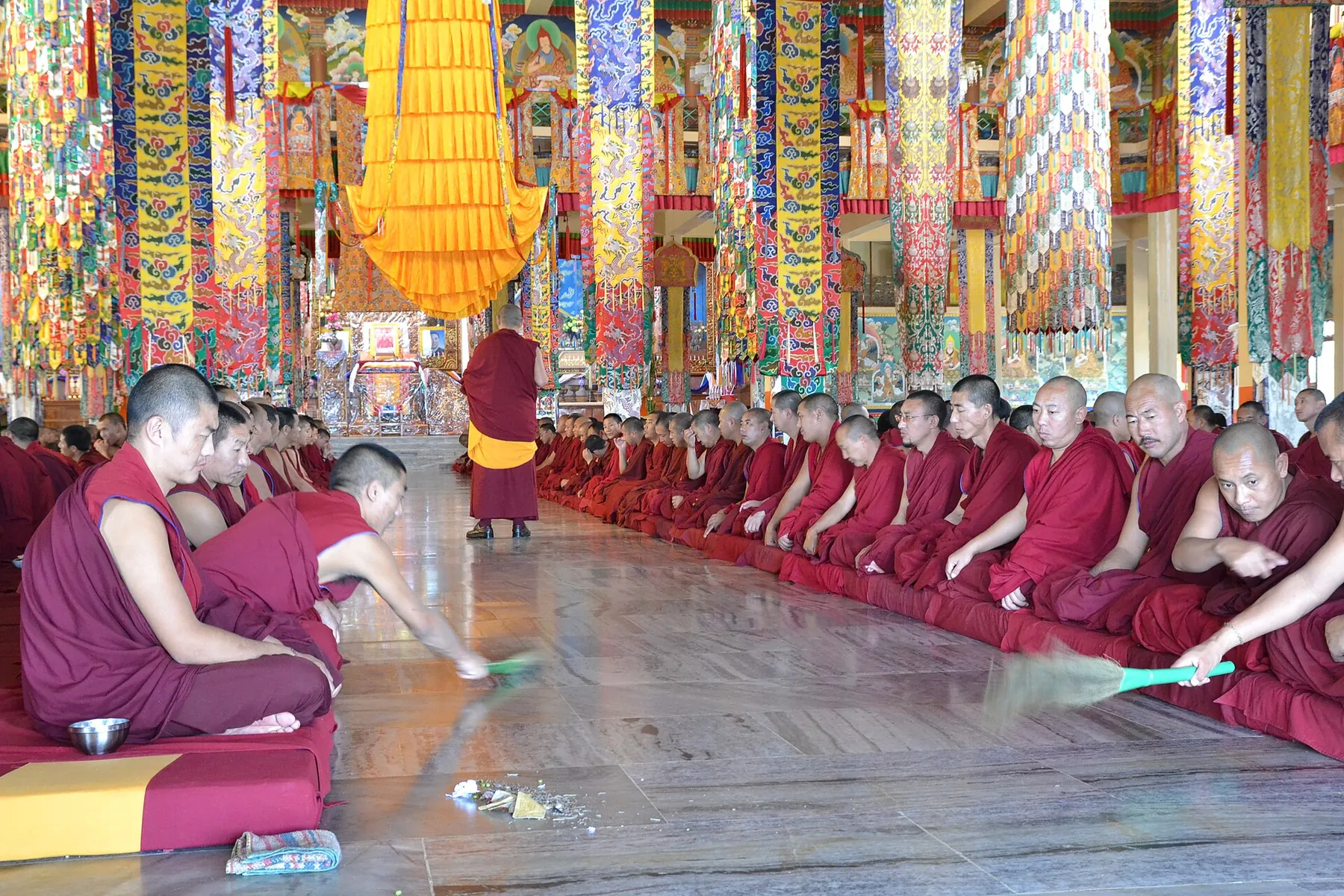
Rows of monks seated on the floor of the assembly hall at Sera Jey during a ceremony

16 · Going to a teaching

Nobody explains the queue

A visiting lama, an hour of prayers you cannot follow, then everybody stands up holding a white scarf and an envelope and forms a line. Here is what all of it is, in order, so that the first time is not spent guessing.

This describes an evening or a day with a visiting teacher at an FPMT centre, which is the kind of event most people meet first. A monastery does things at greater length and an initiation adds a great deal more, but the shape below holds.

One reassurance before the detail. Nothing here is a test. No part of it is withheld from outsiders, and the reason it goes unexplained is not secrecy but familiarity. Everybody in that room learned it by getting it slightly wrong first.

The shape of an evening

Nine things, in this order

01

You arrive, and take your shoes off

Shoes come off at the door of the hall, and there will be a rack or a heap of them to tell you where. Inside, people sit on cushions on the floor facing a raised seat, the throne, which stays empty until the teacher comes in. There are usually chairs at the back for anybody whose knees need them, and using one is not a failure.

Find a cushion, sit down, and wait. Nobody will brief you. This is the part that unsettles newcomers most, and it is not coldness: it is that everybody around you has done it a hundred times and has stopped noticing that it needs explaining.

In practicePhone off, not silent. Feet not pointing at the throne or at the shrine.

02

Everybody stands when the teacher comes in

The room stands as the teacher enters and stays standing until they are seated. Many people make three prostrations towards the throne. Some do a short standing bow instead. If you do nothing at all and simply stand, you will not stand out.

You may see the teacher prostrate first, towards the shrine. A teacher in this tradition is understood to be passing on something received from their own teachers, not producing it, and the gesture says so.

In practiceStand. Bow if you want to. Sit when the room sits.

03

Prayers, in a fixed order, before a word of teaching

This is the part the user of a translation booklet most often loses their place in, because it is longer than expected and it is not improvised. FPMT publishes the order, and states that the sequence follows instructions Lama Zopa Rinpoche gave in 2008:

  1. Praise to Shakyamuni Buddha
  2. Praise to the Perfection of Wisdom
  3. The Heart of the Perfection of Wisdom Sutra, the Heart Sutra
  4. Extensive Dispelling of Hindrances, following the Heart Sutra
  5. Prayer to the Lion-Face Dakini
  6. The Foundation of All Good Qualities
  7. Mandala Offering to Request Teachings
  8. Taking Refuge and Generating Bodhichitta

Not every occasion uses all eight. A short evening talk may use two. A long initiation will use all of them and more.

In practiceFollow in the booklet if there is one. Listening is enough.

04

The teaching is requested, not announced

Step seven above is worth stopping on, because it explains something that looks strange from outside. Before the teacher speaks, somebody offers a mandala: symbolically, the whole universe and everything good in it, made either with a metal mandala set and rice or with a hand gesture.

Its function is a request. In this tradition a teaching is given because it was asked for. That is why the schedule can say a talk begins at seven and the talking begins at twenty past: the asking is not a warm-up act, it is the reason there is anything to attend.

In practiceWatch this one. It is the thing most people misread as delay.

05

The teaching itself

Anything from forty minutes to three hours. If the teacher is Tibetan there will be consecutive translation, which halves the content and doubles the length, and the translator is doing something extremely difficult in public.

Questions, if there are any, usually come at the end and often through a microphone passed round. It is normal for a teacher to answer a question with a story, or to answer a different question from the one asked.

In practiceNotes are fine. Recording usually is not, unless it is announced.

06

Dedication, and a long life prayer

At the end the merit of having listened is dedicated, which in plain terms means the good of the session is deliberately aimed at everybody rather than kept. FPMT's booklet places a long life prayer for the teacher before the dedication prayers, followed by the concluding Lamrim prayer. On many occasions there is also a long life prayer for His Holiness the Dalai Lama.

There may be a second mandala offering here, of thanks rather than request.

In practiceStay seated to the end. Leaving during dedication is the one real gaffe.

07

The line for blessings, with the white scarves

Now the part that is invisible from outside and that nobody explains. People form a queue towards the throne carrying a folded white scarf, the khata, and usually a plain envelope.

FPMT's own instructions set out the order: a lama, a geshe, or somebody representing the centre goes first, offering a mandala together with representations of the holy body, speech and mind, a khata, and a money offering in an envelope. Then everybody else may stand and offer their own.

At the throne you bow your head. The teacher takes the scarf and puts it straight back, around your neck or over your head. This is not a refusal and it is not the scarf being returned as unwanted: it is the blessing coming back with it, and it is what is supposed to happen. In the FPMT text for a festival occasion, the verse recited while touching the head to the throne asks that the teacher live long, that their wishes succeed, and that they guide you until you reach their state.

In practiceBoth hands. Head down. Do not hold on to the scarf.

08

The envelope

Teachings in this tradition are not sold. The centre covers its costs from donations, and the offering to the teacher goes in an envelope, handed over or placed down discreetly with the scarf. This is dana, generosity, the first of the six perfections, and the reason you were not charged at the door.

Two practical things nobody tells you. FPMT's instructions say the sum should be an uneven number, 101 rather than 100, 51 rather than 50. And no amount is checked, announced, or compared. If you have nothing to give, you join the queue anyway.

In practiceEnvelope, not loose notes. An odd number if you can.

09

The red cord

You may be handed a thin cord, usually red, sometimes yellow or five-coloured, with a knot in it. This is a blessing or protection cord, and it is the object visitors most often take home and then have no idea what to do with.

It is string that has been knotted and blessed with mantra recitation. Lama Zopa Rinpoche was direct about what to do with it: “These blessing cords should not just be taken like a custom and put on your altar or in a container. They should be worn; the idea is for them to touch your body.” So: neck or wrist, not a drawer.

The knot is the point of it, so it does not get untied. When it eventually frays through and falls off, that is just what string does. It is not an omen, and nothing about your practice has failed.

In practiceWear it. Do not untie the knot.

Still worried

The questions people are too embarrassed to ask

Do I have to be Buddhist to go?

No, and at most centres a good half of the room on any given night is not. Nobody will ask, and nothing is required of you afterwards.

What do I wear?

Ordinary clothes that cover the shoulders and knees. Nothing special, nothing Tibetan.

Is there a charge?

Usually a suggested donation for the room, and the offering to the teacher is separate and voluntary. Teachings themselves are not sold.

What if I do not want to join the blessing queue?

Then do not. It is not a register and nobody is counting. Sitting quietly while others queue is completely ordinary.

Can I take photographs?

Assume not, unless it has been announced. Somebody will be filming for the centre; that is not the same permission.

I was given a khata. What do I do with it?

Keep it. Many are woven with mantras and auspicious symbols, and FPMT asks that those be treated like other holy objects: kept up high and clean, not on the floor, not used as an ordinary scarf. FPMT suggests plain khatas without Dharma words precisely so this is less of a problem.


Terms used here are defined in the Lexicon, which links from the first mention of each in the text above. If you have not been to a centre at all yet, Start Here is the page before this one, and Find a Centre lists 138 of them.

Sources

References

Everything above that is a matter of fact rather than of manners comes from one of these. The order of prayers and the offering sequence are taken from FPMT’s own published liturgy and practice texts, not from description.

  1. 1
    FPMT Prayers for Teaching OccasionsFPMT Education Services, 2018

    The order of prayers before and after a teaching, arranged according to the instructions of Lama Zopa Rinpoche in 2008, and the rubric placing the long life prayer before the dedications.

  2. 2
    Prayers for Teachings (booklet)FPMT Education Services

    FPMT's own copy of the teaching-occasion prayers.

  3. 3
    How to Do the Great FestivalFPMT, Lama Zopa Rinpoche Practice Series

    The offering sequence: a mandala with representations of holy body, speech and mind, a khata and a money offering in an envelope, made first by a lama, geshe or centre representative and then by everybody else; that the sum should be an uneven number; and the verse recited while taking the blessing.

  4. 4
    Showing Respect to Holy ObjectsFPMT

    How khatas are handled, why one woven with mantras is not put on the table in front of the teacher, and the care of Dharma materials.

  5. 5
    The Benefits of Blessing StringsLama Zopa Rinpoche, Lama Yeshe Wisdom Archive

    That the cords are blessed with many thousands of mantras, and Rinpoche's instruction that they are to be worn against the body rather than kept on a shelf or in a box.

  6. 6
    Centres, projects and servicesFPMT

    The directory of 138 centres in 34 countries, transcribed country by country.

  7. 7
    FPMT 50th anniversaryFPMT

    The founding at the end of 1975, the 1975 tour of nine countries, and the size of the network.

Every factual claim on this page rests on one of the sources above. Links open in a new tab. The full list for the whole site, and the standard this site holds itself to, is on the sources page.