24 · Whose site this is
The name is not a title somebody chose
It is a line of recognised incarnations that begins in Mongolia in 1637, and the seventh of them is a monk at Sera Jey who is about ten years from his degree. These are his pages.
The short version
Darpa Pandita was born on 4 October in Rashaant, a district of Khövsgöl province in northern Mongolia, and recognised in 2013, at eleven, as the seventh Mongolian incarnation of the line whose name he carries. He introduces himself as Darpa Pandita the Seventh, Tenzin Choikye Lodoi Rinpoche.
That is his own spelling. The Mongolian press writes the same name in Cyrillic as Данзанчойжилодой, which is the same three syllables gone through Mongolian, so a reader looking him up in one language will not obviously find him in the other. His own pages carry all three scripts at once, which is the tidiest summary of where this line has lived:
འདར་པ་པཎྜི་ཏའི་རིན་པོ་ཆེ།
Дарба Бандида гэгээнтэн · Darpa Pandita Rinpoche. The Tibetan is copied out of his own page rather than transcribed, for reasons this site has written about.
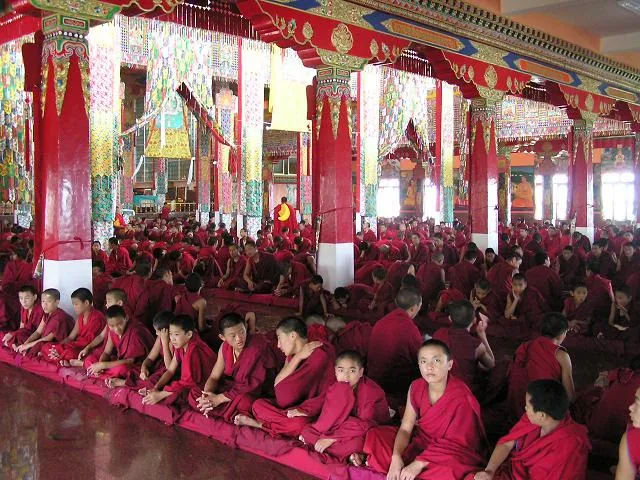
He came to Sera Jey Monastic University at Bylakuppe at about ten years old and has been here ever since. He is reading for the Geshe Lharampa degree, the long one, and by his own estimate is about ten years from it. He is also, at home, the head of Buddhism of Khövsgöl aimag, a province roughly the size of Ireland.
Asked by a Mongolian paper what went through his head when he was told who he was, he said: “I thought, surely not.” Then he laughed. It was sudden news.
The monastery he studies at → · What a day there looks like → · What a Geshe degree costs →
What the name means
Eighteen times, seven of them in Mongolia
In Tibetan the name is written dar pa pan+di ta. In Mongolian it is Дарба бандида, and the press spells it three or four different ways. Bandida is simply the Mongolian form of the Sanskrit paṇḍita, a scholar, so the name means something closer to a description than to a rank.
The line is held to be an emanation of one of the sixteen arhats, the direct disciples of the Buddha who were asked to remain in the world. It has been identified eighteen times. Eleven of those were in India and Tibet. The seven since have all been born in Mongolia, and it was the first of those who was given the title Darva Bandid Gegeen.
A word about what recognition is not. It is not a claim to authority over anyone, and it is not a qualification. It does not shorten the curriculum by a single year. The seventh incarnation is sitting the same examinations, in the same courtyard, as every other monk on this hill, and that is the point of the system rather than an exception to it. Titles and ranks sets out what the words mean, and claims to be careful of covers what happens when somebody treats a recognition as a credential.
Photographs
What photographs there are
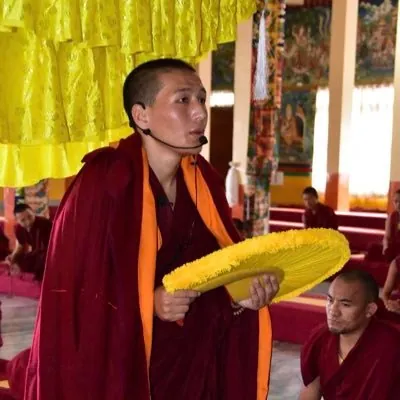
Credits for every photograph on this site are in sources and image credits.
Who says so
Twenty in Mongolia, and more than two hundred who say it themselves
Recognitions were forbidden in Mongolia in 1928 and none were made through the whole communist period. They resumed after 1990. The procedure now is that Gandantegchinlen and the administration of the province take part, and the Dalai Lama confirms it.
In June 2022 News.MN published the list of everyone in Mongolia holding that confirmation from His Holiness the Fourteenth Dalai Lama and the Ninth Bogd Jebtsundamba Khutugtu. There are twenty. Thirteenth on it: Дарба Бандида хувилгаан Данзанчойжилодой.
The same article gives the number that makes the first one mean something. Alongside those twenty, it reports, more than two hundred people in Mongolia style themselves as incarnations with no confirmation of any kind. A list of twenty is not a boast. It is the short list, and the reason to publish it is that the long one exists.
Most of the modern Mongolian khutagts are studying in India, at Gomang, at Sera Jey or at Dharamsala. His own household in Mongolia, in the usual Tibetan arrangement for a recognised lama, is called Darpa Pandita Labrang.
The part that is not a coincidence
The first one went to Sera too
Sodovjamts was born in 1637. At seventeen he left for Tibet, and he studied at Sera, which had been standing then for a little over two hundred years. After fifteen years he took the Lharampa degree. He was made gesgüi of Sera Thekchenling, the officer who keeps the discipline of the whole college, and afterwards abbot of Gandandarjailin in Tibet. The Dalai Lama gave him the title Darba Bandid Chorji.
He stayed twenty-three years. In 1678 he went home to Mongolia and immediately began building, and what he built became Rashaant khüree, a monastery that would run for two hundred and fifty years and hold close to a thousand monks. Eight years later he sat at the great assembly of the Khalkha and the Oirat at Khürenbelchir, next to Öndör Gegeen Zanabazar.
Three hundred and fifty years later the seventh incarnation is at Sera, reading for the same degree, and says he will go home when he has it. Nobody arranged that. It is what the line does.
Three hundred and eighty years
From a scripture house to a field of foundations and back
The line begins in Mongolia
Sodovjamts is born in the banner of Sharz Dayan Khun Taij, to a lay practitioner named Zanyn. He is the first of the line to be born in Mongolia. Eleven earlier incarnations are counted in India and Tibet.
He goes to Sera at seventeen
The same journey his seventh incarnation would make three and a half centuries later. Fifteen years of it bring him the Lharampa degree; then he is made gesgüi of Sera Thekchenling, the officer who keeps the discipline of the college, and afterwards abbot of Gandandarjailin. The Dalai Lama gives him the title Darba Bandid Chorji.
Home after twenty-three years, and a monastery
He returns to Mongolia and immediately builds a scripture house on the land that becomes Rashaant khüree. In 1686 he sits at the great Khalkha and Oirat assembly at Khürenbelchir alongside Öndör Gegeen Zanabazar.
The monastery finds its place
After two moves it settles at the foot of Bulgan mountain, where the eight auspicious signs are complete, and stays there almost a hundred and twenty years.
Thirteen halls, seven colleges, a thousand monks
A tantric college in 1880, two more in 1902, a medical school in 1913. The monastery is ordered on the model of Tashilhunpo and founds branch monasteries of its own.
Burned
Rashaant is the starting point of the lamas’ rising in the four western aimags, so it is closed early. By the end of the year the monks have been rounded up and the monastery is burned to the ground. About fourteen college foundations can still be traced in the grass.
The seventh is recognised
A boy of eleven from Rashaant sum, the same district. Asked later what he felt when he was told, he said: “I thought, surely not.” It was sudden news.
Home for three months
He comes back from India in January and is met at the airport by monks of Gandantegchinlen and of Gandandarjailin in Mörön, by the aimag administration and by lay people from the district. He stays until April, then returns to Bylakuppe.
Still reading
About ten more years to the Lharampa degree, by his own estimate, and then home. The first one took fifteen.
Rashaant khüree
The monastery he is the seventh of, which is not there
Its religious name was Dashdarjaalin, in Tibetan bkra shis dar rgyas gling, the flourishing of good fortune. It stood north of what is now Rashaant sum centre, on the slope of Bulgan mountain, at 49°07′N 101°25′E. It is number 132 in Rinchen’s catalogue of the monasteries of Mongolia.
At its height it had thirteen halls, seven colleges, eight temples and stupas, and nearly a thousand monks living there permanently. Its protector was the red one, Jamsran. It held a Kangyur given by the Bogd, the sutras the first two incarnations had translated, Zava Damdin’s history of Mongolia, a Tibetan and Mongolian dictionary, figures cast by Zanabazar himself, decades of cham masks, and a lion throne that a Dalai Lama had sat on.
In 1932 it was the centre of the lamas’ rising in the four western aimags. It was closed before most, the monks were arrested, and the buildings were burned. Everything in the paragraph above went with them. What is left is the outline of about fourteen colleges in the ground, and one new hall, Dashdarjaalin, built on the foundations of the old tantric college.
Mongolia lost something in the order of eight hundred monasteries in those years. Buddhist countries has the wider account of what was destroyed where, and what has come back.
The seven
The Mongolian incarnations
| # | Name | Dates | |
|---|---|---|---|
| First | Содовжамц Sodovjamts | 1637–1702 | Went to Tibet at seventeen, studied at Sera for fifteen years, took the Lharampa degree, served as gesgüi of Sera Thekchenling and then as abbot of Gandandarjailin. Came home in 1678 and founded the monastery. |
| Second | Гунгаажамц Gungaajamts | 1737–1810 | With the first, the translator of the Sungdui and the Jadamba into Mongolian. Copies were kept at the monastery until 1932. |
| Third | — | Not recorded in the survey this page draws on. The gap is left as a gap. | |
| Fourth | Лувсантүвдэнванчог Luvsantüvdenvanchog | 1809–1852 | |
| Fifth | Хайдавсамданжамж Khaidavsamdanjamj | 1854–1870 | In 1864 the monastery’s main temple was granted a name by the Manchu emperor. |
| Sixth | Агваанчойнжордондов Agvaanchoinjordondov | 1870–1927 | Born to a poor family. Took the gavj examination at Ikh Khüree in 1905 with the Thirteenth Dalai Lama present. Opened three colleges and a medical school. Invited into the new Institute of Scriptures in 1923, said he was too old to travel, and wrote them a book instead. |
| Seventh | Данзанчойжилодой Tenzin Choikye Lodoi | born 4 October, recognised 2013 | Recognised at eleven. At Sera Jey since about 2012, reading for the Geshe Lharampa degree, and head of Buddhism of Khövsgöl aimag. He writes this site. |
Dates as recorded in the Documentation of Mongolian Monasteries survey of Rashaant khüree. The third incarnation is missing from that source and is left missing here rather than filled in from somewhere less careful.
Elsewhere
His own two pages
The Facebook page is the one people actually read: about 8,218 followers in September 2026, listed under Mysore, and written for a Mongolian audience. The X account has been open since May 2015 and is much quieter, about ninety followers: short quotations, a line on karma or on what a teacher is actually for, a new year greeting. Facebook shows the posts only to a reader who is logged in, so nothing from either page is reproduced here.
facebook.com/DarpaPandita · x.com/DarpaPandita
This site is not either of those. It is not a personal feed and it does not publish his schedule or his teachings. If you want to hear from him, the two links above are the places, and they are the only ones: this site does not publish a private address or telephone number for him. Anything official, from examination dates to donations to permission to visit Bylakuppe, goes to Sera Jey directly, and the monastery’s own address, telephone and email are on Visit.
Why the site exists
Written at a teacher’s asking
This site was not a personal project that grew. It was asked for by his teacher, which is why it is about the tradition rather than about him, and why the page you are reading is the twenty-fourth rather than the first.
What is on it is what a monk at Sera Jey can usefully tell somebody who is not one: what the school teaches, what the words mean, what is actually recited and when, what happens in a temple so you are not lost in it, where the tradition survived and where it was destroyed, and how to find a teacher who is real. Every page carries its sources at the bottom, and all of them are listed in one place.
One thing is missing from this page, and it is the important one. Everything above is drawn from Mongolian records and the Mongolian press, which is to say from other people writing about him. His own account of any of it, in his own words, is not here yet. When he writes it, it goes at the top and the rest of this page moves down where it belongs.
Sources
References
The Mongolian material comes from the Documentation of Mongolian Monasteries, a survey compiled from published monastic histories and oral history interviews recorded in the districts themselves, and from two 2022 reports in the Mongolian press, one of them an interview with him. Alexander Berzin supplies the sixth incarnation from the English-language side. Dates given in the Tibetan and Mongolian calendars have been left as the sources give them.
- 1Darpa Pandita (@DarpaPandita)X
His own account: the title he uses for himself, “Darpa Pandita the 7th TenzinChoikye Lodoi Rinpoche”, the 4 October birthday, Mongolia as his location, and the link to his Facebook page. Open since May 2015.
- 2Дарба Бандида гэгээнтэн (Darpa Pandita Rinpoche)Facebook
His own page, and the larger of his two: about 8,200 followers in September 2026, listed under Mysore. It supplies his name in Tibetan, which is copied from it programmatically rather than transcribed, the Cyrillic form of the lineage name, and his own description of himself as “Darpa Pandita the 7th Tenzin Choikye Lodoe Rinpoche”. Facebook serves the posts only to a reader who is logged in, so nothing from the page body is used here.
- 3Монгол Далай ламын батламжтай 20 хутагт хувилгаантай (Mongolia has twenty recognised incarnations holding the Dalai Lama’s confirmation)A. Tseesüren, News.MN, 14 June 2022
How a recognition is confirmed in Mongolia: Gandantegchinlen and the local administration take part, and the Dalai Lama confirms it. The list of the twenty who hold that confirmation, with Darba Bandida khuvilgaan Danzanchoijilodoi thirteenth on it. That no recognitions were made between 1928 and 1990. That modern Mongolian incarnations study at Gomang, Sera Jey and Dharamsala. And that more than two hundred people are reported to style themselves incarnations without any of this.
- 4Rashaant khüree (Bandida Gegeenii khüree, Darbabandida khiid), record 884Documentation of Mongolian Monasteries, Arts Council of Mongolia
The Tibetan name of the line, dar pa pan+di ta; the founding of the monastery in 1678 and its three sites; the first incarnation’s fifteen years at Sera, his Lharampa degree, his post as gesgüi of Sera Thekchenling and the title given him by the Dalai Lama; the dates of the Mongolian incarnations; the colleges, the thousand monks and the Jamsran protector; the sixth incarnation and Tseveen Jamsrano’s invitation of 1923; and the burning of the monastery in 1932. Compiled from Banzragch and Sainkhüü (2004), Chuluunbaatar (2004), Yeröölsüren (2005), the Khövsgöl aimag reference dictionary (2003) and an oral history interview recorded at Rashaant in 2007.
- 5ДАРБА БАНДИДА гэгээнтэн өнөөдөр эх орондоо ирлээ (Darba Bandida returns home today)toim.mn, 23 January 2022
The seventh incarnation’s personal name, his birth in Rashaant sum in Khövsgöl, that he studies at Sera Jey in India, that he is the head of Buddhism of Khövsgöl aimag, and the programme of his visit home in early 2022.
- 6Дарва Бандида гэгээнтэн (interview)toim.mn, 15 February 2022
That the line has been identified eighteen times, seven of them in Mongolia; that the seventh was recognised in 2013 at the age of eleven; and his own words: ten years at Sera Jey by 2022, about ten more to come, the Lharampa degree, and what he thought when he was told.
- 7Use of the Shambhala Legend for Control of MongoliaAlexander Berzin, Study Buddhism
The sixth incarnation from the other side, in English: that the early Mongolian communist regime tolerated Buddhism because monastic leaders such as Darva Bandida argued for a return to early Buddhist simplicity, and that the Buryat scholar Jamsrano supported him.
- 8About UsSera Jey Monastic University
The founding by Jetsun Kunkhen Lodrö Rinchen Senge, the two administrations, the Geshe Lharampa degree, the 75th abbot, and the affiliated centres abroad.
- 9The Gelug Monastic Education SystemStudy Buddhism
The five great treatises, the sequence of study, and the structure of the Geshe degree.
Every factual claim on this page rests on one of the sources above. Links open in a new tab. The full list for the whole site, and the standard this site holds itself to, is on the sources page.