04 · Monastic Life
The day, and
the year
A Geluk education is a long argument conducted on a strict timetable. This is how the hours and the seasons are arranged. The twenty years are set out elsewhere, by somebody who has finished them.
The day
Beginning before light
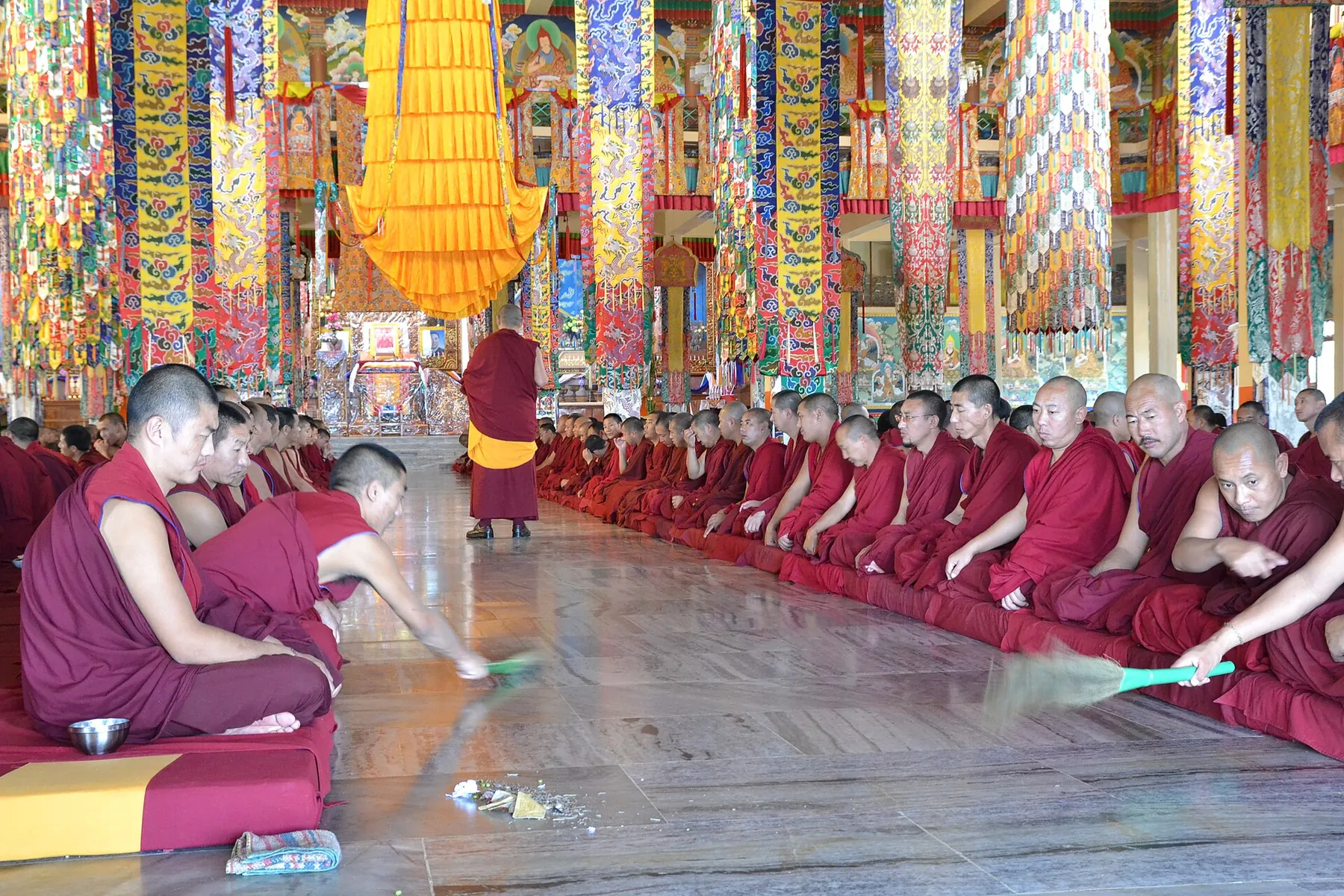
The shape of a monk's day has not changed much in six hundred years, though the bell has been joined by an alarm clock. Times shift with the season and with each khangtsen's own schedule; what follows is the common pattern.
- Before dawn
- Rising, washing, and memorisation: root texts are learned by heart aloud, which is why the grounds hum before sunrise.
- Early morning
- The assembly gathers in the great hall for the morning puja: chanted liturgy, offerings, tea and tsampa served down the rows by young monks.
- Mid-morning
- Class with the gegen (the teacher): line-by-line reading of the day's passage from the college's yigcha.
- Midday
- The main meal, then private study: rereading, note-making, preparing the arguments to be used that afternoon.
- Afternoon
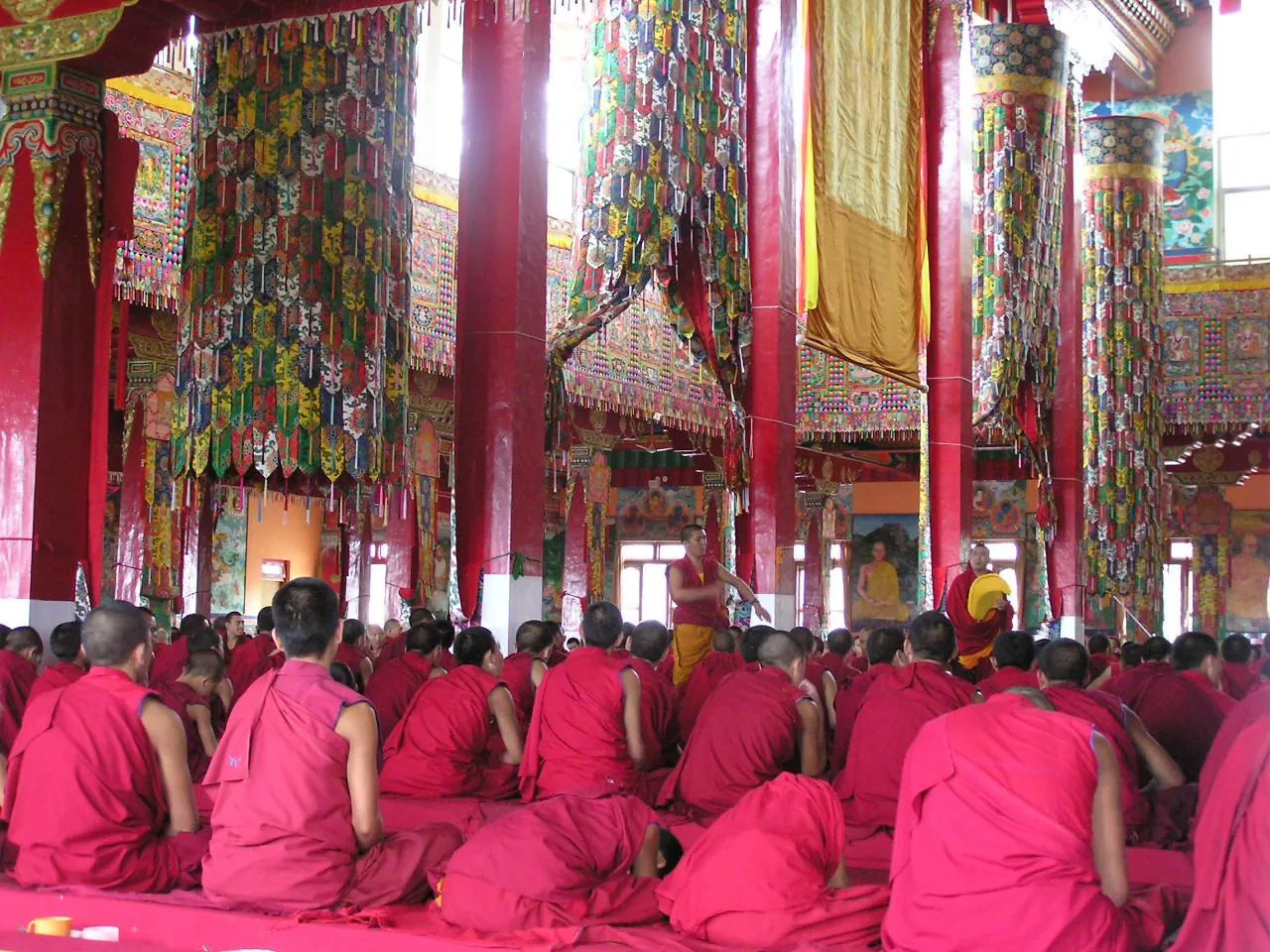
- Debate in the courtyard, in pairs and in circles, for hours. The loudest part of the day by a wide margin.
- Evening
- A second debate session, often continuing after dark, then recitation and sleep. Senior monks may debate past midnight in the weeks before examinations.
The curriculum, the courtyard and the degree
Written by somebody who has finished them
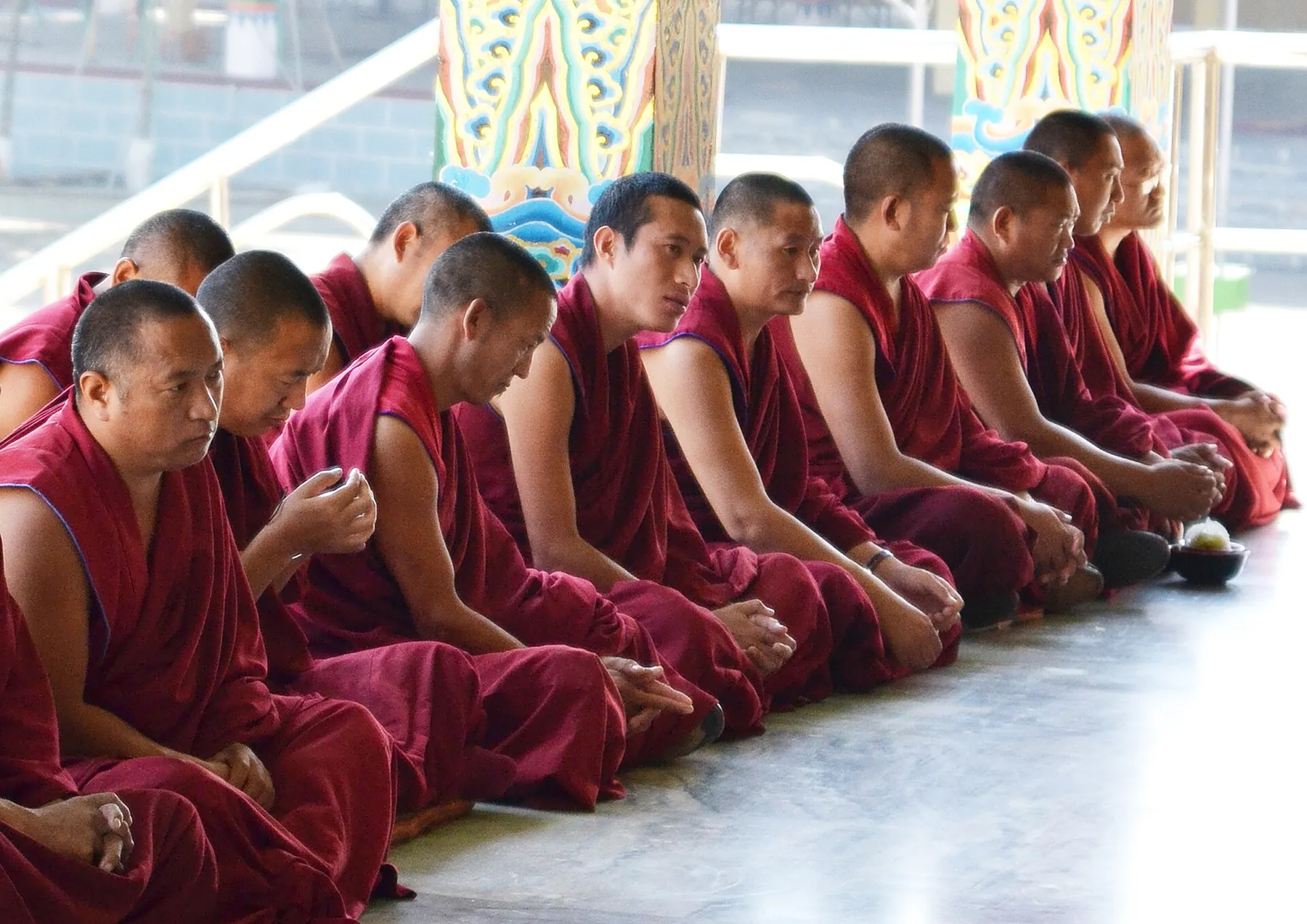
The classical course is five Indian treatises, circled for years each and defended aloud in the debate courtyard, and it ends in a Geshe degree examined in public. That account used to sit on this page, written by a monk about ten years short of the degree. It now belongs to Venerable Geshe Dashnyam Byambatseren, a Mongolian monk of this monastery and personal secretary to the Darpa Pandita, who completed the five treatises between 2003 and 2021 and defends his degree here before more than four thousand monks in October 2026. Same facts, and the authority of somebody who spent twenty-five years on them.
The five treatises, the courtyard and the degree
What stays here is the part this page is actually for: the shape of an ordinary day, and the year the monastery keeps.
Alongside the classical course
Modern subjects, and a recognised degree
Sera Jey's school teaches more than 550 pupils in English, mathematics, science, computing and Tibetan language, a monk may be memorising Dharmakīrti in the morning and sitting a physics class in the afternoon. Since 2022 the monastery's BA (Hons) programme has been affiliated to the University of Mysore in Ancient Tibetan Language, Ancient Philosophy and Ancient Psychology, the first such affiliation granted to a Tibetan monastic institution in India.
The reasoning is His Holiness the Dalai Lama's own: that the Nālandā tradition Tibet inherited was an investigative one, and that it has nothing to fear from, and much to say to, modern science.
The year
Festivals and observances
The monastic year follows the Tibetan lunar calendar, so dates move against the Gregorian one. These are the days that empty the classrooms and fill the courtyard.
- Losar
- Tibetan New Year, in February or March. Days of ritual, new robes, guthuk soup, and the whole settlement visiting each other.
- Monlam Chenmo
- The Great Prayer Festival, immediately after Losar, instituted by Tsongkhapa in 1409 and the largest prayer gathering of the Geluk year.
- Chotrul Düchen
- The Day of Miracles, closing Monlam on the full moon of the first Tibetan month.
- Saka Dawa
- The full moon of the fourth month, marking the Buddha's birth, awakening and parinirvāṇa together. The most meritorious day of the year.
- Chökhor Düchen
- The first turning of the wheel of Dharma at Sarnath, in the sixth month.
- Lhabab Düchen
- The Buddha's descent from the Heaven of the Thirty-Three, in the ninth month.
- Ganden Ngamchö
- The anniversary of Je Tsongkhapa's passing, on the 25th day of the tenth month, butter lamps on every roof and windowsill in the settlement.
- Jang Gönchö
- The winter inter-monastic debate session, drawing students from the great Geluk seats for weeks of continuous debate.
- Examinations
- Annual recitation examinations, supplementary examinations and the Rigchung minor debate ceremonies punctuate the academic year.
Dates shift each year. For the current calendar, check the monastery's own announcements at serajeymonastery.org before planning a visit around a festival.
Next
Words you will hear, explained
Yigcha, khangtsen, geshe, tsöpa, lamrim, śūnyatā. The Lexicon is a working dictionary of the vocabulary this tradition actually uses.
Sources
References
The timetable, the modern school and the university affiliation as described by the monastery itself rather than by observers.
- 1The Gelug Monastic Education SystemStudy Buddhism
The five great treatises, the sequence of study, and the structure of the Geshe degree.
- 2About UsSera Jey Monastic University
The founding by Jetsun Kunkhen Lodrö Rinchen Senge, the two administrations, the Geshe Lharampa degree, the 75th abbot, and the affiliated centres abroad.
- 3Sera Jey Monastery in India to offer BA Honours degreesTibetan Review
The BA (Hons) programme launched on 21 October 2022 in Ancient Tibetan Language, Ancient Philosophy and Ancient Psychology, and the secondary school's 550 pupils.
- 4About UsSera Jey Foundation
Current enrolment of more than 4,800 monk-students, and the 2022 University of Mysore affiliation.
Every factual claim on this page rests on one of the sources above. Links open in a new tab. The full list for the whole site, and the standard this site holds itself to, is on the sources page.