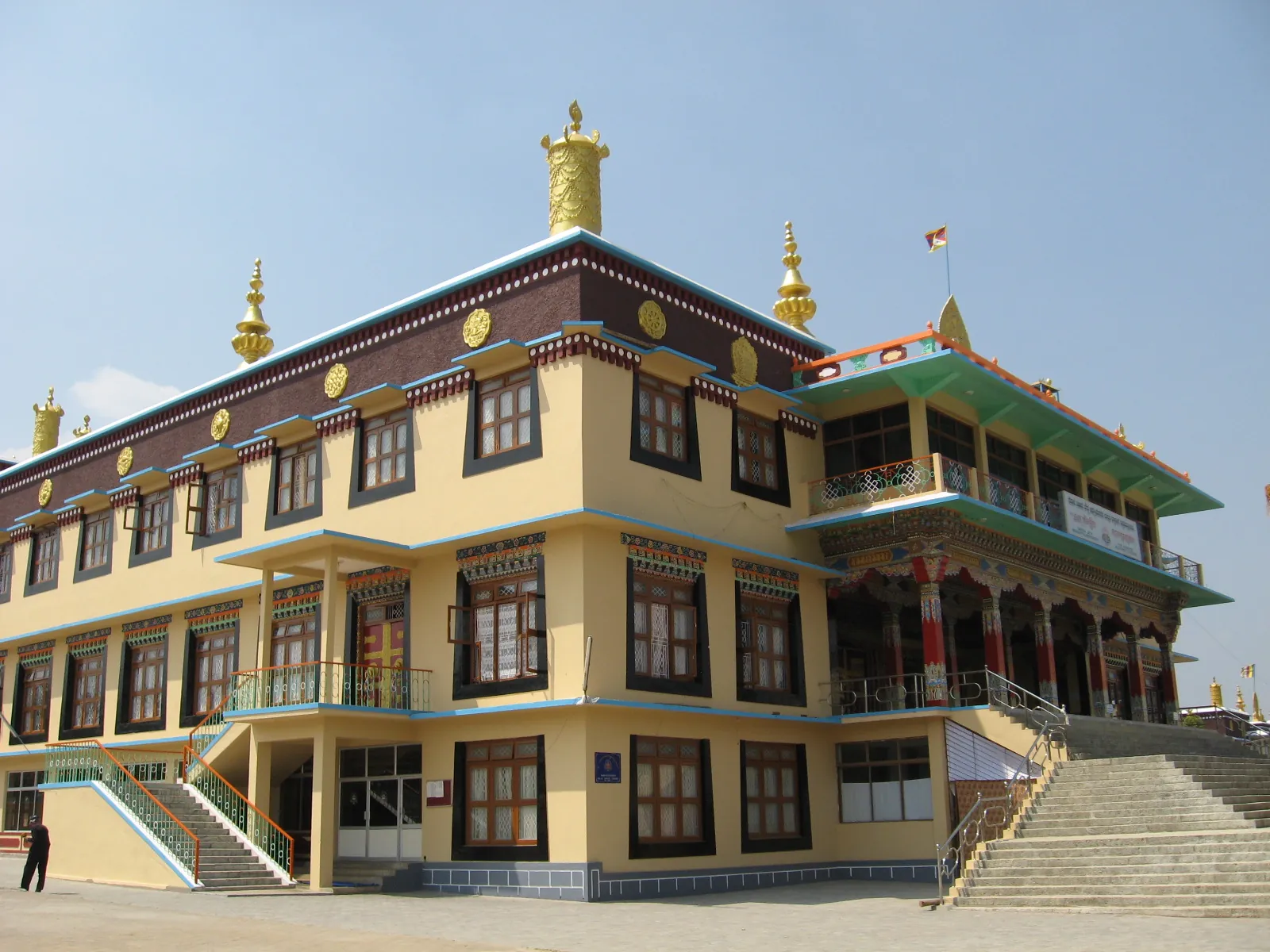
03 · The Monastery
Sera Thekchenling
A great seat of the Geluk order, the tradition of Je Tsongkhapa and of His Holiness the Fourteenth Dalai Lama, founded outside Lhasa in 1419 and rebuilt, from nothing, in southern India.
Origins
Founded in the last year of Tsongkhapa's life
Sera Thekchenling (“Sera, the Great Vehicle Park”) was established on the slopes north of Lhasa in 1419 by Jamchen Chöje Shakya Yeshe, a close disciple of Je Tsongkhapa (1357–1419), the founder of the Geluk order. With Ganden and Drepung it formed the three great seats, the institutions that would define Tibetan scholastic education for five hundred years.
Sera was never a single school. It divided into philosophical colleges, and the largest of them, Sera Jey, was founded in the same early-fifteenth-century period by Jetsun Kunkhen Lodrö Rinchen Senge, another disciple of Tsongkhapa, who served as its first abbot. Its companion college, Sera Mey, developed alongside it; a third, the tantric college of Ngagpa, completed the monastery.
What separates one Geluk college from another is not doctrine but the yigcha, the textbook tradition, the particular set of commentaries a college reads and defends. Sera Jey's yigcha were composed by Jetsun Chökyi Gyaltsen, and monks at Bylakuppe still debate from them today. A student arriving now is entering an argument that has been running, continuously, for five centuries.
Which tradition is this?
Sera Jey belongs to the Geluk (dGe-lugs) school of Tibetan Buddhism, founded by Je Tsongkhapa and headed spiritually by His Holiness the Dalai Lama. Everything described on this site (the curriculum, the debate form, the degrees, the festivals) is Geluk practice as it is carried on at Sera Jey.
Chronology
Six centuries, two countries
Sera Thekchenling founded near Lhasa
Established by Jamchen Chöje Shakya Yeshe in the year of Tsongkhapa's death. Sera Jey college is founded in the same period by Jetsun Kunkhen Lodrö Rinchen Senge, its first abbot.
The yigcha are written
Jetsun Chökyi Gyaltsen composes the textbook tradition that becomes the entire scriptural syllabus of Sera Jey, still the basis of study at Bylakuppe.
Growth to thousands
Before 1959 the monastery housed several thousand monks and drew students from across the Tibetan plateau, Mongolia and the Himalayan borderlands.
Destruction and exile
Following the uprising in Lhasa, the monastery is assaulted and largely destroyed. Surviving monks follow His Holiness the Dalai Lama into exile in India. For a decade they live in transit camps in the north while a permanent site is sought.
Re-establishment at Bylakuppe
197 Sera Jey monks and 103 from Sera Mey are resettled at Bylakuppe in Mysuru district, Karnataka. The two monasteries receive 225 acres of forestland, three-quarters of an acre per monk, of which Sera Jey's share is 147¾ acres. The Government of India sponsors 38 one-room tiled houses for the 300 monks. The monks clear the forest, lay the bricks and farm the land themselves, living for years on the annual harvest.
The first assembly hall
Construction begins in 1976 and is completed in 1978; the hall, seating 1,500, is inaugurated in 1979, the first permanent prayer hall of the exiled monastery.
The health care committee
The Sera Jhe Health Care Committee is founded under the guidance of His Holiness the Dalai Lama, and begins providing Tibetan and Western medicine, tuberculosis care and community health work to the monastery and the wider settlement.
The great assembly hall
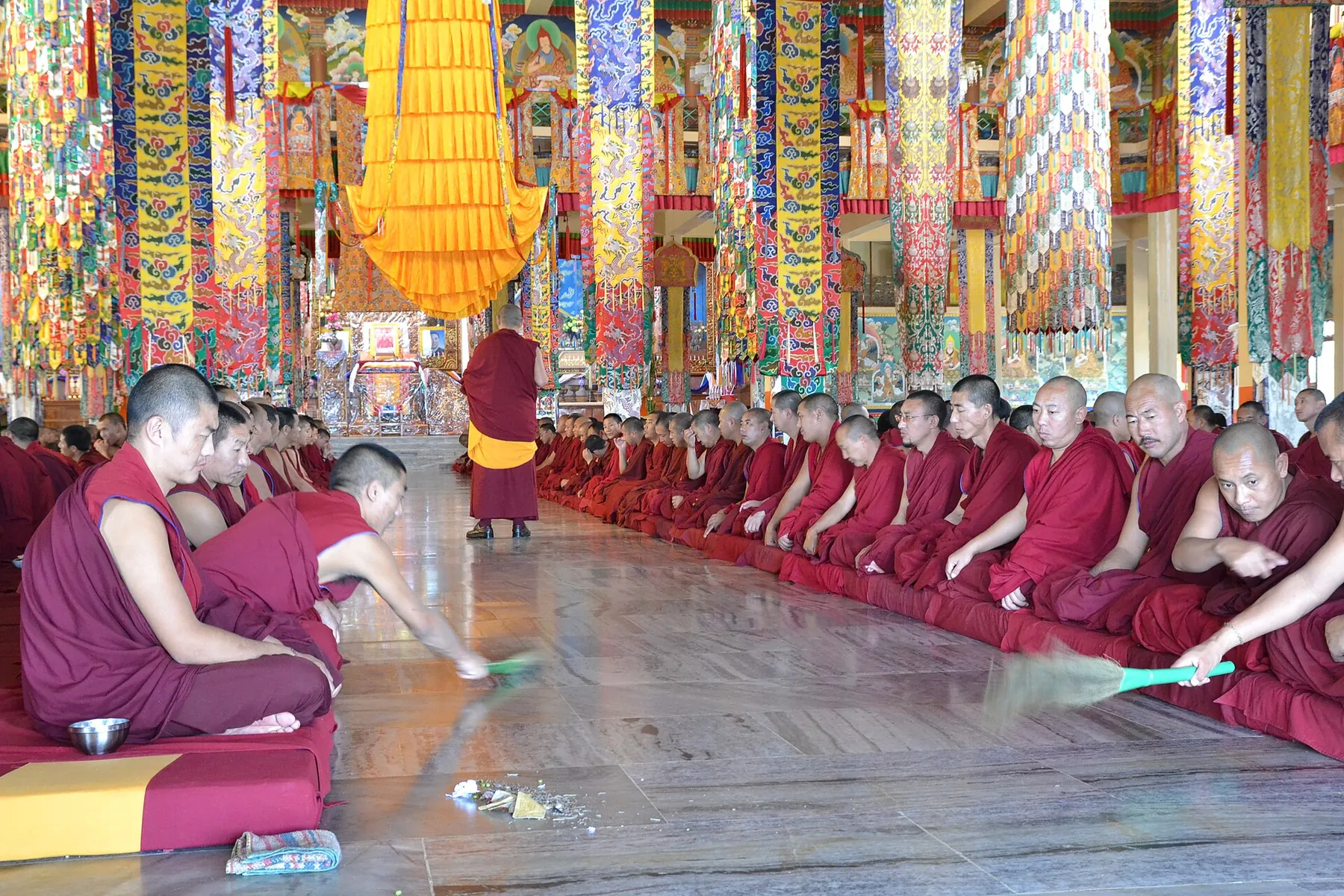
Proposed in 1995 and built over three years as the monastic population passes 3,000. It measures 23,275 square feet, stands 31 feet high on 110 pillars, and seats an assembly of 3,500. His Holiness the Dalai Lama inaugurates it on 31 December 1997.
The 75th abbot
Jetsun Gedun Choephel is enthroned as abbot (khenpo) of Sera Jey, continuing an unbroken line of abbatial succession from the monastery's founder.
A recognised university degree
On 21 October the monastery's BA (Hons) programme is affiliated to the University of Mysore in Ancient Tibetan Language, Ancient Philosophy and Ancient Psychology, making Sera Jey the first Tibetan monastic institution in India to be affiliated to an Indian university.
More than 4,800 monk-students
Drawn from the Tibetan settlements of India and Nepal, the Himalayan regions of Ladakh, Spiti, Sikkim, Arunachal Pradesh, Bhutan and Mongolia, and from outside Asia entirely.
How it is organised
A monastery is a federation, not a building
Sera Jey runs on two parallel administrations and dozens of smaller households. Knowing the structure explains almost everything a visitor sees.
- Khenpo
- The abbot, the spiritual head of the monastery, appointed in a line of succession reaching back to Lodrö Rinchen Senge. Sera Jey enthroned its 75th in 2016.
- Spiritual administration
- Oversees the curriculum, examinations, the ritual calendar and the discipline of the assembly.
- General administration
- Handles finance, construction, the kitchen and food committee, sponsorship and the monastery's external affairs.
- Khangtsen
- Regional houses. Every monk belongs to one, usually determined by where he comes from; the khangtsen feeds him, houses him and stands behind him. They are the monastery's social bones.
- Dratsang
- The college itself, Sera Jey is a dratsang, a philosophical college of the larger Sera monastery, alongside Sera Mey and the tantric college.
- Institutions
- A secondary school with more than 550 students, a health care committee and clinic, a food committee, a library and archive, and a home for elderly monks.
- Branches abroad
- Affiliated dharma centres in New York, California, Minnesota, Toronto, Basel, Taipei, Singapore and Bangalore.
The buildings
What stands on the ground today
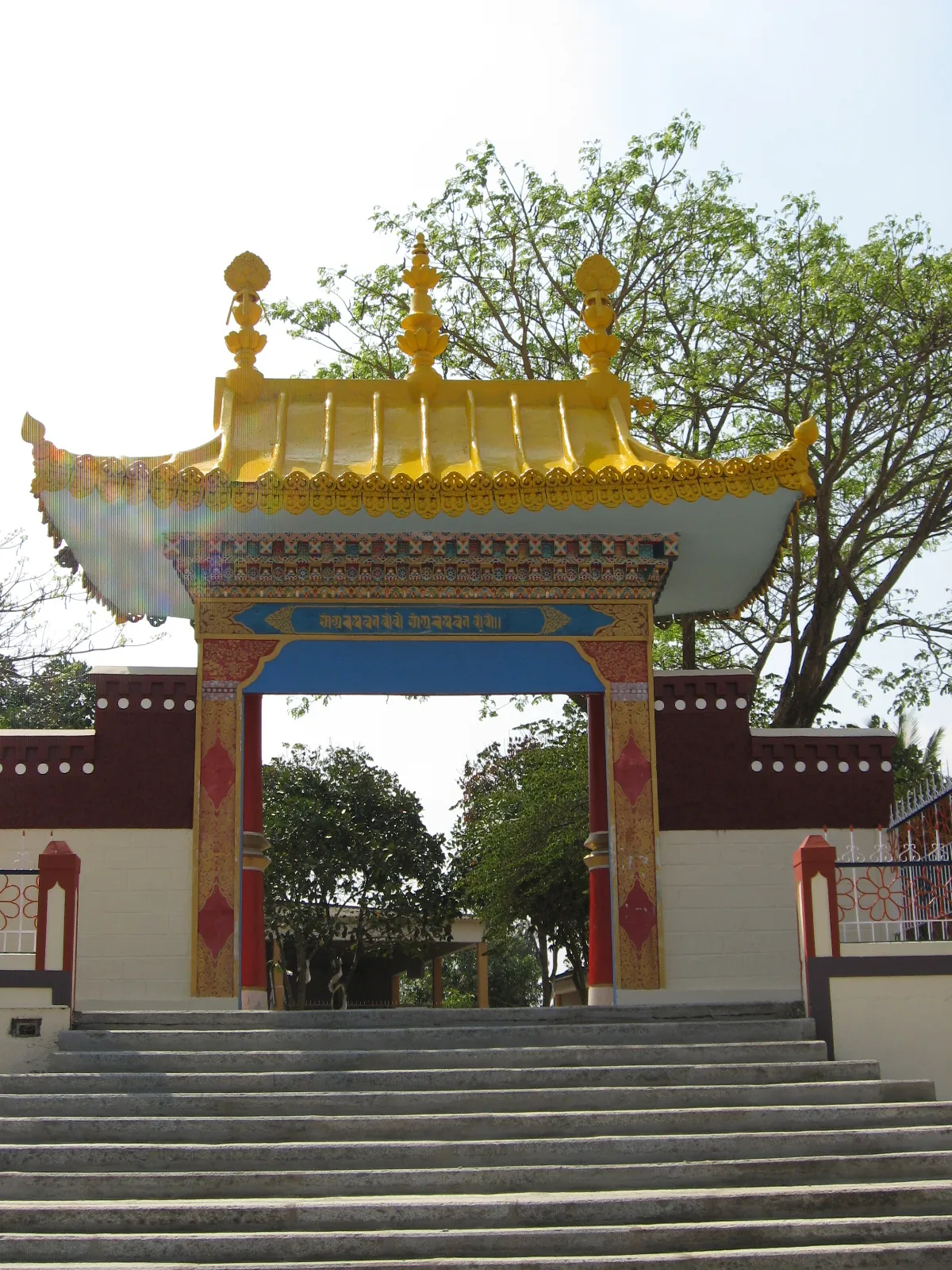
The ceremonial gate opens onto a paved assembly courtyard where the whole monastery gathers for major pujas. Behind it rises the great assembly hall of 1997, its roof carrying the gilded ganjira and the dharma wheel flanked by deer. Around them stand the khangtsen residences, the debate courtyard with its covered colonnade, the school, the clinic, the kitchen, the library, and the long low blocks of monks' quarters.
Almost none of it was built by contractors. The first generation of monks quarried, carried and laid most of what they could, and the buildings that followed were funded by decades of small sponsorships from Tibetan families and foreign donors. The monastery reads, architecturally, as exactly what it is: a Tibetan institution translated into Karnataka brick, laterite and tile.
Continue
The structure is only half the story
The other half is the day, the hours before dawn, the five great treatises, and the twenty years between a boy's ordination and a geshe's examination.
Sources
References
Every date and figure in the chronology above comes from one of these. Where the monastery publishes its own history, that is the source used.
- 1About UsSera Jey Monastic University
The founding by Jetsun Kunkhen Lodrö Rinchen Senge, the two administrations, the Geshe Lharampa degree, the 75th abbot, and the affiliated centres abroad.
- 2Re-establishment at BylakuppeSera Jey Monastic University
The 1970 move: 197 Sera Jey and 103 Sera Mey monks, 225 acres at three quarters of an acre per monk, 147¾ acres to Sera Jey, 38 tiled houses, and the first assembly hall of 1976 to 1979.
- 3New Assembly Prayer HallSera Jey Monastic University
The 1997 hall: proposed 1995, 23,275 square feet, 31 feet high, 110 pillars, an assembly of 3,500, inaugurated by His Holiness the Dalai Lama on 31 December 1997.
- 4About UsSera Jey Foundation
Current enrolment of more than 4,800 monk-students, and the 2022 University of Mysore affiliation.
- 5Sera Jhe Health Care CommitteeSera Jhe Health Care
The health care committee founded in 1989 under the guidance of His Holiness the Dalai Lama, and its services to the monastery and the settlement.
- 6Sera Jey Monastery in India to offer BA Honours degreesTibetan Review
The BA (Hons) programme launched on 21 October 2022 in Ancient Tibetan Language, Ancient Philosophy and Ancient Psychology, and the secondary school's 550 pupils.
- 7ContactSera Jey Monastic University
The postal address, telephone number, travel distances from Bengaluru, and the list of international branch centres.
- 8
- 9BylakuppeWikipedia
The 1960 land grant of nearly 3,000 acres, Lugsung Samdupling founded in 1961, Dickyi Larsoe in 1969, and the settlement's population.
- 10Doeguling Tibetan Settlement, MundgodCentral Tibetan Relief Committee
The settlement founded in 1966, its population of over fifteen thousand, and its institutions.
Every factual claim on this page rests on one of the sources above. Links open in a new tab. The full list for the whole site, and the standard this site holds itself to, is on the sources page.