Questions
14 questions, answered properly
Not the obvious ones. These are questions people actually ask online about this tradition and about monastic life, including several that get answered badly almost everywhere. Sources under each.
How this page works
Short answers, because that is what a question deserves. Where a subject is worth more than three paragraphs it goes to The Courtyard instead, and this page links across. If a question you have is not here, it probably should be.
Things people notice and wonder about
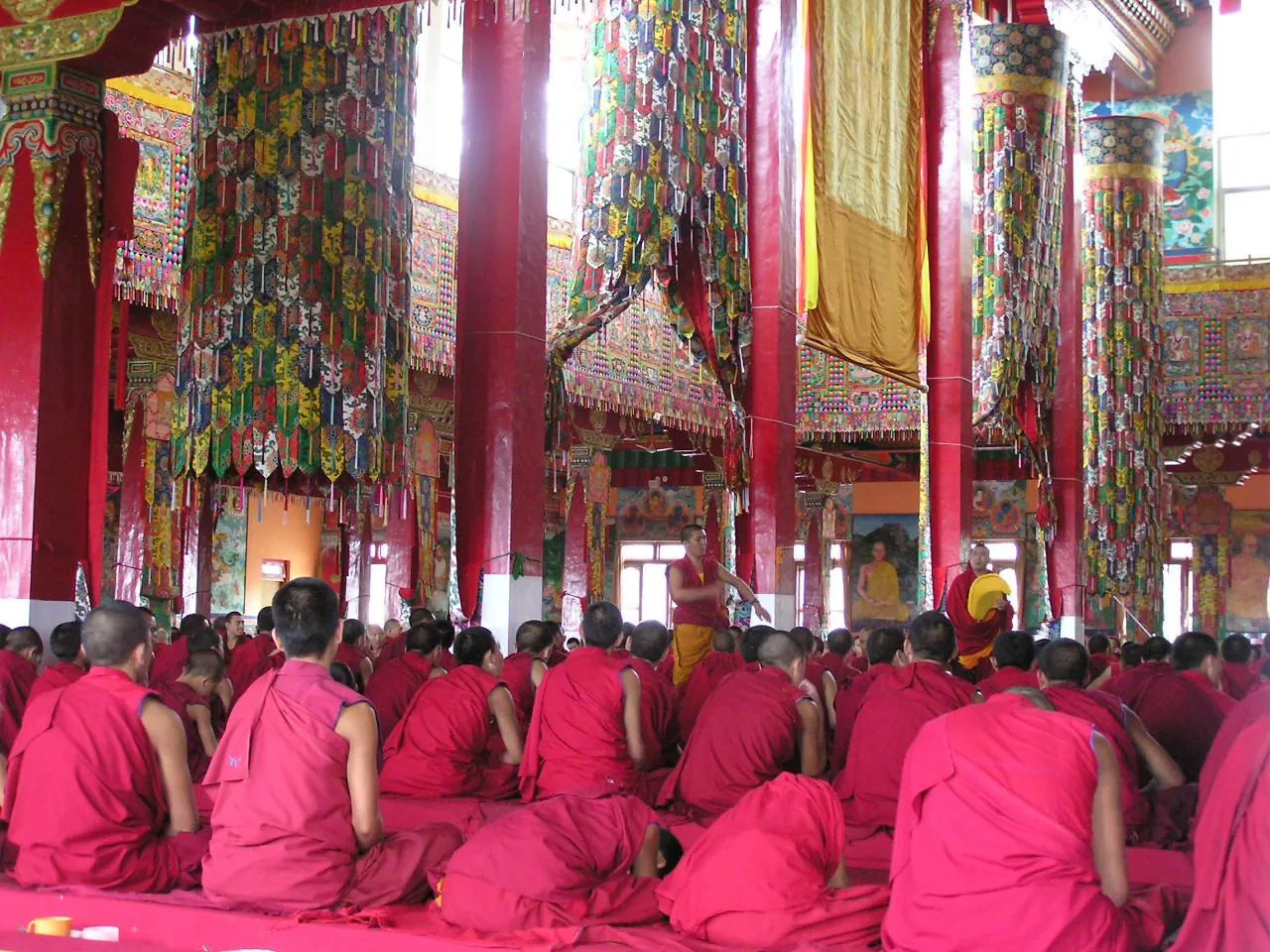
Why do the monks clap like that during debate?
The clap belongs to the standing challenger only, never the seated defender, and it lands on the last syllable of the challenge. Its working job is to mark the exact moment a claim becomes binding, so that everybody within earshot knows what the defender now owes.
It also carries a taught meaning. The right hand, coming down, stands for method and compassion; the left, receiving, for wisdom. The sound is their joining. Both explanations are true at once, which is fairly typical of this tradition.
Tibetan Nuns Project on the gestures of debate · Why the debate courtyard has no chairs, by a geshe of this monastery
Is it praying? Who are they praying to?
Mostly it is not praying in the sense of asking a deity for something, because there is no creator god in Buddhism to ask. What sounds like prayer is usually one of three things: liturgy recited together, mantra recitation, or the verbal working-through of a visualisation.
There is genuine devotion in it, directed at buddhas and bodhisattvas, but a buddha is understood as somebody who became one, not as somebody who always was. The request is for inspiration and blessing rather than intervention.
Why does a mala have 108 beads?
Various symbolic explanations are given and the tradition does not settle on one. The practical answer is more useful: 108 is long enough to settle into and short enough to finish, and it makes counting accumulations in hundreds of thousands arithmetically tidy.
You turn back at the large guru bead rather than crossing it, so a round is always 108 and never 109.
The ones that surprise people
Do Tibetan monks eat meat?
Often, yes, and this surprises almost every Western visitor. The Tibetan canon permits meat under the rule of threefold purity: a monk may eat it if he has not seen, heard, or suspected that the animal was killed for him specifically. On the Tibetan plateau, at four thousand metres with almost nothing growing, that permission was not academic.
The picture is mixed and changing. Many monks and nuns are vegetarian, vegetarianism has been strongly encouraged in recent decades, and the food served in the assembly halls of the three great seats is vegetarian.
Do monks have phones? Do they have money?
Phones, frequently. At some large monasteries the majority of monks carry one, and this has been true for well over a decade.
Money is more interesting. There is no salary. A monk is supported by donations, by his khangtsen, and often by an individual sponsor abroad. Some monasteries pay a stipend from visitor income, and monks earn small amounts by performing rituals for lay families or by painting thangkas. Nobody is getting rich, and the whole thing runs on an economy of giving that has no equivalent in a salaried society.
Reporting on monasteries and mobile phones · Khangtsen, in the Lexicon
Is the Dalai Lama the head of Tibetan Buddhism?
No, and this is probably the most widely held misconception about the tradition.
Tibetan Buddhism has four schools, each with its own head. The head of the Geluk school is the Ganden Tripa, the Holder of the Throne of Ganden, an office reached through scholarly attainment and seniority and held for a fixed term rather than through recognised reincarnation.
His Holiness the Dalai Lama is a Geluk lineage holder of enormous spiritual authority, and was Tibet's head of state until he gave up political office in 2011. He is not the institutional head of the Geluk school, and he has never been the head of Tibetan Buddhism as a whole.
Why is there a Sera in Tibet and a Sera in India?
Because the institution and the buildings are different things.
Sera was founded near Lhasa in 1419 and the buildings are still standing there. After 1959 the monastery was emptied, and in 1970 the monks who had escaped rebuilt it at Bylakuppe in Karnataka. Both places are called Sera, both are real, and the one in India is now by far the larger. Sera Jey alone has more than four thousand eight hundred monk-students; the monastery in Lhasa holds roughly three hundred under population caps.
Becoming, and stopping
How young can a boy enter a monastery?
Novice ordination has traditionally required a minimum age of seven, which is the age at which the Buddha's own son Rahula was ordained.
The old Vinaya formulation for the lower limit is memorable: a candidate should be old enough to scare off a crow. Boys frequently live and study at a monastery for years before taking even novice vows, so being at a monastery and being ordained are two separate things.
Samanera ordination and the minimum age · Gelong and getsul, in the Lexicon
What happens to a monk who never gets the Geshe degree?
Nothing dramatic, and it is common. The full course runs seventeen years at Sera Jey and about twenty-three for the highest grade, and not everybody is aiming at it.
Some monks complete only the memorisation examinations. Some take one of the lower grades of the degree instead of Lharampa, sometimes because of health or age, sometimes because their monastery needs them. Others move into ritual, administration, teaching, art or the kitchen, all of which the institution needs as much as it needs scholars.
Can a monk leave? What happens if he does?
Yes. Monastic vows are not a life sentence and disrobing is a recognised procedure, not an excommunication. A monk asks to be released, returns his robes, and returns to lay life.
Socially it is harder than the rule makes it sound. In most Buddhist societies disrobing carries a degree of disapproval, and for somebody who entered at eight and leaves at twenty-six it is a complete change of life with no obvious landing place. Re-ordination later is possible in some traditions.
Can women do the same degree?
Yes, now. The Geshema degree is the female equivalent, and the first Geshemas graduated in 2016 after decades of groundwork and with the encouragement of His Holiness the Dalai Lama. Nunneries in India run the same five-treatise curriculum and the same public debate examinations.
That it took until 2016 is part of the answer, and worth saying rather than skipping.
The Geshema degree, Tibetan Nuns Project · Geshema, in the Lexicon
Can a foreigner ordain or study at a monastery like this?
Foreigners do ordain in this tradition and some live and study in the great monasteries. The International Mahayana Institute, FPMT's ordained community, has a house at Sera Je itself.
The practical obstacles are real. It takes fluent Tibetan to follow the curriculum, it takes years, and foreign nationals need a Protected Area Permit even to stay overnight at Bylakuppe. Most Westerners who want this train at a Western monastery first. That is the sensible route and nobody will think less of you for taking it.
Sera IMI House, in the FPMT directory · The Protected Area Permit
Money, and how it works
Who pays for all of this?
Donation, almost entirely. There are no fees, no tuition and no endowment of the kind a Western university would recognise.
A monastery of several thousand runs on individual sponsorship of monks, on a food fund, on offerings made for pujas, and on charitable foundations abroad. Sera Jey's own institutions, its secondary school of more than 550 pupils, its health care committee founded in 1989, its kitchen and its library, are funded the same way.
Do I have to become a Buddhist to study or visit?
No. His Holiness the Dalai Lama has said repeatedly that most people are better off deepening the tradition they grew up in, and he invites non-Buddhists to his teachings as observers.
Visiting requires courtesy, not conversion. Studying requires curiosity. Taking refuge, which is the formal boundary of being a Buddhist, is a separate decision that nobody will push you towards.
If yours is not here
Ask it
Questions asked by readers are how this page grows, and several of them will end up as full pieces in The Courtyard. There is no wrong question and no beginner's question.
Questions reach the monk who writes this site on his own Facebook page or on X. They do not go to the monastery office, which has enough to do and did not write this site.
Related
Longer answers
Start Here covers what to read and how to find a teacher. Titles and Ranks covers who is who. Claims to Be Careful Of covers what this tradition does not teach.
Sources
References
Each answer above links its own sources. This is the same set in one list.
- 1The Meaning of Gestures in Tibetan Buddhist DebateTibetan Nuns Project
The clap, the standing challenger and the seated defender, and what the gesture is taught to mean.
- 2Tibetan Vegetarians Past and PresentTricycle
The rule of threefold purity, the plateau diet, and vegetarianism in the great monasteries.
- 3The monastery and the mobile phoneThe Queen's Journal
Mobile phones in monasteries, and how monks are supported without salaries.
- 4Ganden TripaWikipedia
The office of the head of the Geluk school, filled on merit and seniority for a fixed term.
- 5What is a Geshe?FPMT Mandala
The four grades of the degree, the seventeen-year minimum at Sera Je, the twenty-three years for Lharampa, and the joint examinations of Sera, Drepung and Ganden.
- 6Disrobing, in The Buddhist Monastic CodeThanissaro Bhikkhu, dhammatalks.org
How a monk leaves the order, and that it is a recognised procedure rather than an expulsion.
- 7
- 8The Geshema DegreeTibetan Nuns Project
The degree opened to nuns, and the first Geshemas graduating in 2016.
- 9About UsSera Jey Foundation
Current enrolment of more than 4,800 monk-students, and the 2022 University of Mysore affiliation.
- 10Sera Jhe Health Care CommitteeSera Jhe Health Care
The health care committee founded in 1989 under the guidance of His Holiness the Dalai Lama, and its services to the monastery and the settlement.
- 11Protected Area PermitBureau of His Holiness the Dalai Lama
PAP requirements for foreign nationals visiting the Bylakuppe, Mundgod and Hunsur settlements.
- 12Mantras and their prerequisitesFPMT
When an initiation is required to recite a mantra and when it is not, and the oral transmission.
Every factual claim on this page rests on one of the sources above. Links open in a new tab. The full list for the whole site, and the standard this site holds itself to, is on the sources page.