Darpa PanditaSera Jey · Bylakuppe Plan a visit
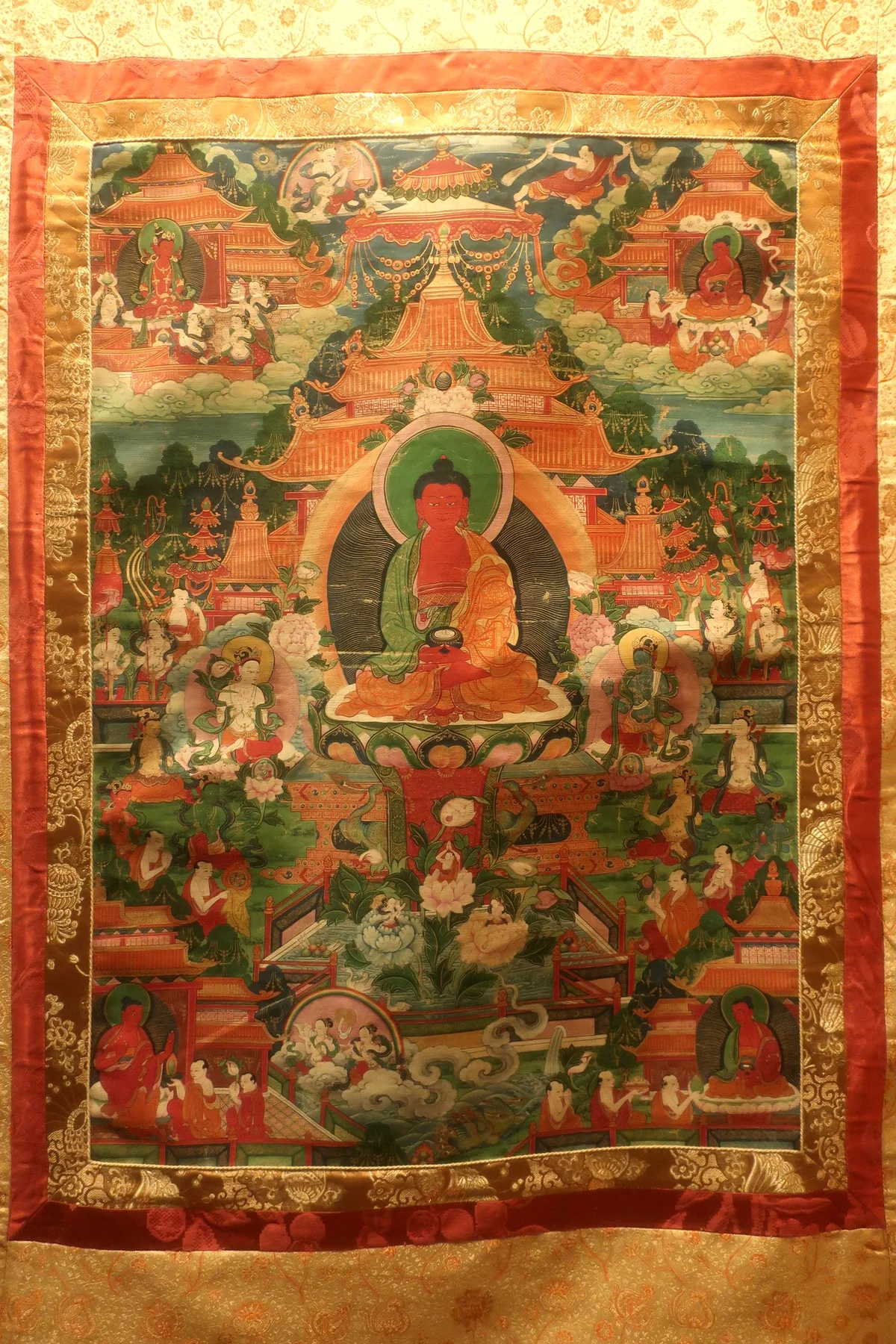
A Tibetan painting of Amitabha, the Buddha of the western pure land

22 · Death and dying

What is actually done

This tradition thinks about death constantly and without sentiment, and it is one of the few subjects on which it has something concrete to say to somebody who is not Buddhist and has run out of time to become one.

Most of what follows is taken from FPMT's own published advice from Lama Zopa Rinpoche, which is a manual rather than an essay. It is what is done, not what is generally said about the subject.

One reassurance before any of it, and it is in that manual's own words: it may not be possible to do everything, materials may be missing, circumstances may not allow it. That is all right and you should not worry. Do what you can. Nothing here is a procedure that fails if a step is skipped.

First, the book you have heard of

The Tibetan Book of the Dead is not from this school

Anybody who goes looking will find it within a minute, and will reasonably assume it speaks for Tibetan Buddhism as a whole. It does not.

The Bardo Thodol is a terma, a revealed treasure text, attributed to Karma Lingpa (1326 to 1386), and it is the best-known work of Nyingma literature. The Nyingma are a different school with a different transmission. The book is not a forgery, not disreputable and not rejected here; it is simply somebody else's text, and the Western title was given to it by its first translators.

The Geluk tradition works on the same subject differently. Its tantric presentation takes death, the intermediate state and rebirth as the path to the three bodies of a buddha, and its practical material is the kind of thing set out below: prayers, pujas and a schedule. If you want the Geluk material, asking for the Book of the Dead will not get it.

The sequence

Six things, in the order they happen

01

While there is still time

The instruction that governs everything else is a division of labour. Others can take care of the body. You take care of the mind. In a hospital there are already people whose job is the body; almost nobody has been given the other job.

What that means concretely is trying to get the person to a state of mind that is not frightened and not grasping. The strongest version, if they are capable of it, is tonglen: taking on others' suffering and giving out happiness, so that the person dies thinking of somebody else. His Holiness the Dalai Lama calls dying with that attitude a self-supporting death. Where that is beyond them, plain loving kindness, wishing others well, does the same work more simply.

In practiceJudge what the person can actually hold, not what you would like them to.

02

Use their words, not ours

This is the instruction that surprises people, and it is explicit in FPMT's own advice.

If Buddhist vocabulary will not land, do not use it. Say ‘fully enlightened being’ rather than Buddha. And if the dying person is Christian, talk about God: a compassionate God, a loving God, the Omniscient One. Help them think that their own loving heart is one with God, that the kingdom of God is within. The stated purpose is to free the person from guilt and from anger.

The same principle covers objects. A stupa may be placed on the chest, and if the person is not Buddhist you say it is for peace, or healing, or purification, which is true.

In practiceNobody is being converted. The aim is a mind without fear or anger.

03

Clear the room of grief

The hardest instruction, and the one FPMT emphasises hardest. As the time comes very close, the environment should be calm. Anybody who is crying, or clinging to the dying person, should not be in the room. The advice adds that this cannot be stressed enough.

The reasoning is not that grief is shameful. It is that the dying person's state of mind at that moment is held to matter enormously, and that distress in the room pulls them into attachment and fear exactly when neither can be afforded. Grieve, fully, in the next room.

In practiceSomeone calm stays. Everybody else can love them from outside the door.

04

Sound

Mantras playing, or somebody reciting quietly near the ear. Medicine Buddha and Chenrezig are the ones named most often.

FPMT's position is that this leaves an imprint whether or not the person is listening, understands, or believes any of it, and is therefore worth doing for somebody in a coma or with dementia. Whether you accept that or not, it has a plainly reasonable side: a room with a quiet voice in it is a better room to die in than a silent one.

In practiceQuiet, steady, near the ear. Not a performance.

05

When the breath stops

The first thing, in this tradition, is Medicine Buddha practice.

Then something Western medicine has no category for. In Tibet the body would not be touched until a lama in the village had performed phowa, the transference of consciousness. A lama can do this at a distance, which is why the family is told to say which direction the body lies in.

The tradition describes signs that consciousness has left. Before the body is moved, the hair at the centre of the crown is pulled back, so that consciousness leaves through the crown rather than lower.

In practiceIn a modern hospital most of this is impossible. The advice says so.

06

Forty-nine days

The bardo, the intermediate state, is understood to last up to forty-nine days, in cycles of seven. One week at a time: if rebirth is not found, the being takes another bardo existence and the week begins again.

Here is a precise doctrinal difference worth having. Forty-nine days is Lama Tsongkhapa's position, and therefore the Geluk one. Other Tibetan schools hold it can run to as much as a year. This site follows the tradition it is written from, and says which that is.

What is done during those weeks is practical and repetitive: Medicine Buddha puja dedicated to the person's rebirth, ideally daily for the forty-nine days, and if that is not possible then every seventh day. The final one is made more extensive, closing with the King of Prayers. Pujas can be sponsored at Kopan and elsewhere if you cannot do them yourself.

In practiceThe seventh-day rhythm is the version most families actually keep.

If you are not Buddhist

Which of this is usable anyway

A fair amount, and the tradition's own advice is unusually relaxed about it, since it tells you to use the dying person's religion rather than yours.

The division of labour holds regardless of belief: somebody should be responsible for the person's mind, and in most deaths nobody has been given that job. Clearing the room of open distress holds regardless of belief. A quiet voice near the ear holds regardless of belief. Aiming the person's attention outwards, at somebody they love rather than at their own fear, holds regardless of belief.

The rest, the phowa, the pujas, the forty-nine days, rests on a view of rebirth you either hold or do not. This site is not going to pretend that part is optional in order to make the page more widely useful.

What this is not

Nobody is arranging anybody’s rebirth

Everything above is understood to help. None of it is a guarantee, and anybody who offers you one is describing something the tradition does not teach.

This matters because the subject attracts that claim more than any other. Claims to be careful of covers it properly: the idea that a teacher can settle your future rebirth in advance, for a fee or otherwise, is not a Geluk position. Karma is held to be workable right up to the last moment, which is precisely why the last moment is treated with such care, and precisely why it cannot be sold in advance.


Terms used here are in the Lexicon. The figures named, Amitābha and the Medicine Buddha among them, are on Buddhas and deities, and their mantras with word-by-word meanings are on the mantras page.

Sources

References

The practical material is taken from FPMT’s own published advice from Lama Zopa Rinpoche rather than from general description, so that what is on this page is what is actually done.

  1. 1
    Caring for the Dying and Dead: Essential Advice from Lama Zopa RinpocheFPMT

    Nearly everything practical on the death page: that the job is to care for the mind while others care for the body, the instruction to use the dying person's own religious vocabulary, that no one crying should be in the room, the Medicine Buddha practice as the first thing after the breath stops, the Tibetan custom of not touching the body until a lama has done phowa, the crown hair, and the schedule of pujas across forty-nine days.

  2. 2
    Death and Dying: Practices and ResourcesFPMT

    FPMT's own collected material on death and dying, including the Eight Prayers for the Time of Death used in Geluk monasteries.

  3. 3
    Practices at the Time of DeathLama Zopa Rinpoche, Lama Yeshe Wisdom Archive

    Further advice on what is recited at the time of death and afterwards.

  4. 4
    Bardo ThodolWikipedia

    That the book known in the West as The Tibetan Book of the Dead is a terma revealed by Karma Lingpa (1326 to 1386) and is the best-known work of Nyingma literature, not a Geluk text.

  5. 5
    Mantras and their prerequisitesFPMT

    When an initiation is required to recite a mantra and when it is not, and the oral transmission.

  6. 6
    The Gelug Monastic Education SystemStudy Buddhism

    The five great treatises, the sequence of study, and the structure of the Geshe degree.

  7. 7
    Brief biography of the Fourteenth Dalai LamaThe Office of His Holiness the Dalai Lama

    Birth, recognition, 1950, Beijing in 1954, the Geshe Lharampa examination, the 1959 exile, the 1989 Nobel Peace Prize, and the 2011 retirement from political office.

  8. 8
    Lama Yeshe Wisdom ArchiveLYWA

    The collected teachings of Lama Yeshe and Lama Zopa Rinpoche, much of it free to read.

Every factual claim on this page rests on one of the sources above. Links open in a new tab. The full list for the whole site, and the standard this site holds itself to, is on the sources page.