The Courtyard · Practical
How to disappear for a month
Nobody fails a retreat because the meditation was too hard. They fail it because a direct debit bounced in week two and the centre had to come and find them. The unglamorous work of leaving modern life for thirty days.
· 11 min read
The teaching about renunciation is famous. The paperwork is not. But if you sign up for a month at Kopan or ten days at Tushita, the part that will actually go wrong is not your concentration. It is the bank.
What you are actually agreeing to
Read the conditions before you read anything about meditation, because they are stricter than people expect.
At Kopan, phones, laptops and anything else that connects to the internet are handed in at reception for the duration of the course. Attendance at every session is compulsory. Silence runs from nine in the evening until after lunch the next day.
At Tushita it is tighter still. Every communication and entertainment device goes into the centre's safe at check-in. Silence is complete from the evening of the first day until the course ends. You do not leave the property for the entire course. And their own instruction is explicit: settle all travel arrangements, emails and phone calls before the first session begins.
So plan for a hard cut, not a slow fade. No quick check of anything. No stepping out to sort something. For ten days, or thirty, you are genuinely unreachable and genuinely unable to act.
Start six weeks out
One week is not enough, and this is the single most common mistake. Six weeks gives you time to discover the problems you did not know you had, which is most of them.
A useful way to think about it: everything in your life that happens automatically is now a liability, and everything that requires you is now a blocker. Go through both lists.
The direct debit trap
Here is the scenario that ruins retreats.
You leave with what looks like enough in the current account. In week two an annual insurance premium comes out that you had forgotten renews in November. The account goes under. The next three direct debits bounce, each with a fee. Your card gets declined. Somewhere around day eighteen the centre office finds you in the courtyard and says your emergency contact has been calling.
The fixes are dull and they work:
Write down every recurring payment and its date, not from memory but from three months of statements. People routinely miss two or three.
Leave a buffer of at least double what those payments total. Overdraft arranged, not hoped for.
Check whether any card expires while you are away. A card that expires mid-retreat takes every subscription attached to it down with it.
Tell your bank you are travelling, and where. A fraud hold on a card in Nepal is a very boring reason to have to leave a retreat.
Carry some cash. Tushita, for instance, accepts Indian rupees only and cannot change foreign currency, and the local cash machines are not guaranteed to be working.
The subscription audit
Everybody has more than they think. Bank statements, app store, and the email folder where receipts land.
Three piles. Pause what pauses cleanly. Cancel what you will not miss, which after a month away is usually more than you expected. Leave running only what genuinely has to keep running.
One trap worth naming: services that let you pause but silently resume at full price, and annual plans that renew during your absence at a rate you would not have accepted. Check the renewal dates, not just the monthly cost.
Two-factor authentication, the modern trap
This one is new and it catches almost everybody.
Your bank sends its confirmation codes by text. Your phone is in a safe in Dharamsala. Your email needs a code from an authenticator app on the same phone. You now cannot log in to anything, and neither can the person you asked to help.
Before you go:
Print your backup codes. On paper. Leave a copy with somebody you trust and take a copy yourself.
Put your authenticator on a second device that is not the phone you are handing in, or on a device that stays at home with your trusted person.
Check which accounts fall back to SMS only, because those are the ones that will lock you out completely.
Consider whether anything critical can be moved off SMS entirely before you leave.
And test it. Actually log in once using only the backup route, from a different device, before you get on the plane.
Email, work and the people who need you
An out of office that says you are away is not enough. Say three things: the date you are genuinely reachable again, that you will not be reading anything before then, and who to contact instead with the authority to actually decide something. A deputy who has to wait for you is not a deputy.
For anything with a deadline inside your absence, move it or delegate it in writing. Tax, renewals, contracts, court or immigration correspondence, anything with a fixed date. A month is long enough for a missed letter to become a real problem.
Post, home and the practical rest
Somebody collects your post, or it is redirected. A visible pile is both a missed deadline and an advertisement.
Somebody has a key and knows what to do about a leak. Somebody knows where the stopcock is.
Travel insurance that actually covers the country, the length of stay and the altitude, and that you have read rather than bought. Check what it says about pre-existing conditions.
Medication for the whole period plus a margin, in original packaging, with a prescription copy. Centres ask you to arrive in good physical and mental health, and to tell them in advance about anything ongoing. Do tell them. They are not looking for a reason to refuse you; they are looking for a reason not to be surprised.
Your visa long enough, with room either side. And for the settlements in Karnataka, a foreign national needs a Protected Area Permit to stay overnight, applied for about a month before arriving in India.
Social media, and the thing nobody says
Two practical notes.
Do not announce to a public account that your home will be empty for thirty days. Tell the people who need to know, privately.
And consider not announcing it at all. There is a version of going on retreat that is mostly about having gone on retreat, and posting the departure is where it starts. You can always tell people afterwards. Or not.
The last forty-eight hours
One page, given to one person. On it: where you are, the centre's phone number and address, the dates, the fact that you cannot be reached and what counts as a real emergency, your emergency contact, where the backup codes are, where the keys are, and what you want done if something has to be decided without you.
Then settle everything that requires you, because after this there is no partial contact. Tushita's instruction is the right standard for any retreat: finish your business in town before the first session starts.
Why any of this is the practice
It is tempting to treat all of the above as the boring bit before the real thing. It is not.
Go through the list honestly and you will find it is a fairly exact inventory of what you are attached to. The subscriptions you cannot bring yourself to cancel. The work that supposedly cannot run without you for four weeks, which is a claim worth examining. The accounts you check without deciding to. The anxiety that arrives when you imagine being genuinely unreachable, which is information about something.
Lama Zopa Rinpoche called a Kopan course the most important education of your life. The education starts about six weeks before you get there, at a kitchen table, with three months of bank statements and a pen. Most of what you find will be ordinary, and some of it will be the actual reason you signed up.
Terms used here are defined in the Lexicon, which links from the first mention of each in the text above.
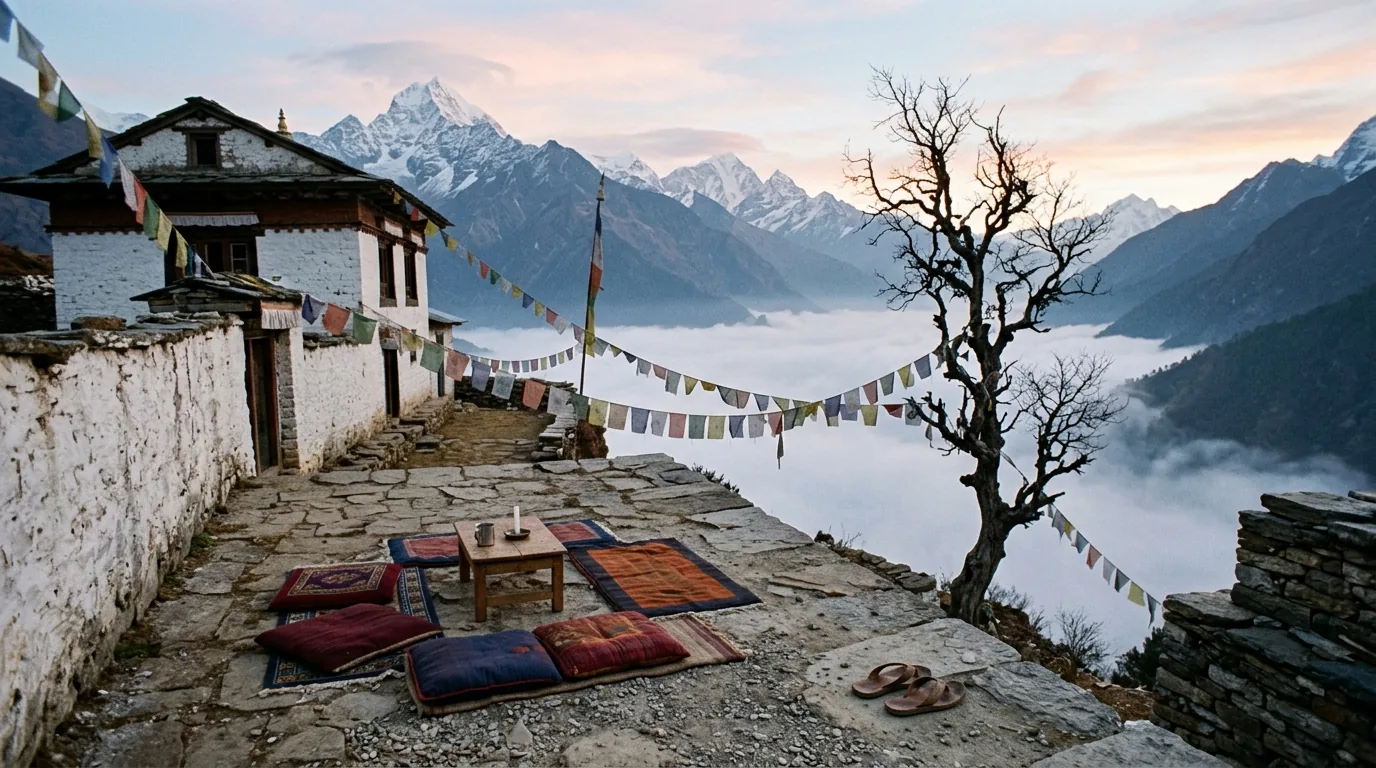
The picture at the top of this piece is an illustration, not a photograph. It was generated with an image model and does not show a real place, person or event. Every photograph elsewhere on this site is a real one, credited on the sources page.
Sources
References
Everything in this piece that is a matter of fact rather than of judgement rests on one of these.
- 1Rules of DisciplineTushita Meditation Centre, Dharamsala
What a residential course actually requires: all devices into the safe at check-in, complete silence from the evening of the first day, not leaving the property, and attending every session.
- 2Frequently Asked QuestionsTushita Meditation Centre, Dharamsala
No contact with family during a course, all travel and business settled before the first session, local currency only, and the requirement to arrive in good physical and mental health.
- 3Kopan November Course: the most important education of your lifeFPMT
The month-long November course running every year since 1971, its lamrim structure, an average of around two hundred students a year, and how many senior FPMT students first met the lamas there.
- 4The First Kopan Meditation CourseFPMT
The first course at Kopan in April 1971: ten days, taught by Lama Zopa Rinpoche to about a dozen students, on thought transformation.
- 5Kopan MonasteryKopan Monastery, Kathmandu
The monastery itself, its courses and its conditions of attendance.
- 6Protected Area PermitBureau of His Holiness the Dalai Lama
PAP requirements for foreign nationals visiting the Bylakuppe, Mundgod and Hunsur settlements.
- 7Protected Area Permit portalMinistry of Home Affairs, Government of India
The official online application for Protected Area Permits.
Every factual claim on this page rests on one of the sources above. Links open in a new tab. The full list for the whole site, and the standard this site holds itself to, is on the sources page.