The Courtyard · History
The wrong monk
In 1967 a Russian-American socialite walked into a monastery in Darjeeling looking for somebody else, and mistook the young monk in front of her for him. The mistake held. Almost everything Western about this tradition comes from what happened next.
· 9 min read
If you want to understand why there is a Buddhist centre in Bilbao, a monastery for Western monks in France, a hospice in Brisbane and a publisher in New York, you have to start with a hill outside Kathmandu. And to get to the hill you have to start with a woman who was in the wrong room.
Ghoom, 1967
Zina Rachevsky was not the person anybody would have picked for this.
She was born in New York in 1930, to a Russian émigré father and an American mother whose own father had been a millionaire. She spent her childhood in France during the war. She married a French count at eighteen and divorced him two years later, married a filmmaker after that, took drama classes in Hollywood, and lived the kind of life that gets a person described in obituaries as a socialite.
In 1967 she turned up at Ghoom Monastery in Darjeeling, looking for a teacher called Domo Geshe Rinpoche. The young monk she found and addressed was not him. It was Thubten Zopa Rinpoche, who had been known by a similar title and who was, at that point, a refugee in his early twenties with no particular reason to be interesting to anybody.
She had come to the wrong monk. She stayed anyway.
A year at her house
Zopa Rinpoche and his own teacher, Lama Thubten Yeshe, spent close to a year teaching a small group of foreigners at Rachevsky's home. This was not normal. The Tibetan refugee community in India in 1967 was preoccupied with survival and with rebuilding its monasteries; teaching Westerners was nobody's priority and, for most, nobody's idea.
When she left for Ceylon she wrote to His Holiness the Dalai Lama, repeatedly, asking permission for the lamas to follow her. Permission came. The three of them went to Dharamsala first, where she was ordained as a novice nun and took the name Thubten Changchub Palmo.
Then, in 1968, instead of Ceylon, they went to Nepal.
The hill
They settled first near the great stupa at Boudhanath, outside Kathmandu. After a few years they were able to buy land at the top of a nearby hill called Kopan, and in 1969 they founded what they called the Nepal Mahayana Gompa Centre.
The main building went up over 1971 and 1972, paid for largely by Western students who had, by then, started arriving.
It is worth pausing on how improbable this was. Two refugees, one of them not yet thirty, with no institutional backing, on a hill in a country neither of them was from, building a monastery aimed at foreigners, at a moment when the entire Tibetan monastic system was being rebuilt from nothing in the forests of south India.
Twenty people, then two hundred
The first meditation course ran in 1971. Accounts differ slightly on the numbers, which is what you would expect of an event nobody thought to document at the time: FPMT's joint biography of the two lamas puts the first course at around twenty people, while its account of the first ten-day course in April of that year says about a dozen. Either way, it was a room, not a movement.
Then it grew, fast. By the seventh course, in the autumn of 1974, they had to cap attendance at two hundred, because two hundred was what the building held.
The format that emerged is the one still running: a month, in November, walking the entire graduated path in order. Around two hundred people a year, from everywhere. Its structure has barely changed in fifty years.
What came off that hill
The list is longer than seems reasonable for one hill and about five years.
1972: Tushita Retreat Centre at Dharamsala, which still runs the ten-day introduction that is most Westerners' first serious contact with this tradition.
1972: Mount Everest Centre at Lawudo, which took in around fifty Sherpa boys aged between five and nineteen.
December 1973: Kopan becomes the headquarters of the International Mahayana Institute, the community of Western monks and nuns. The IMI still has a house at Sera Je, a hundred metres from where this website is written.
1975: the whole thing is given a name and a structure, and becomes the Foundation for the Preservation of the Mahayana Tradition. Fifty years later that is 138 centres, projects and services in 34 countries.
And underneath the institutional list, the part that actually matters: a very large share of the senior Western students in this tradition, including most of the people who went home and founded those centres, first met the teaching on that hill. Not in a university, not in a book. On a month-long course in Nepal that they had heard about from somebody in a guesthouse.
Zina
She did not see much of it.
Zina Rachevsky died in Nepal on 20 October 1973, aged forty-three. She had been ordained about five years. She saw the hill bought, the building go up, and perhaps three of the courses.
There is no tidy lesson in that, and it would be dishonest to supply one. What can be said is narrow and true: she was persistent about something that nobody else was interested in, at a moment when it could still have gone either way, and the results of that persistence are now on four continents.
If you want to go
The course still runs. It has not been softened.
Phones and laptops are handed in at reception for the duration. Attendance at every session is compulsory. Silence runs from nine at night until after lunch the next day. You do not need to be Buddhist, you do not need to know anything, and nothing is asked of you afterwards.
What you do need is to have sorted out your life sufficiently that you can vanish for a month without it collapsing behind you, which turns out to be the harder half. That is a separate problem, and worth its own piece.
Terms used here are defined in the Lexicon, which links from the first mention of each in the text above.
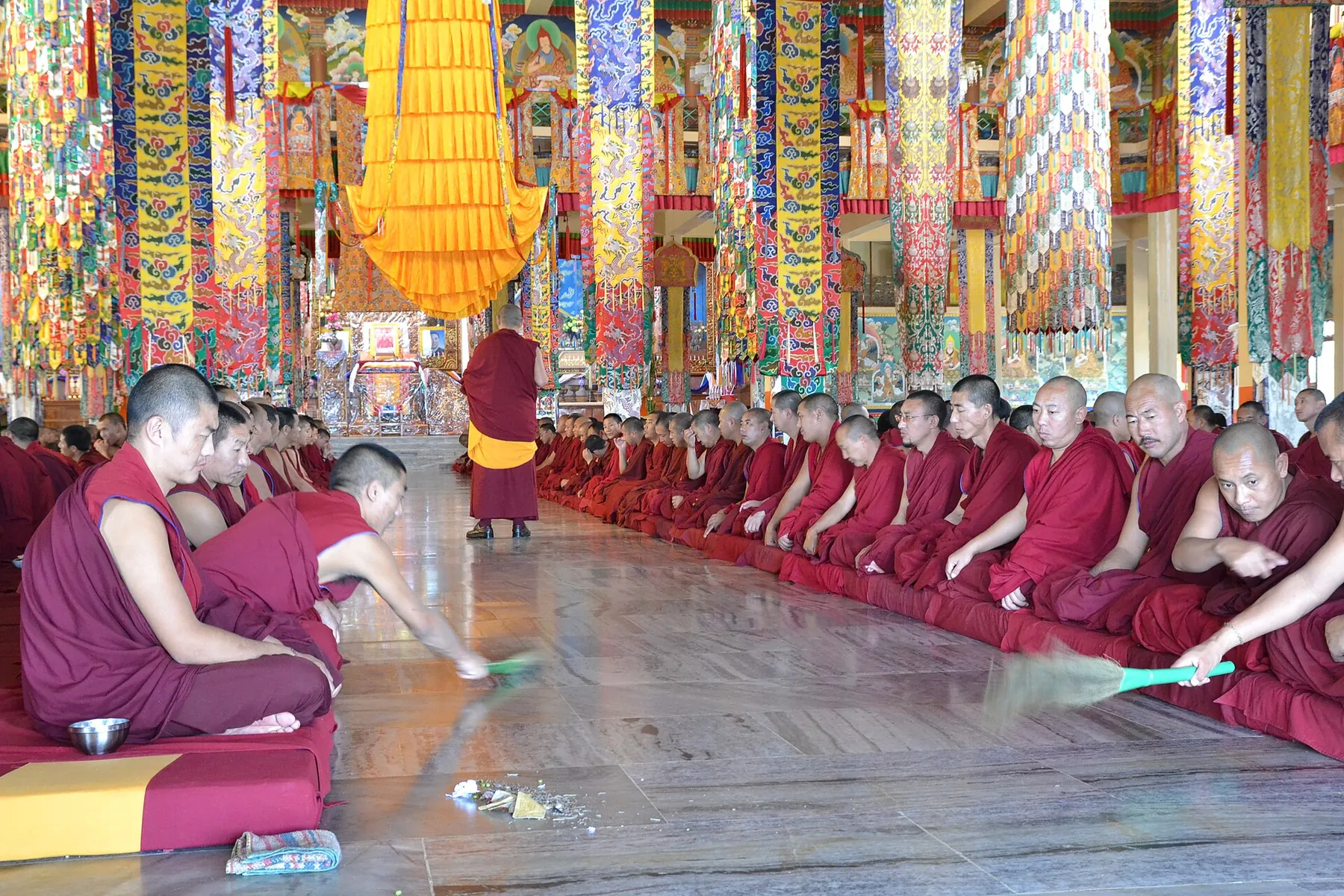
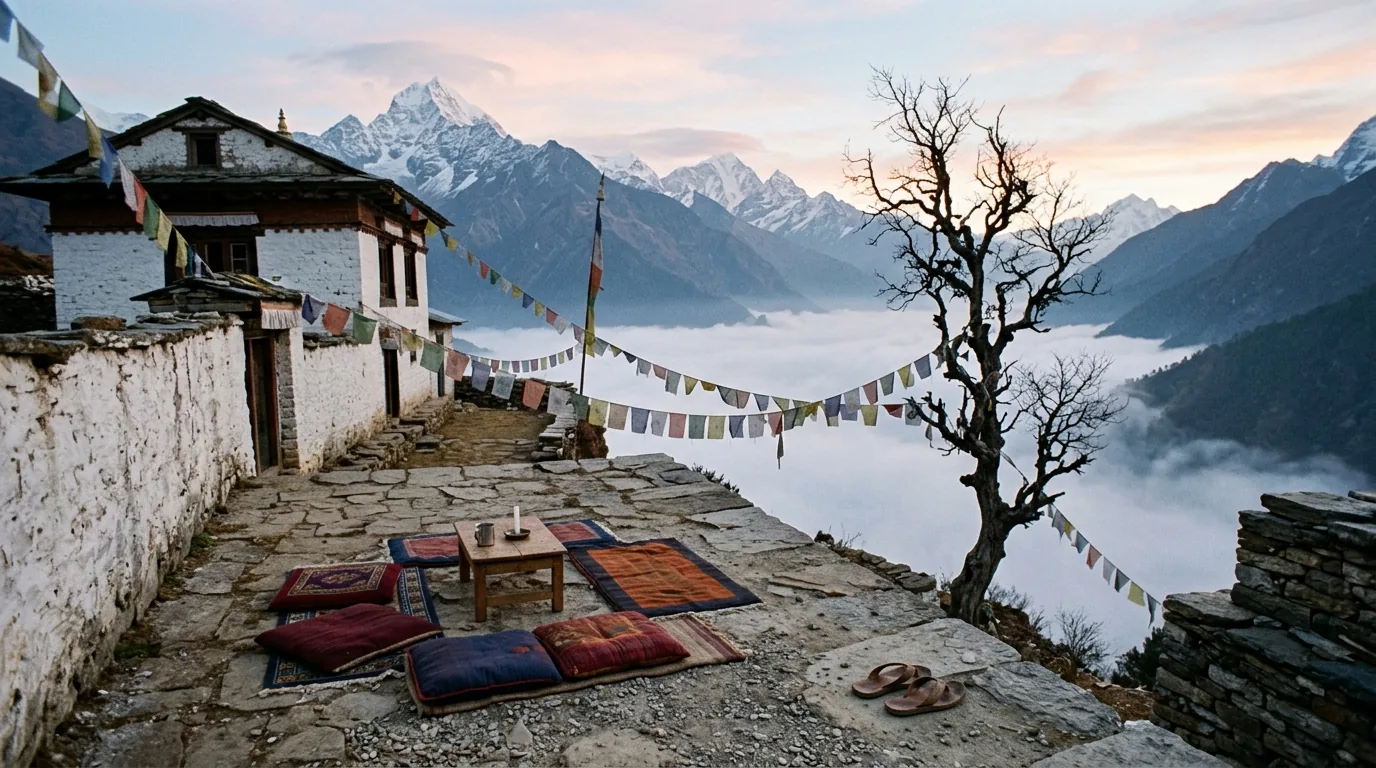
The picture at the top of this piece is an illustration, not a photograph. It was generated with an image model and does not show a real place, person or event. Every photograph elsewhere on this site is a real one, credited on the sources page.
Sources
References
Everything in this piece that is a matter of fact rather than of judgement rests on one of these.
- 1A Joint Biography of Lama Yeshe and Lama Zopa RinpocheFPMT
Meeting Zina Rachevsky at Ghoom in 1967, the move to Nepal in 1968, the purchase of Kopan hill and the founding of the Nepal Mahayana Gompa Centre in 1969, the first course in 1971, the seventh course capped at 200 in autumn 1974, and the International Mahayana Institute from December 1973.
- 2Zina RachevskyWikipedia
Born in New York in 1930, her family background, her life in France and Hollywood, her ordination, and her death in Nepal on 20 October 1973.
- 3The First Kopan Meditation CourseFPMT
The first course at Kopan in April 1971: ten days, taught by Lama Zopa Rinpoche to about a dozen students, on thought transformation.
- 4Kopan November Course: the most important education of your lifeFPMT
The month-long November course running every year since 1971, its lamrim structure, an average of around two hundred students a year, and how many senior FPMT students first met the lamas there.
- 5Lama Thubten YesheFPMT
Born 1935, entered Sera at six, studied until 1959, the first Western students in 1967, Kopan, the teaching tours, and the recognition of his reincarnation.
- 6Lama Zopa RinpocheFPMT
Born 1945 at Thami, recognised as the Lawudo Lama, Buxa Duar, Kopan, and thirty-nine years as spiritual director.
- 7Kopan MonasteryKopan Monastery, Kathmandu
The monastery itself, its courses and its conditions of attendance.
- 8FPMT 50th anniversaryFPMT
The founding at the end of 1975, the 1975 tour of nine countries, and the size of the network.
Every factual claim on this page rests on one of the sources above. Links open in a new tab. The full list for the whole site, and the standard this site holds itself to, is on the sources page.