The Courtyard · History
197 monks and 147 acres: what re-establishment actually looked like
In 1970 a monastery that had housed thousands was reduced to a cohort, a forest and a decade of manual labour. The monastery's own account is admirably unsentimental.
· 9 min read
There is a version of this story in which a tradition is heroically preserved. The numbers, which Sera Jey publishes itself, tell a plainer one.
The decade before, in a British prison
Sera Jey's own history refers to almost ten years of a holding programme before 1970. That programme had an address, and it is worth knowing.
When Chinese troops moved against Drepung in March 1959, a few hundred monks escaped to India out of a population of over ten thousand. They came out through Bhutan. What they and monks from the other seats set up, at a place called Buxa in the West Bengal Dooars, was a monastic study centre called Buxa Chogar.
It stood on the grounds of a former British prison camp, jungle-bound, which had operated as a detention camp under colonial emergency law from 1930 to 1937 and as a special jail from 1942 to 1947 and again from 1949 to 1951. The great Geluk monastic universities spent the 1960s being rebuilt inside it, in a climate and at an altitude that had nothing to do with anywhere any of them came from.
In 1966 the Indian Ministry of External Affairs was alerted to the conditions there. The move south followed.
The arithmetic
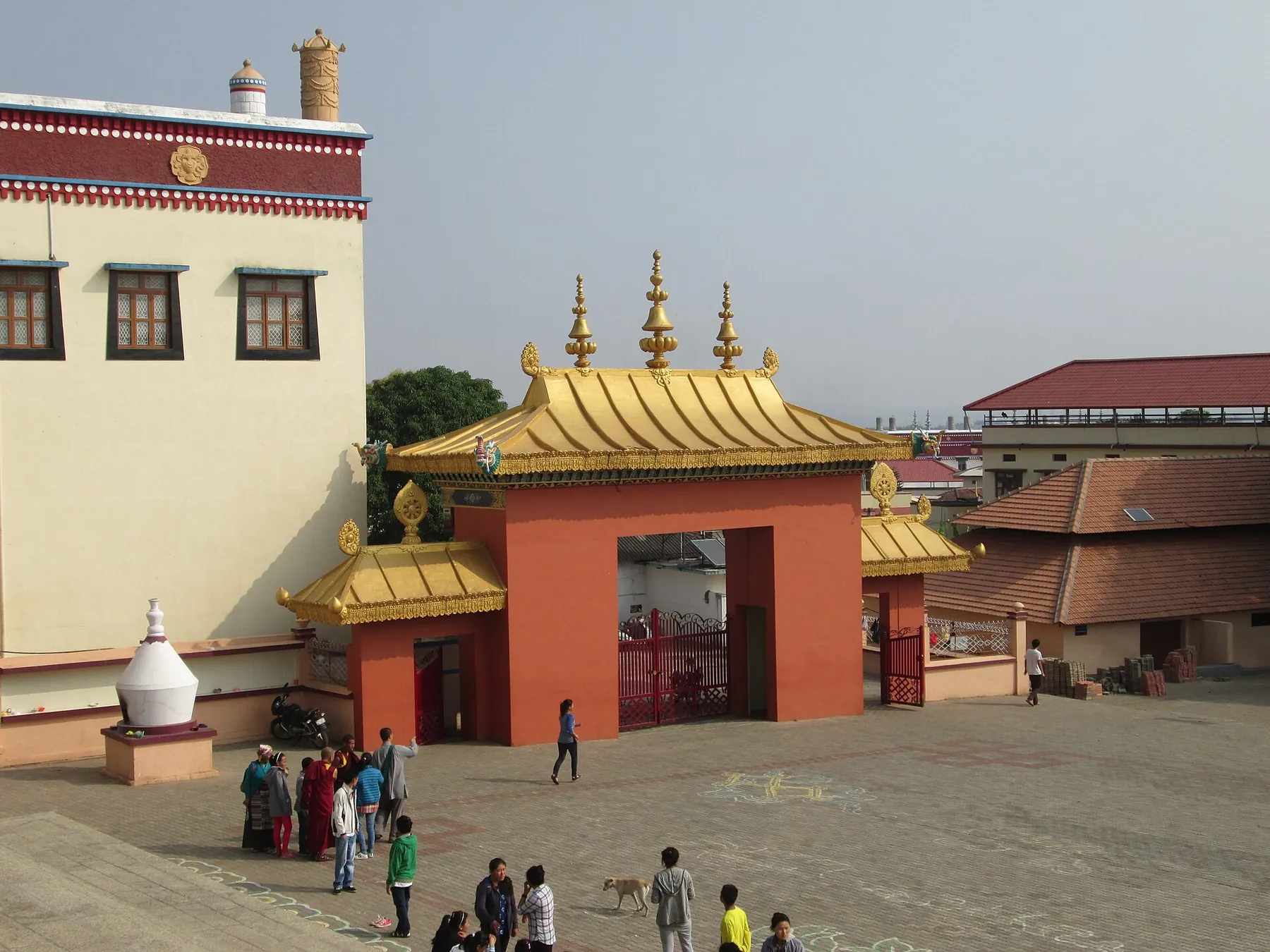
In 1970, after that decade, 197 Sera Jey monks and 103 Sera Mey monks were moved to a site in the Tibetan resettlement at Bylakuppe, in Mysore District, Karnataka. Three hundred men, to re-establish a monastery that had held thousands.
They were given 225 acres of forest between the two monasteries, allocated at three quarters of an acre per monk. Sera Jey's share, for its 197, came to 147¾ acres.
The Indian government sponsored 38 one-room tiled houses for all three hundred monks: twenty-four for Sera Jey, fourteen for Sera Mey. Work the division out and it is about eight men to a room.
What that meant daily
The forest was not cleared for them. The monks cleared all 225 acres themselves and did all the construction labour on the houses. The land was then cultivated at the onset of the monsoon.
One harvest a year. That harvest was the only resource and the only means of survival for the entire community. The monastery's own history says the monks were, in its phrase, more or less obliged to engage for their livelihood and survival.
Which is a dry way of saying that for most of the 1970s a Geluk monastery was a farm, and that the men doing the farming were the ones who were supposed to be spending twenty years on five books.
The first hall
Construction of the first assembly prayer hall began in 1976 and finished at the end of 1978. It was inaugurated in 1979, nine years after they arrived.
Before that there had been a smaller hall roofed with asbestos sheeting. Nine years of that, first.
Outgrowing it
The hall was built to hold 1,500 monks, which was the entire population of the monastery at the time. From 197 to 1,500 in under a decade.
That growth was not births. From the early eighties large numbers of young Tibetans began crossing out of Tibet, most of them teenagers and some younger, arriving into an education system that had been rebuilt from a forest clearing precisely in time to receive them.
The point of the arithmetic
Every figure here is small and specific, and that is why they are worth having. A tradition was not preserved by a decision. It was preserved by three hundred men clearing scrub with hand tools on three quarters of an acre each, eight to a room, living off one harvest a year, for the better part of a decade, in a climate none of them had grown up in.
Sera Jey today reports more than four thousand eight hundred monk-students. The line from 197 to that number runs through 1970, and there was nothing inevitable about it.
Terms used here are defined in the Lexicon, which links from the first mention of each in the text above.
Sources
References
Everything in this piece that is a matter of fact rather than of judgement rests on one of these.
- 1Re-establishment at BylakuppeSera Jey Monastic University
The 1970 move: 197 Sera Jey and 103 Sera Mey monks, 225 acres at three quarters of an acre per monk, 147¾ acres to Sera Jey, 38 tiled houses, and the first assembly hall of 1976 to 1979.
- 2New Assembly Prayer HallSera Jey Monastic University
The 1997 hall: proposed 1995, 23,275 square feet, 31 feet high, 110 pillars, an assembly of 3,500, inaugurated by His Holiness the Dalai Lama on 31 December 1997.
- 3About UsSera Jey Monastic University
The founding by Jetsun Kunkhen Lodrö Rinchen Senge, the two administrations, the Geshe Lharampa degree, the 75th abbot, and the affiliated centres abroad.
- 4About UsSera Jey Foundation
Current enrolment of more than 4,800 monk-students, and the 2022 University of Mysore affiliation.
- 5BylakuppeWikipedia
The 1960 land grant of nearly 3,000 acres, Lugsung Samdupling founded in 1961, Dickyi Larsoe in 1969, and the settlement's population.
- 6Buxa FortWikipedia
That in March 1959 only a few hundred of Drepung's more than ten thousand monks escaped to India via Bhutan; that the refugee monks set up a monastic study centre called Buxa Chogar on the grounds of a jungle-bound former British prison camp; that the fort had served as a detention camp from 1930 to 1937 and a special jail from 1942 to 1947 and 1949 to 1951; and that in 1966 the Indian Ministry of External Affairs was alerted to conditions there.
Every factual claim on this page rests on one of the sources above. Links open in a new tab. The full list for the whole site, and the standard this site holds itself to, is on the sources page.