The Courtyard · Teachings
The Wheel of Time, and why it matters if you are nobody in particular
His Holiness the Dalai Lama has given the Kālachakra empowerment thirty-four times, to crowds of a hundred thousand and more. Almost none of those people were going to become tantric adepts. That is not a failure of the ceremony. It is the design.
· 10 min read
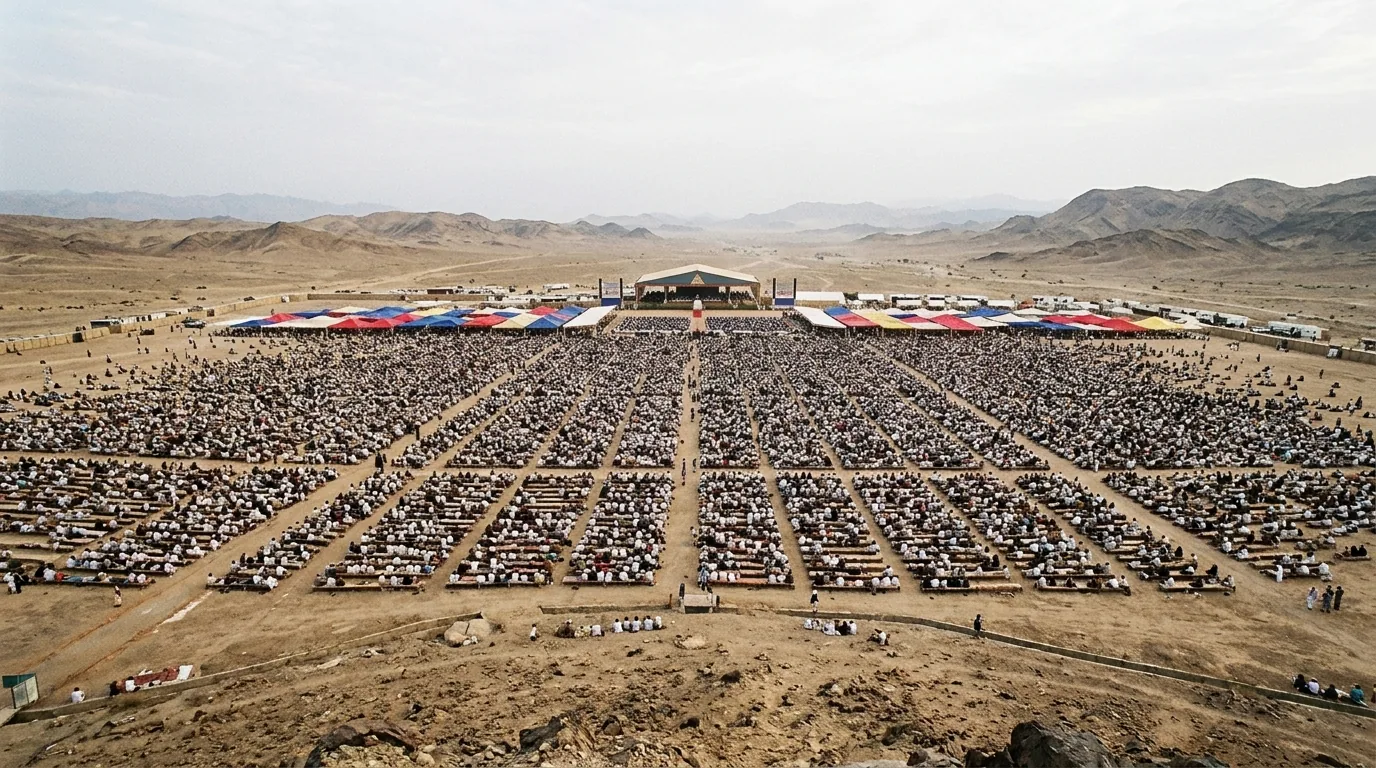
In January 2017, about a hundred and twenty thousand people from some ninety countries sat down on the plain at Bodh Gaya, in the cold, for twelve days. Most of them could not see the throne without a screen. Many were farmers and traders from Ladakh and Spiti and Mongolia who had travelled for days on buses. A large number were not Buddhist at all. What they had come for was the thirty-fourth Kālachakra empowerment given by His Holiness the Dalai Lama, and the obvious question, if you are a sceptical modern person, is what on earth any of them thought they were getting.
First, what it actually is
Kālachakra means wheel of time. It is a tantric system, and its distinguishing idea is a correspondence between three wheels. The outer wheel is the world: planets, seasons, the movement of the year, and Kālachakra literature is unusual in containing real astronomy, calendrics and medicine. The inner wheel is the body: breath, the channels through which energy moves, the cycles a person runs on without noticing. The third wheel is called the alternative, the practice itself, which works on the inner wheel and, by the logic of the system, on the outer one too.
You do not have to accept that cosmology to see what is being claimed. The claim is that a person is not separate from the world they complain about, that the two run on the same mechanism, and that the only end of the mechanism you can actually reach is the inner one.
Why this one is public
Tantra is normally taught privately, to prepared students, under conditions. Access requires empowerment; empowerment requires a qualified teacher, a relationship, and vows. The whole architecture is built to prevent people from taking up powerful methods casually, and the Geluk tradition in particular, Tsongkhapa's whole reform was about restoring the proper order, is strict about it.
Kālachakra is the exception. Of its eleven initiations, the first seven are given publicly; the remaining four are not. His Holiness has given those seven to enormous crowds since 1954, explicitly in connection with world peace, and has invited non-Buddhists to attend as observers. Nothing else in the tantric world works like this.
The two doors
This is the part people misunderstand, and it is the part that answers the question. Everyone at a Kālachakra is doing one of two things, and the tradition is entirely open about which.
Through the first door you take the empowerment properly. That means commitments: in the fullest form, eighteen root and forty-six ancillary vows, restraint in speech, abstention from intoxicants, care about how you eat, and a daily practice recited six times a day for the rest of your life. It is a serious undertaking and it is not for most people, including most people who are in the field that week.
Through the second door you receive it as a blessing. You sit, you listen, you follow what you can, you generate whatever compassion you are able to generate, and you take on nothing you cannot keep. This is not a consolation prize for the unqualified. It is provided for, deliberately, by a tradition that would otherwise never open this door at all.
So what does an ordinary person get
Something quite specific, and rather unglamorous.
You get twelve days in which the only thing being asked of you is attention. No phone worth looking at, nothing to achieve, nowhere to be. That alone is now a rare commodity.
You get a sustained, structured push toward compassion, in the company of a hundred thousand people doing the same thing, led by someone who has spent seventy years on it and is unusually hard to disbelieve in person. Whatever you think is happening metaphysically, something happens sociologically: it is very difficult to spend twelve days deliberately wishing well to strangers and come out unchanged.
And you get to watch the sand mandala. Monks build it over a week, grain by grain, through metal funnels, to exact proportions, inside a curtained enclosure. It is extraordinary. At the end of the ceremony they destroy it and pour the sand into moving water. Nobody attending fails to understand what has just been said to them.
The honest caveat
None of this is magic, and the tradition does not claim it is. An empowerment ripens a capacity; it does not install a result. If you take the vows and abandon them, you are worse off than if you had not, which is exactly why the blessing door exists and why it is signposted. Anyone who tells you that attending a Kālachakra will fix your life has not been paying attention to the content of the Kālachakra.
What it offers the ordinary person is more modest and more durable: a demonstration, at enormous scale, that the interior life is worth taking seriously, and a first formal connection to a system that will still be there in twenty years if you decide to go further.
Where Sera Jey comes in
Monks from the great Geluk seats, Sera among them, are the people who build the mandala, hold the ritual, and keep the transmission intact between one empowerment and the next. What happens in the courtyard at Bylakuppe every afternoon is the unglamorous, twenty-year, argumentative maintenance work that makes a ceremony like Bodh Gaya possible at all.
If the field at Bodh Gaya is the tradition's public face, the debate courtyard is its engine room. Both are open to visitors. Only one of them is quiet.
Terms used here are defined in the Lexicon, which links from the first mention of each in the text above.
The picture at the top of this piece is an illustration, not a photograph. It was generated with an image model and does not show a real place, person or event. Every photograph elsewhere on this site is a real one, credited on the sources page.
Sources
References
Everything in this piece that is a matter of fact rather than of judgement rests on one of these.
- 1Kalachakra initiationsThe Office of His Holiness the Dalai Lama
The thirty-four Kālachakra empowerments given between 1954 and 2017, with places and attendance.
- 2Attending a Kalachakra Initiation for World PeaceStudy Buddhism
Taking the empowerment against receiving it as a blessing, and the commitments involved.
- 3Mantras and their prerequisitesFPMT
When an initiation is required to recite a mantra and when it is not, and the oral transmission.
- 4Rebirth, Recognition and Tradition, 24 September 2011The Office of His Holiness the Dalai Lama
The distinction between rebirth driven by karma and rebirth directed by a realised being, the methods of recognition, and the rejection of politically chosen candidates.
- 5The Gelug Monastic Education SystemStudy Buddhism
The five great treatises, the sequence of study, and the structure of the Geshe degree.
Every factual claim on this page rests on one of the sources above. Links open in a new tab. The full list for the whole site, and the standard this site holds itself to, is on the sources page.