The Courtyard · Fiction
If Tibet were free tomorrow: a thought experiment about going home
This is fiction. It is also the one scenario nobody in the settlements plans out loud, and the documents that would govern it already exist. Here is roughly how it would go.
· 12 min read
A note on this piece. It is a thought experiment, not a prediction, not policy and not advocacy. The actual position of His Holiness the Dalai Lama and of the Central Tibetan Administration is the Middle Way Approach: genuine autonomy for Tibetans within the People’s Republic of China, explicitly not independence. Everything factual below is sourced. Everything else is clearly marked as speculation.
Read this as fiction, because that is what it is. It is a scenario, not a prediction, not a policy and not advocacy. It matters to say so clearly, because the actual position of the Central Tibetan Administration and of His Holiness the Dalai Lama is not independence at all. Their policy, the Middle Way Approach, has since 1974 sought genuine autonomy for Tibetans within the People's Republic of China, and explicitly rules out seeking separation. So the premise below is one that the Tibetan leadership itself does not hold.
With that said. The question gets asked constantly in the settlements, usually late, usually by somebody in their twenties who has never seen the place. What would actually happen?
Day one is already written down
The strange thing about this thought experiment is that a large part of it is not speculative at all. There is a document.
On 26 February 1992 His Holiness issued the Guidelines for Future Tibet's Polity and Basic Features of its Constitution, and it is unusually specific about the handover. The moment Tibetans return, the exile administration ceases to exist. Not winds down, not transitions: the guidelines say the Tibetan administration in exile shall be deemed to have automatically ceased to exist. Power passes to an interim President. A Constituent Assembly of at least 250 representatives has one year to finalise a constitution. The future state is to have no offensive forces, to be a zone of peace, and to protect its environment.
And the part people forget: His Holiness wrote that he had already decided not to accept any political status in the government of a future Tibet. He would hand over his historical and political authority and live as an ordinary citizen. He then went ahead and did the difficult half of that in advance, in 2011, devolving all political authority to an elected leadership while still alive to see it work.
So the constitutional question is, on paper, settled. Everything interesting happens after that.
The arithmetic nobody likes
Start with the numbers, because they govern everything.
There are somewhere between 100,000 and 140,000 Tibetans in exile, depending on whose count and which year; roughly 94,000 in India at the 2009 census, and a community that has been shrinking for two decades rather than growing. Inside Tibet there are around six or seven million.
So the return is not a nation coming home. It is a very small, highly organised minority rejoining a very large population that stayed, lived under occupation, and has its own institutions, its own habits and its own quite reasonable views about people arriving from Karnataka with opinions.
Second number. Most Tibetans in exile were born in India or Nepal. They speak Tibetan, they were educated in Tibetan schools, and they have never been to Tibet. Their parents' homeland is, to them, a place they know from photographs and from the fierce, particular homesickness of the old. Migration research on every diaspora ever studied says the same thing: the first generation returns, the second visits, the third sends money.
The monasteries are the hardest part
Here the arithmetic gets brutal, and it is worth setting it out plainly.
In 1950 Drepung held around ten thousand monks and was the largest monastery in the world. Sera held about six thousand. Ganden about four thousand. Today, inside Tibet, Drepung and Sera each hold roughly three hundred, under population caps enforced by the authorities.
Meanwhile Sera Jey at Bylakuppe alone has more than four thousand eight hundred monk-students. Drepung at Mundgod has several thousand more. The exile institutions are now, by a wide margin, the larger ones.
Which produces the awkward shape of any return. The buildings in Lhasa cannot hold the people in Karnataka. The institutions in Karnataka were built for the people who are in them. You cannot simply reverse 1959, because what would be moving back is not the thing that left. What left was a few hundred monks carrying a curriculum in their heads. What would return is a functioning university system with schools, clinics, kitchens, libraries, printing, four thousand residents and a fifty-year-old campus.
So how it would probably actually go
Not as an exodus. As a slow, staged, partly reluctant institutional migration, over something like a generation. If you wanted to sketch the phases:
Year one: delegations, not moves. Senior geshes and abbots travel first, to look. The question is not sentimental, it is structural: what is standing, what is a museum, what is a functioning monastery, what has been rebuilt in a shape nobody recognises. Nothing large moves until somebody credible has walked the ground.
Years one to three: the lineages before the people. If the point of the whole exercise is an unbroken transmission, then what moves first is teaching capacity. A hundred senior geshes back inside Tibet, teaching, would matter more than five thousand bodies. This is precisely the reverse of 1959, when the teachers were the ones who had to leave.
Years three to ten: split-site institutions. The likeliest outcome, and the least romantic. Sera exists in Lhasa and at Bylakuppe simultaneously, as one institution on two campuses, the way universities everywhere already work. Students move between them. Examinations are held jointly. Nobody is asked to choose.
Years ten to twenty-five: gravity shifts, slowly. If Tibet is genuinely free and genuinely functional, the centre of the tradition drifts north again, because that is where the lay population is. The Karnataka campuses do not close. They become what they arguably already are: the tradition's international faculty.
His Holiness. Politically, by his own written commitment, he takes no office. Practically, everything would wait on him going first, and he has been clear for decades about what he actually wants, which is to see Tibet, not to govern it.
What would not move at all
This is the part the question usually misses, and it is the most interesting bit.
The tradition is no longer only Tibetan. There are 138 FPMT centres, projects and services in 34 countries. There is a monastery for Western monks in France and a training abbey in Washington State. There is an accredited Buddhist college in Oregon. The canonical texts have been translated into English on a scale that did not exist in 1959, and the archives that hold the teachings are in Massachusetts and Berlin as much as in Karnataka.
None of that goes anywhere. A free Tibet would not recall the diaspora institutions any more than Ireland recalled Boston. What it would do is remove the thing that has justified them as emergency measures. They would stop being a tradition in exile and become, simply, a tradition with branches. That is a smaller change than it sounds and a much larger one than it sounds, depending on the day.
The unglamorous list
Any honest scenario has to include the boring obstacles, because they are the ones that actually decide it.
Property. The Karnataka settlements sit on land granted by the Indian state. Bylakuppe is about 3,210 acres. Sera Jey's own share was 147¾ acres in 1970 and the campus on it is now worth many times what was spent. Who owns it if the residents leave? What happens to the settlement's schools, its hospital, its old people's home?
Documents. Many exile Tibetans hold Registration Certificates rather than citizenship, some hold Indian citizenship, and some hold nothing very useful at all. Moving a hundred thousand people across an international border requires all of that to be resolved by two governments that would have plenty else to argue about.
The old. The people with the strongest claim to go home are the ones least able to travel and least likely to survive the resettlement. That is not a footnote. In every return migration in modern history it has been the central human problem.
The young. A twenty-five-year-old geshe candidate at Bylakuppe has a life: a teacher, a khangtsen, friends, a debate partner he has argued with for eleven years. Asking him to move is asking him to leave the only place he knows in order to go to the place he is from.
Why it is worth thinking about anyway
Because the exercise clarifies what these institutions actually are.
If Sera were its buildings, 1959 would have ended it. It was not, so it did not. Two hundred men walked out with a curriculum in their memory and rebuilt it in a forest in Karnataka, and the thing that came back was recognisably the same thing.
Which means the answer to the question is less dramatic than it sounds. A free Tibet would not be the tradition coming home. It would be the tradition doing again, in the other direction, the thing it has already proved it can do: move, and not break.
And it would take a very long time, and Bylakuppe would still be here.
Terms used here are defined in the Lexicon, which links from the first mention of each in the text above.
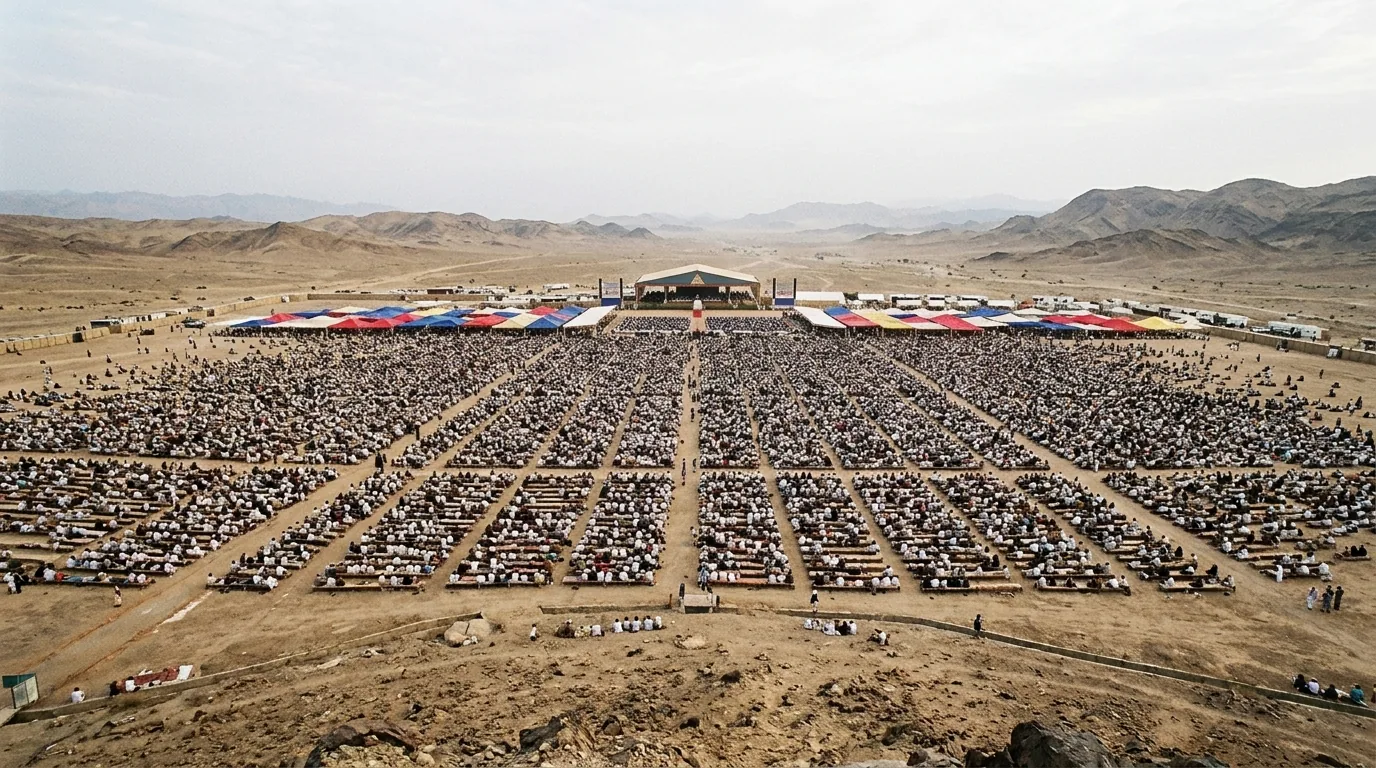
The picture at the top of this piece is an illustration, not a photograph. It was generated with an image model and does not show a real place, person or event. Every photograph elsewhere on this site is a real one, credited on the sources page.
Sources
References
Everything in this piece that is a matter of fact rather than of judgement rests on one of these.
- 1Guidelines for Future Tibet's Polity, 26 February 1992Tibet Justice Center
The dissolution of the exile administration on return, the interim President, the Constituent Assembly, his decision to take no political office, demilitarisation and the environment.
- 2The Middle-Way PolicyCentral Tibetan Administration
The official policy since 1974: genuine autonomy within the People's Republic of China, explicitly not independence.
- 3Tibet, Tibetan Refugees and the Way AheadCentral Tibetan Administration
The size of the Tibetan exile population and its decline over two decades.
- 4About UsSera Jey Foundation
Current enrolment of more than 4,800 monk-students, and the 2022 University of Mysore affiliation.
- 5Travel guide to Drepung Monastery, MundgodDrepung Gomang Monastery
Drepung at Mundgod, its colleges, and the size of the monastic population.
- 6Doeguling Tibetan Settlement, MundgodCentral Tibetan Relief Committee
The settlement founded in 1966, its population of over fifteen thousand, and its institutions.
- 7Re-establishment at BylakuppeSera Jey Monastic University
The 1970 move: 197 Sera Jey and 103 Sera Mey monks, 225 acres at three quarters of an acre per monk, 147¾ acres to Sera Jey, 38 tiled houses, and the first assembly hall of 1976 to 1979.
- 8Centres, projects and servicesFPMT
The directory of 138 centres in 34 countries, transcribed country by country.
- 9BylakuppeWikipedia
The 1960 land grant of nearly 3,000 acres, Lugsung Samdupling founded in 1961, Dickyi Larsoe in 1969, and the settlement's population.
Every factual claim on this page rests on one of the sources above. Links open in a new tab. The full list for the whole site, and the standard this site holds itself to, is on the sources page.